Your digging level
Description
Sega mauricien (Mauritian sega) is the creole dance‑music of Mauritius, born among enslaved African and Malagasy communities on the island.
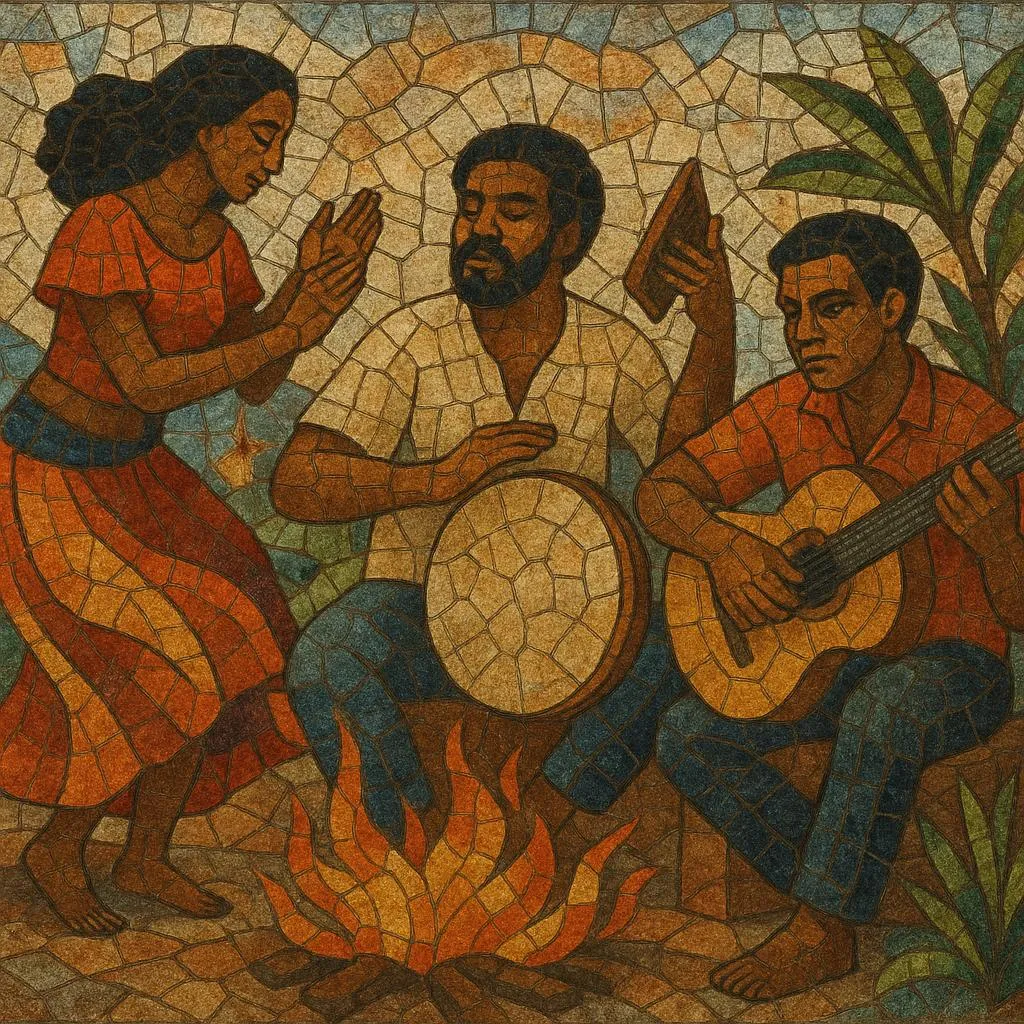
Traditionally performed outdoors around a fire, it features the ravanne (a large frame drum) laying a loping, swaying groove, the maravanne (a box rattle filled with seeds) providing a constant shaker texture, and a metallic triangle marking bright off‑beats. Vocals are in Mauritian Creole, often delivered in an expressive, call‑and‑response style about everyday life, love, humor, and social commentary. The dance is circular and hips‑forward, emphasizing fluid, ground‑hugging movement.
Modern sega mauricien keeps the core percussion but adds guitar, accordion or keyboards, bass, and drum kit, giving it a fuller pop sound while preserving its characteristic rhythmic lift and infectious, celebratory feel.
History
Sega mauricien emerged in the 1700s–1800s among enslaved African and Malagasy communities on sugar estates in Mauritius. Around bonfires after work, people sang in Creole and accompanied themselves on locally fashioned instruments—the ravanne, maravanne (also called kayamb/maravan), triangle, and the bobre (musical bow). These gatherings mixed African polyrhythms, Malagasy melodic sensibilities, and European colonial song‑and‑dance traces into a distinct creole form centered on dance and communal catharsis.
In the early–mid 1900s, sega stepped from private community spaces to public fêtes and radio. Pioneers such as Ti Frère and Serge Lebrasse popularized the style on records and broadcasts, codifying its vocal delivery and instrumental balance. The core trio—ravanne, maravanne, triangle—remained central, while acoustic guitar and accordion began to appear.
From the 1970s onward, amplification and band formats (with bass, drum kit, keyboards, electric guitar) helped sega reach dancehalls and larger stages. Catchy verse‑chorus songwriting in Mauritian Creole broadened its appeal at home and in the diaspora. Acts like Cassiya brought tight vocal harmonies and polished arrangements, while artists such as Menwar kept the percussion‑driven, roots feel in the foreground.
Sega’s rhythmic DNA seeded new fusions—most famously seggae (sega + reggae) in the late 1980s/1990s—while contemporary producers have incorporated zouk, soca, and pop textures. At the same time, the island’s "sega tipik" (the most traditional form of sega) received international safeguarding as a core element of Mauritian intangible cultural heritage. Today, sega mauricien thrives in both acoustic and band settings, remaining a living symbol of Mauritian identity and creole creativity.