Your digging level
Description
Santé engagé (literally “engaged song” in Mauritian Creole) is a Mauritian protest-music tradition that combines sung and rapped social commentaries with the island’s popular séga rhythm.
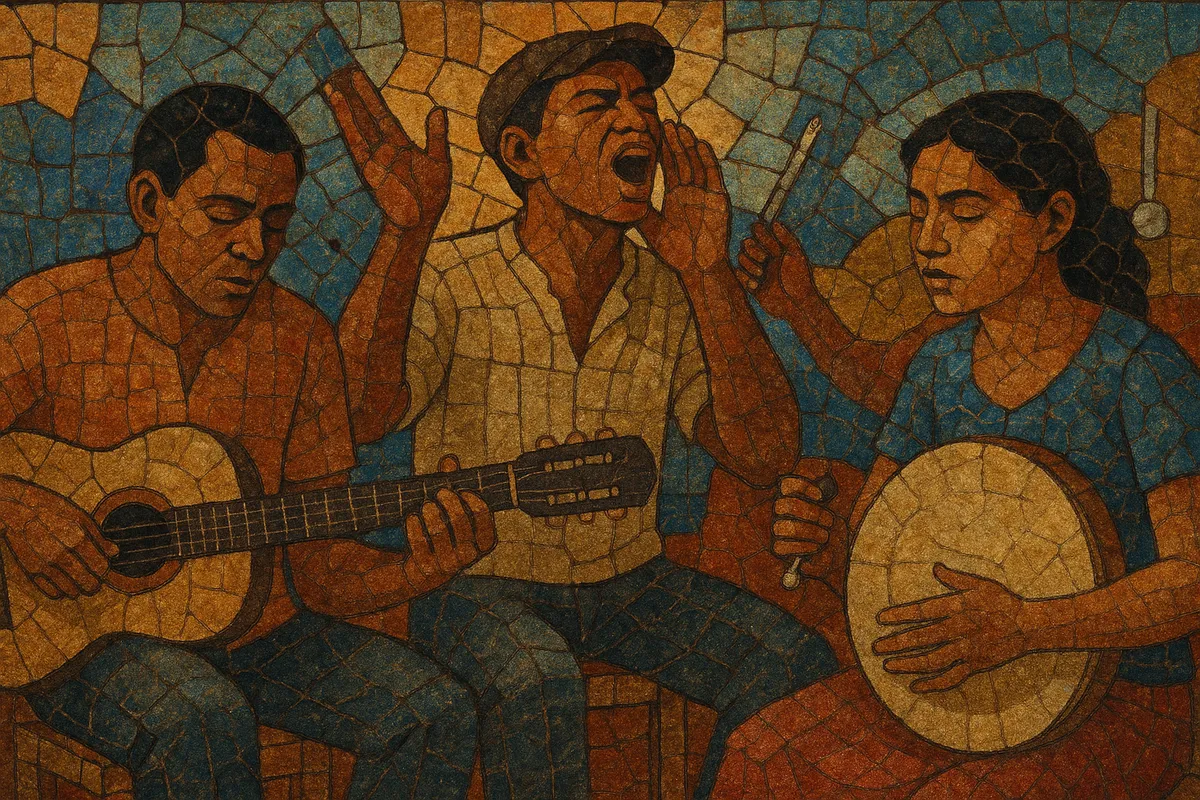
Built around the ravanne (frame drum), maravanne/kayamb (shaker), and triangle—often alongside guitar, bass, and drum kit—it absorbs Indian, Chinese, and wider Western songcraft (folk, rock, reggae, and hip hop). Lyrics—frequently in Kreol Morisien, but also in French, English, and Bhojpuri—address labor rights, language politics, inequality, corruption, and everyday struggles, turning dance-ground grooves into public forums for critique and solidarity.
Musically, it keeps séga’s lilt and call‑and‑response choruses while welcoming spoken‑word/rap sections and reggae offbeats, creating a flexible vehicle for collective expression and street‑level storytelling.
History
Mauritius achieved independence in 1968, and the following decade saw intense debates around language, labor, and identity. Out of this climate emerged santé engagé—grassroots “engaged songs” that fused the island’s séga dance music with explicitly political lyrics. Community singers and bands adapted séga’s percussive backbone and added topical verses that could be chanted at rallies, on picket lines, and in public gatherings.
Through the 1980s, artists increasingly blended reggae’s offbeat guitar, folk- and rock‑style accompaniment, and newly arriving rap delivery with local percussion. The result was a repertoire that could move between sung refrains and spoken or rapped indictments of injustice, while remaining danceable and communal. Indian (Bhojpuri, filmi/bollywood) and Chinese melodic turns and instruments further colored arrangements, reflecting Mauritius’s plural society.
As reggae’s influence deepened on the island, santé engagé’s protest ethos fed directly into seggae (the celebrated reggae–séga hybrid). Artists from both spheres often shared stages and causes, reinforcing the idea that Mauritian popular music could be a vehicle for critique, pride, and reform. Rapped couplets and spoken‑word performance grew more common, strengthening ties to global hip hop while remaining anchored in Kreol Morisien expression.
Santé engagé remains an umbrella for socially conscious Mauritian song-making—equally at home on festival stages and neighborhood fêtes. Contemporary practitioners keep the ravanne at the center, pair it with bands or beat‑driven backlines, and continue to address labor precarity, environmental pressures, and cultural dignity—ensuring the genre’s original civic mission endures.