Your digging level
Description
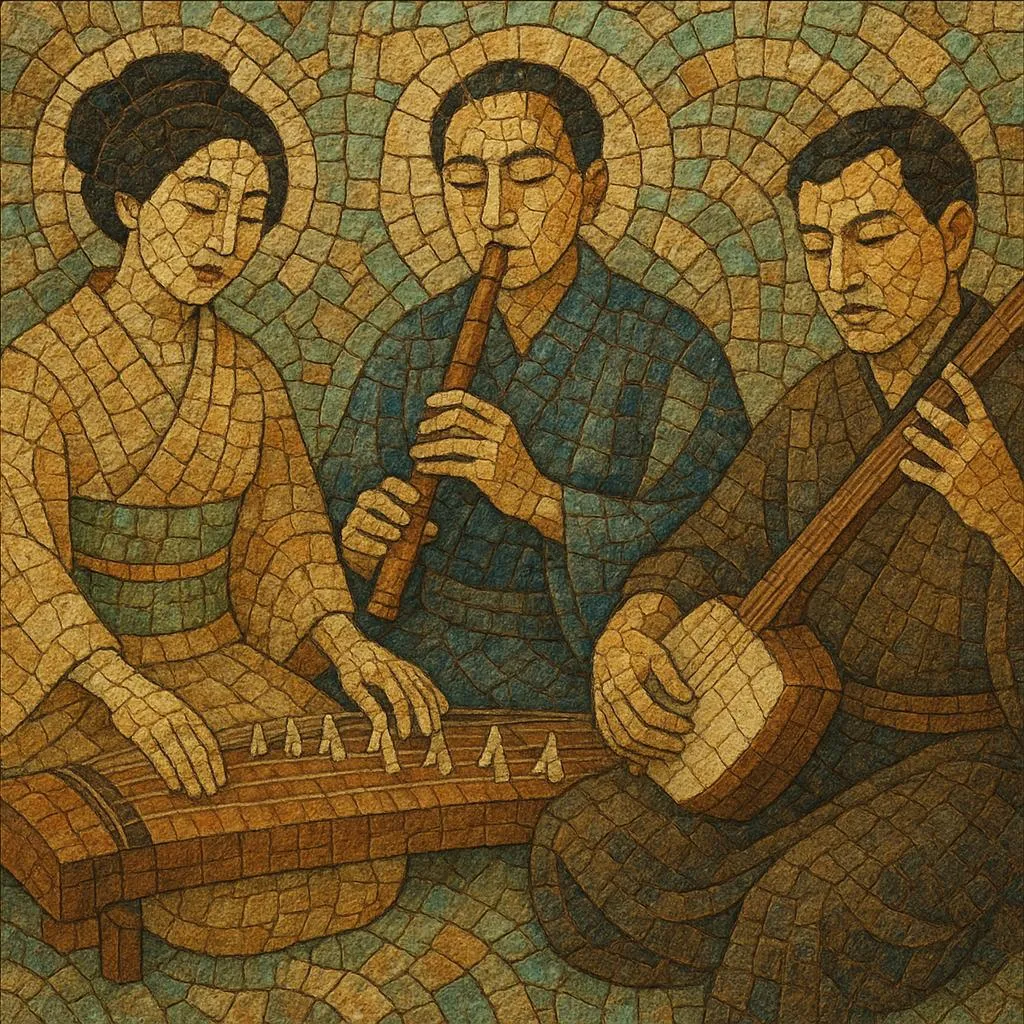
Sankyoku is a refined Japanese chamber music tradition centered on an intimate trio of instruments—koto (13‑string zither), shamisen (three‑string lute), and originally kokyū (bowed lute). From the late Edo period onward, the kokyū part was increasingly performed on shakuhachi (end‑blown bamboo flute), which is now the most common third voice. The ensemble frequently supports a vocalist, with all parts weaving a delicate, ornamented heterophony around a shared melody.
The repertoire draws on jiuta/sōkyoku song types and instrumental forms such as kumiuta, danmono, and tegoto‑mono, featuring characteristic tunings (koto: hira‑jōshi, kumoi‑jōshi; shamisen: honchōshi, niagari, sansagari) and the expressive pitch inflections of shakuhachi (meri/kari, yuri). Texture, pacing, and phrasing foreground ma (silence/space) and the overarching aesthetic arc of jo‑ha‑kyū (introduction–development–rush), yielding music that feels poised, introspective, and conversational.
History
Sankyoku crystallized during the Edo period (1603–1868) as urban merchant and artisan classes cultivated salon music. Koto and shamisen repertoires (sōkyoku/jiuta) that had developed in Kyoto and Osaka were brought together with kokyū to form a balanced, intimate trio—hence the name “sankyoku” (three instruments). Early ensembles accompanied refined song genres and incorporated instrumental suites and interludes.
By the late 18th and 19th centuries, the kokyū line was increasingly taken by shakuhachi. The flute’s broader dynamic and timbral palette—pulsed breathing (komi‑buki), pitch shading (meri/kari), and vibrato (yuri)—proved ideal for dialoguing with the koto and shamisen. This substitution became standard in most schools and remains the prevalent lineup today.
Koto lineages such as Ikuta‑ryū and Yamada‑ryū codified technique, notation, and teaching, while shamisen practices from jiuta and kouta informed vocal delivery and bachi (plectrum) articulation. Common multi‑section forms include kumiuta (sets of short songs) and tegoto‑mono, where a substantial instrumental tegoto (interlude) sits between vocal sections, exemplifying the jo‑ha‑kyū contour and ensemble “conversation.”
In the Meiji era (1868–1912) and beyond, sankyoku moved from salons and teahouses to public concert stages. Composers and masters such as Michio Miyagi expanded repertoire and technique, writing works that foreground the koto–shamisen–shakuhachi trio. Recordings, conservatory training, and competitions further standardized pedagogy and broadened audiences domestically and abroad.
Today sankyoku thrives in traditional schools and on concert platforms, featuring both classical pieces and new compositions. Its textures and instruments frequently intersect with film, contemporary classical, and ambient/kankyō ongaku contexts, while remaining a touchstone for Japanese musical aesthetics of subtle heterophony, ornamentation, and silence.