Your digging level
Description
Palo de Mayo is an Afro‑Caribbean festival, dance, and musical style from the Caribbean coast of Central America, especially the RAAS region of Nicaragua (centered on Bluefields), with related practices in Belize, the Bay Islands of Honduras, and Bocas del Toro in Panama.
The music is upbeat and driving to accompany maypole celebrations in May. It blends African‑derived rhythms and call‑and‑response singing with European maypole customs introduced under British/Creole influence. Songs are often in Nicaraguan Creole English as well as Spanish, feature playful and often sensual lyrics, and are designed to keep dancers circling the “palo” (pole) with buoyant, syncopated grooves.
History
Palo de Mayo originated in Bluefields, on Nicaragua’s Caribbean coast, in the 1600s. European maypole festivities (brought via British influence and Creole communities along the Mosquito Coast) merged with African diasporic musical practices—polyrhythms, call‑and‑response, and circle dancing—producing a distinctly Afro‑Nicaraguan celebration. The month‑long May festival and its music became a focal point for fertility symbolism, communal courtship, and neighborhood pride.
Through maritime and Creole networks, the festival and its music traveled the coast to today’s Belize, the Bay Islands of Honduras, and Bocas del Toro in Panama. Ensembles were historically percussion‑led, with hand drums, shakers, and sticks, and in some communities fiddle, guitar, or banjo reflecting Anglo‑Caribbean quadrille and country‑dance heritage. The repertoire stabilized around fast duple‑meter pieces encouraging continuous circle motion around the maypole.
Radio and local recording scenes in Bluefields amplified Palo de Mayo beyond the festival, while contact with pan‑Caribbean currents introduced brighter horn sections, electric bass and guitar, and arrangements influenced by calypso and later soca. Lyrics—often in Creole English—retained playful double‑entendre and festive themes even as performance migrated from strictly community squares to stages and parades.
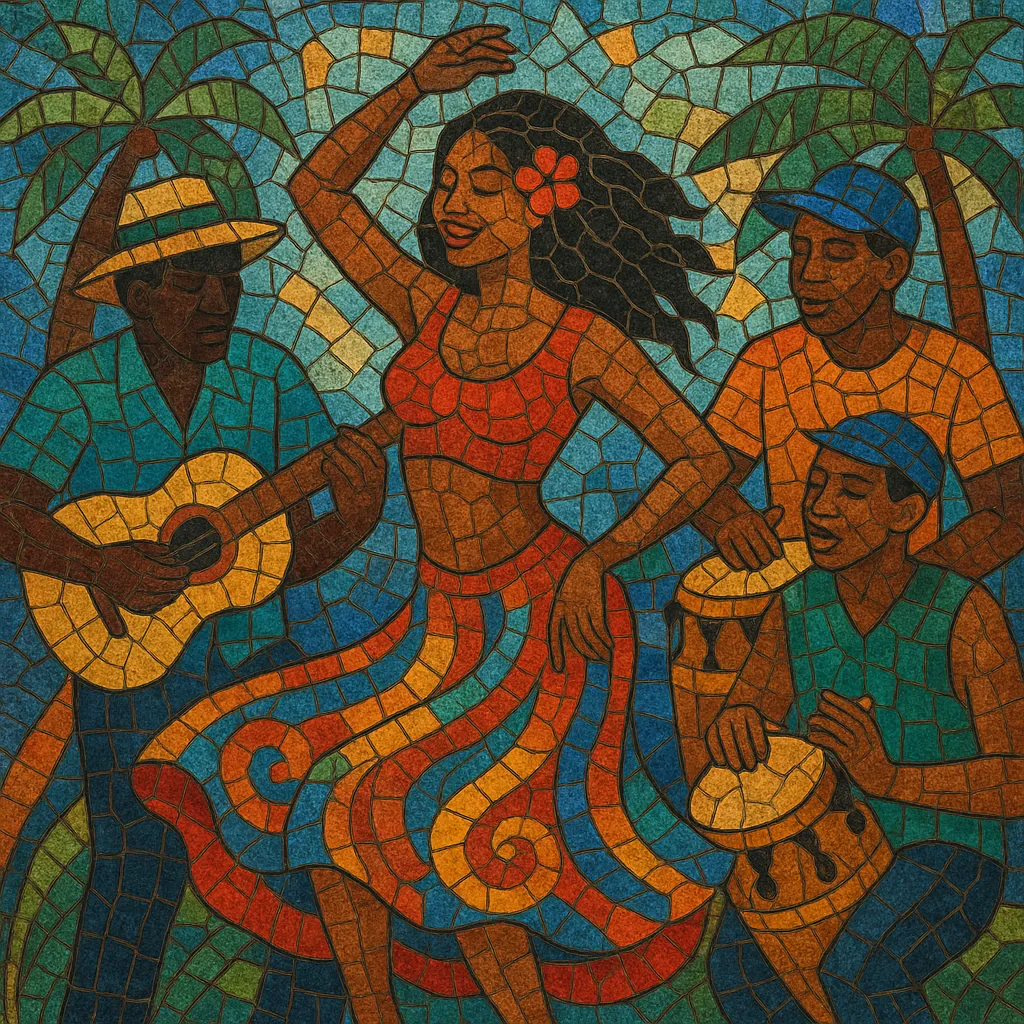
Today Palo de Mayo remains both a living folk tradition and a regional musical identity marker. Neighborhood comparsas (troupes) and bands animate May festivities, while schools and cultural institutions safeguard the tradition year‑round. Modern groups may incorporate congas, drum set, cowbell, and brass alongside traditional shakers and handclaps, but the core remains: high‑energy, syncopated groove designed for collective, sensual maypole dancing.