Your digging level

For this genre
0/8
🏆
Sign in, then listen to this genre to level up

Description

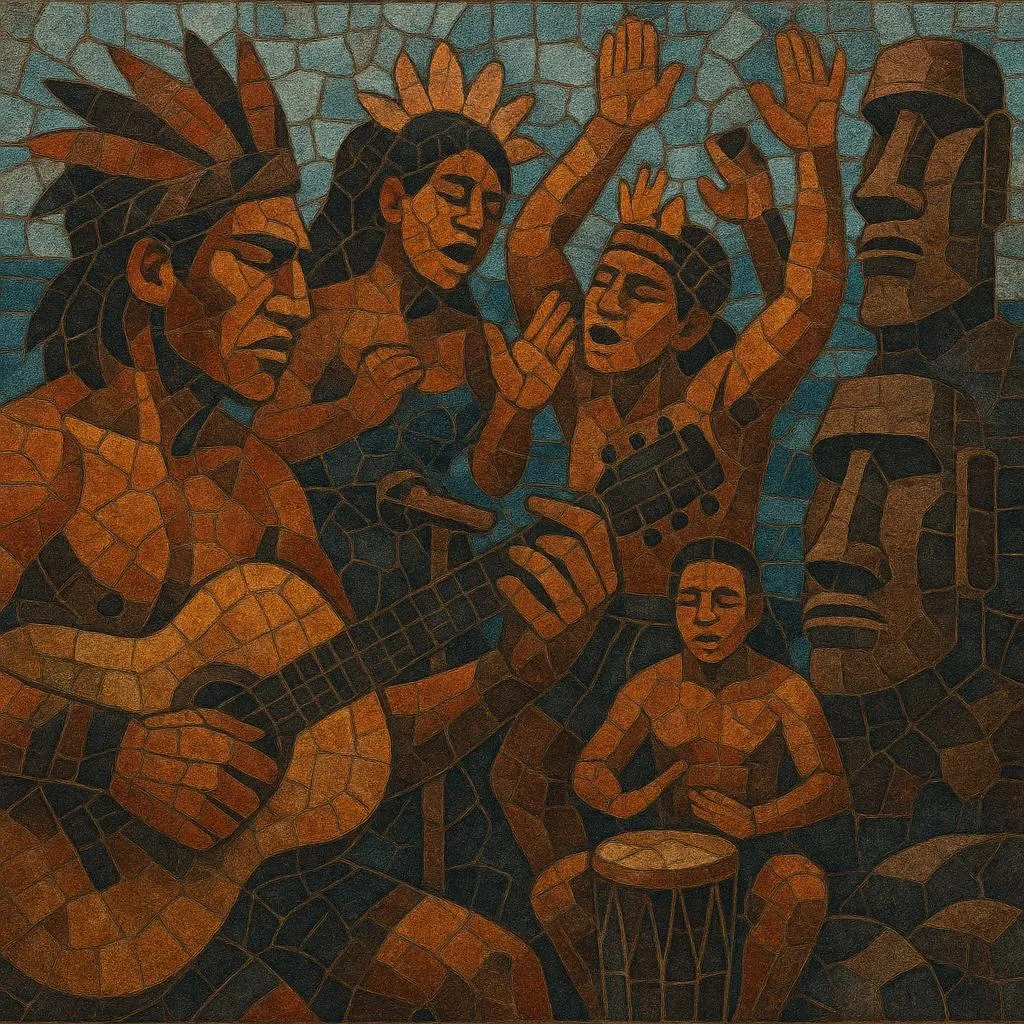
Música Rapa Nui is the musical tradition of Rapa Nui (Easter Island), a Polynesian culture now within Chile. It blends ancestral Polynesian chant and dance-song with instruments and song forms introduced in the 19th–20th centuries.

Core elements include communal chant (riu, ute), call-and-response vocals, vigorous dance rhythms (notably the sau‑sau and the haka-like hoko), and percussion-driven grooves played on slit drums, hand drums, shell trumpets, and body percussion. Since the 1900s, guitars and ukuleles have become central, and many songs are performed in the Rapa Nui language, often evoking the ocean, voyaging, moai ancestors, and mana (spiritual power).

In the late 20th century, staged ensembles and touring bands popularized a high-energy, theatrical version of the style—combining traditional chants, drums, and dances with contemporary harmony and song structure—making Música Rapa Nui a living, evolving heritage that speaks to both island identity and broader Polynesian connections.


Sources: Spotify, Wikipedia, Discogs, RYM, MB, user feedback and other online sources

History

Origins

Rapa Nui musical practice has deep Polynesian roots, with pre-contact vocal genres such as riu (narrative chants) and ute (often humorous, topical songs) accompanying dances and ceremonies. Music functioned as embodied history, reinforcing genealogy, cosmology, and community.

Colonial era and change (19th–early 20th c.)

Following catastrophic population loss and missionary influence in the late 19th century, some drumming and dance practices were curtailed, while guitars, ukuleles, and European-style harmonized singing entered local music-making. New hybrid dance-songs (including the now emblematic sau‑sau) developed in dialogue with Tahitian, Samoan, and Hawaiian currents across Polynesia.

Revival and stage presentation (mid–late 20th c.)

From the mid-1900s, community troupes codified repertoire for performance. The annual Tapati Rapa Nui festival (from the 1970s) catalyzed a broader cultural revival, encouraging intergenerational transmission of language, chants, dances, and crafts. Ensembles began presenting scripted programs for both local celebration and visiting audiences, shaping a recognizably “stage” form of Música Rapa Nui.

Contemporary era (1990s–present)

Touring groups and bands (e.g., Matato’a) fused traditional percussion, chants, and dance with modern song forms, amplified instruments, and global grooves (including Pacific reggae and Latin pop). Today, Música Rapa Nui spans intimate community chants to full-scale theatrical productions, retaining Rapa Nui language and Polynesian aesthetics while engaging with pan-Polynesian and Chilean musical networks.

How to make a track in this genre

Instrumentation and rhythm
•   Center the groove on Polynesian-style percussion: slit-log drums, hand drums, shakers, and body percussion (thigh and chest slaps). Keep patterns interlocking and cyclical, in brisk 2/4–4/4 meters suited to dance (sau‑sau), with occasional haka-like accented figures for hoko sections. •   Add strummed guitar and ukulele for harmonic bed. Use bright, percussive island strumming (down–up with emphasis on off-beats), keeping harmony simple (I–IV–V, occasional vi) to foreground vocals and rhythm.
Melody, vocals, and language
•   Build melodies from pentatonic or narrow-range diatonic cells. Employ call-and-response (a leader’s line answered by the group), antiphony, and communal refrains. •   Sing primarily in the Rapa Nui language; themes often honor ancestors (moai), the sea, navigation, communal labor, and island landscapes. Keep lyrics concise and chantable, with alliteration and repeated vocables for momentum.
Form and staging
•   Alternate chant-driven sections (riu/ute) with dance breaks. Insert “hoko” moments featuring shouted unisons, accented stomps, and synchronized gestures. •   Arrange for visual impact: layered drums enter first, then voices, then strings; highlight dance sequences with dynamic crescendos, stops, and call-and-answer tags.
Fusion aesthetics (modern ensembles)
•   Tastefully incorporate Pacific-reggae lilt (light backbeat, syncopated guitar) or Latin-pop hooks, without overpowering traditional drums and chants. •   Keep mixes dry and present for percussion and group vocals; avoid heavy reverb that obscures rhythmic articulation.
Cultural practice
•   Prioritize communal participation. Rehearse with dancers to align choreographic cues with musical accents. Respect language, stories, and protocol—songs carry history as well as entertainment.

Top tracks

Locked
Share your favorite track to unlock other users’ top tracks

Upcoming concerts

in this genre
Influenced by
Has influenced
No genres found

Download our mobile app

Get the Melodigging app and start digging for new genres on the go
© 2026 Melodigging
Melodding was created as a tribute to Every Noise at Once, which inspired us to help curious minds keep digging into music's ever-evolving genres.
Buy me a coffee for Melodigging