Your digging level
Description
Musica lombarda refers to the traditional and popular music practices of Lombardy (Lombardia) in northern Italy, spanning rural alpine repertoires, city songs from Milan, and contemporary dialect songwriting.
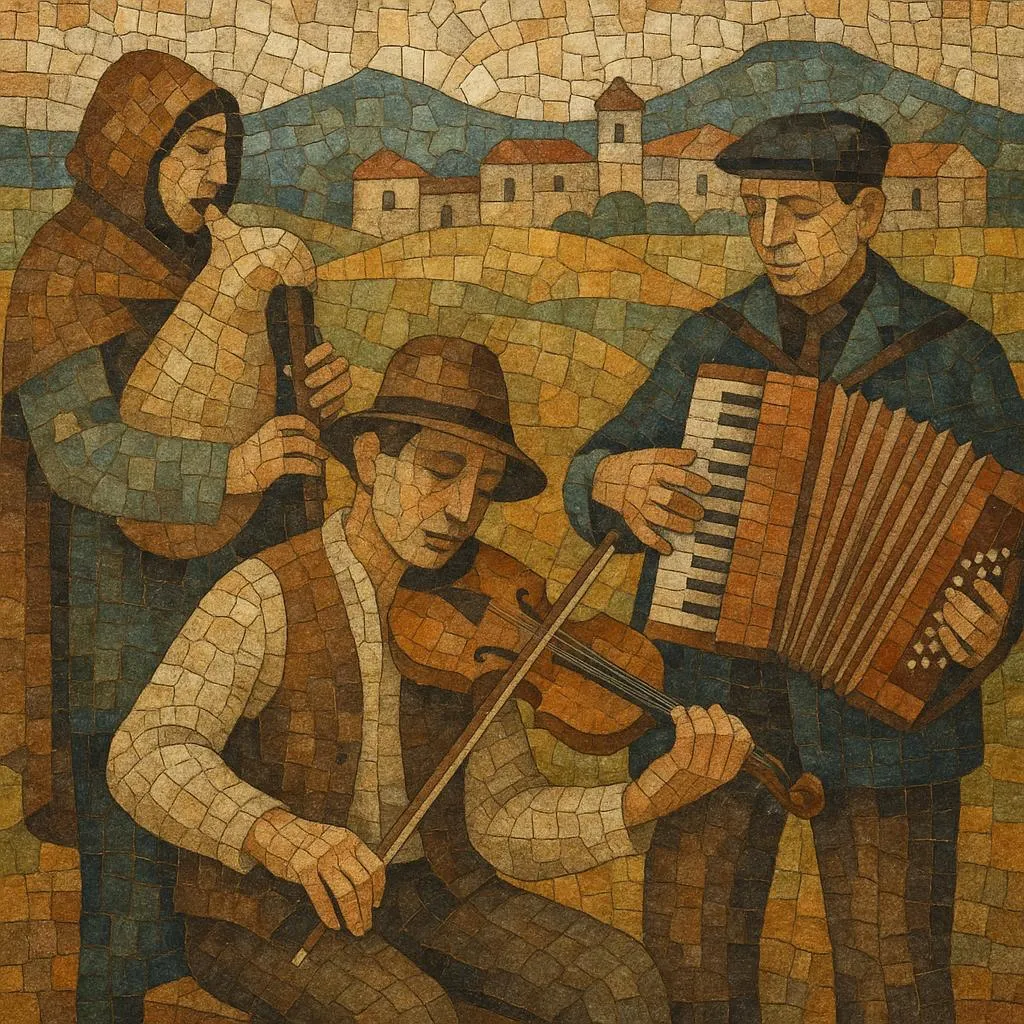
Its sound world ranges from dance tunes (polka, waltz, and schottische) led by fiddles, piffero-like reeds, bagpipes such as the Bergamasque baghèt, and diatonic accordions, to urban songs in Milanese and other Lombard dialects. Choirs and male-voice ensembles retain a strong presence in the Alps and pre-Alps, while modern artists fuse folk materials with rock, pop, and even metal. Lyrics commonly explore local life, humor, work and migration, devotion, and the urban identity of Milan alongside mountain imagery.
History
Lombardy’s musical identity took shape over centuries as a crossroads between Alpine, Central-European, and Po Valley cultures. Village dances and ritual songs (especially around Carnival, Advent, and religious feasts) crystallized during the 19th century alongside the spread of diatonic accordions and brass/folk ensembles.
Rural dance repertoires—polka (2/4), waltz (3/4), schottische (bal-scut), mazurka, and local monfrina variants—were carried by fiddle, organetto, clarinet, and regional instruments like the Bergamasque baghèt (bagpipe) and oboe-like pipes from the Quattro Province area (which includes a Lombard portion in the Oltrepò Pavese).
In Milan, a flourishing popular-song and cabaret tradition grew from the late 19th to mid–20th centuries. Milanese-language songs celebrated neighborhood life, cheeky humor, and the city’s modernity, while publishers and revues helped standardize repertories. These urban repertoires coexisted with mountain male choirs and parish bands across the region.
From the late 1970s onward, Lombardy participated in the Italian folk revival. Field research rescued baghèt tunes and local dance repertoires; folk groups modernized arrangements, and dialect songwriters emerged from lakes and valleys (Como, Bergamo, Brescia, Val Camonica). By the 1990s–2000s, bands mixed Lombard melodies and dialects with folk-rock and, later, heavier styles; at the same time, civic choirs, heritage festivals, and dance collectives sustained the grassroots transmission of traditional forms.
Contemporary musica lombarda embraces continuity and reinvention: village festivals still feature circle dances and call-and-response choruses, while stages in Milan and the pre-Alps host artists blending regional rhythms, dialect poetics, and modern production. The result is a living regional music that feels both local and cosmopolitan.