Your digging level
Description
The music of Mexico is a vibrant and diverse tapestry of sound that reflects the country's complex history and cultural fusion (mestizaje). It is characterized by a rich blend of Indigenous, European (particularly Spanish), and African musical traditions.
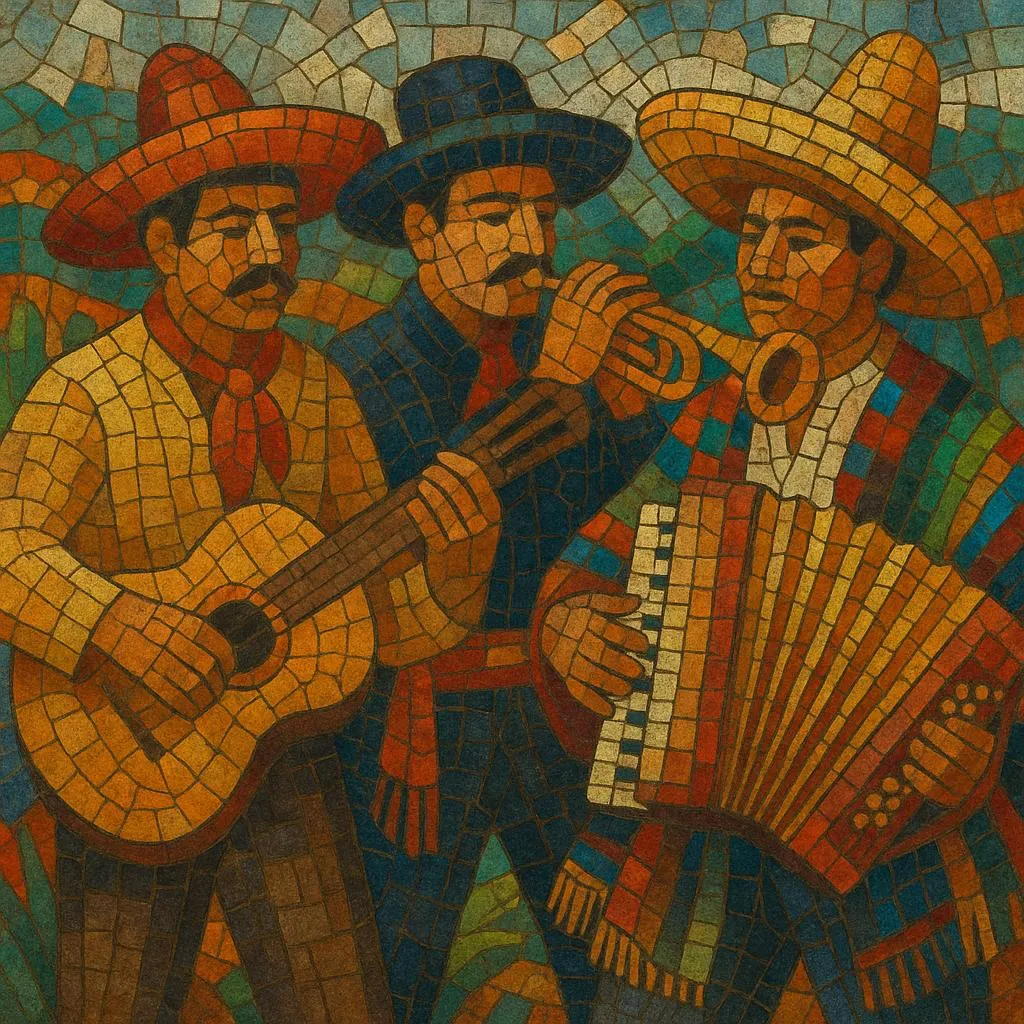
This broad category encompasses a wide array of regional styles, from the string-based ensembles of the south (like Son Jarocho) to the brass-heavy bands of the Pacific coast (Banda) and the accordion-driven rhythms of the north (Norteño). Lyrical themes often explore love, heartbreak, patriotism, rural life, and historical narratives, delivered with passionate vocals and distinctive instrumentation.
History
Before the arrival of Europeans, the indigenous peoples of Mexico (such as the Aztecs and Mayans) possessed a rich musical tradition used primarily for religious rituals, warfare, and celebrations. Instruments were largely percussion and wind-based, including the teponaztli (slit drum), huehuetl (upright drum), conch shell trumpets, and clay flutes. String instruments were unknown.
With the Spanish conquest in the 16th century, European instruments like violins, guitars, and brass were introduced, along with polyphonic church music. Enslaved Africans brought complex rhythmic structures and instruments like the marimba. This era saw the birth of the Mestizo sound, blending these three roots into regional folk styles known collectively as Sones.
The 19th century brought further European influence, particularly from German, Polish, and Czech immigrants who introduced the accordion, polka, and waltz to Northern Mexico. This fusion laid the groundwork for Norteño and Banda music. During the wars for independence and revolution, the Corrido (narrative ballad) became a crucial tool for spreading news and glorifying heroes.
The post-revolutionary era saw the rise of a unified national identity. The Mariachi ensemble was standardized and popularized through the "Golden Age" of Mexican cinema (1930s–1950s), with icons like Pedro Infante and Jorge Negrete becoming symbols of Mexican masculinity (charros). Ranchera music became the emotional soul of the nation.
In the late 20th and early 21st centuries, Mexican music continued to evolve. Rock en Español gained a massive following, while Regional Mexicano genres like Banda and Norteño modernized and expanded globally. Contemporary styles like Corridos Tumbados now blend traditional instrumentation with urban trap influences.
Polka & Waltz: For Northern styles (Norteño, Banda), use a 2/4 "oom-pah" beat for polkas and a 3/4 time signature for waltzes.
•Sesquialtera: For Son styles (like Son Jarocho), use a complex polyrhythm that alternates between or superimposes 6/8 and 3/4 time signatures.
•Cumbia: Employ a steady 4/4 beat with a "shuffling" percussion pattern, often emphasizing the off-beat.
Mariachi: Combine violins, trumpets, a classical guitar, a vihuela (high-pitched, 5-string guitar for rhythm), and a guitarrón (large acoustic bass).
•Norteño: The core is the accordion and the bajo sexto (12-string bass guitar), supported by drums and sometimes saxophone.
•Banda: Use a large brass ensemble featuring tubas (for the bass line), trumpets, trombones, clarinets, and a tambora (bass drum with cymbals).
Progressions: Stick to simple, strong harmonic progressions (I-IV-V) in major keys for Rancheras and Corridos. Use minor keys for Boleros or tragic ballads.
•Vocals: Singing styles vary from the operatic, full-throated bel canto style of Mariachi to the harmonized duets (often in parallel thirds) of Norteño. The Grito—a passionate, uninhibited shout—is a signature performance element used to express emotion during instrumental breaks.