

Your digging level
Description
The music of Mauritania refers primarily to the Moorish (Bīḍān/Haratin) art‑music known locally as azawān, sustained by hereditary musician lineages called iggāwen (griots). In this caste system, iggāwen historically praised patrons and warriors, carried news between communities, and still provide music at life‑cycle events—especially weddings—often with patrons informally controlling recordings of the performances.
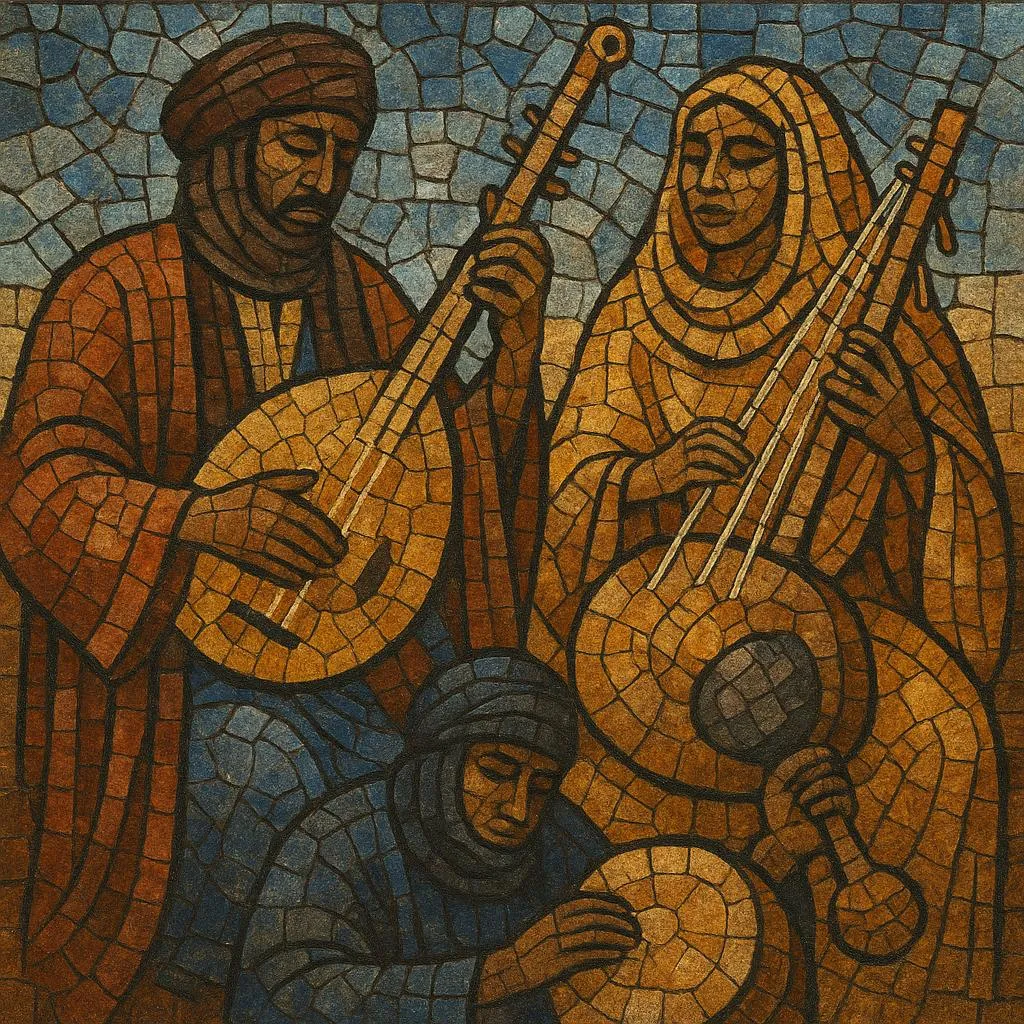
Its core sound centers on the men’s four‑string lute tidinit and the women’s angled harp ardin, with percussion from the tbal kettledrum (and rattles like the daghumma). Repertoire is organized by three “ways” (al‑bayḍa ‘white’, al‑kahlā ‘black’, l‑gnaydiya ‘spotted’) and proceeds through five modal stages (karr, fāgu, lakhal, labyad, lebtyāt), a learned system linking musical color to emotion and life‑cycle symbolism. Since the late 20th century, amplified guitar has frequently shadowed or replaced the tidinit, while the poetic, melismatic vocal style in Ḥassāniyya Arabic remains central.
History
Most written accounts describe Moorish art‑music (azawān) as a scholarly tradition maintained by iggāwen families, whose status was historically low but whose social role was indispensable for praise, diplomacy, satire, and news‑bearing among nomadic and oasis communities. By long‑standing convention, men play tidinit and women ardin; together with tbal they accompany improvised poetry and sung narrative for patrons.
Performance follows three “ways” (al‑bayḍa, al‑kahlā, l‑gnaydiya) and moves—often in a fixed arc—through five modes (karr, fāgu, lakhal, labyad, lebtyāt). These modal ‘colors’ are associated with life stages and feelings; mastery is transmitted orally within families. Many sources trace the codification of this system in Moorish society to early modern centuries.
From the 1970s onward, wedding sound systems and urbanization encouraged amplified ensembles; electric guitar took on tidinit phrasing and became a signature of contemporary Mauritanian sets. Field recordings from Nouakchott document this high‑energy, audience‑driven performance context, while international releases and tours by artists such as Dimi Mint Abba, Malouma, and later Noura Mint Seymali brought the style to global stages.
Today, tradition‑bearers continue classical tent‑style concerts (e.g., Maison des Cultures du Monde’s azawān recordings) while younger bands hybridize ardin/tidinit with drum set and bass. The core caste lineages, instruments, modal theory, and poetic improvisation remain the grammar of the music at home and abroad.

