Your digging level
Description
Moorish traditional is the courtly, hereditary music of the Bidan (Moor) communities of Mauritania and the southern Western Sahara. It is built around poetic declamation in Hassaniya Arabic and a refined modal system performed by specialist musician families known as iggāwen (griots).
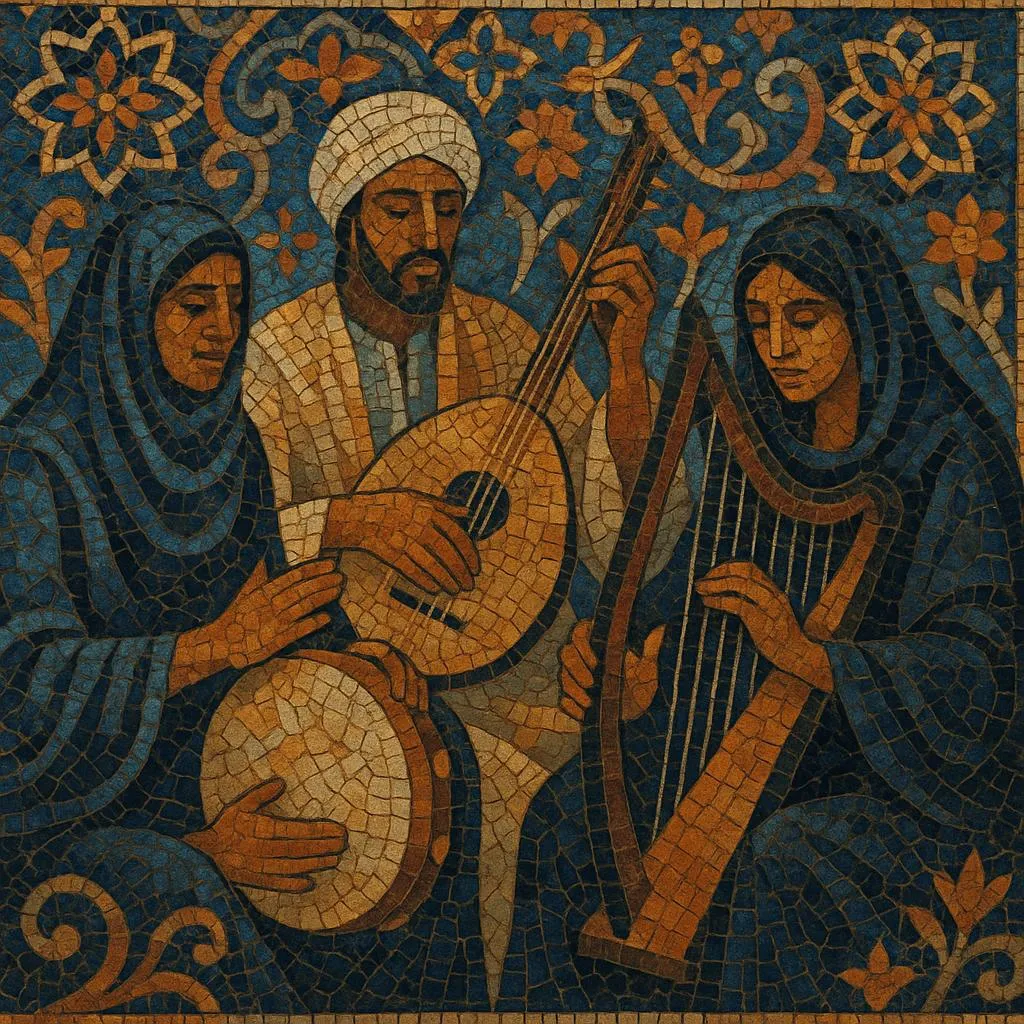
Its core sound centers on two iconic instruments: the tidinit (a plucked skin‑topped lute historically associated with male performers) and the ardin (a multi‑string harp traditionally played by women), supported by the t’bal frame drum and handclaps. Voices—often highly melismatic—carry texts that range from praise poetry and love lyric to social commentary, with precise rhythmic cycles and ornamental nuance.
Stylistically it sits between Maghrebi and Saharan worlds: Andalusian court aesthetics, Arab poetic prosody, and Berber/Saharan practice converge in a modal palette that local musicians often group into contrasting “white” and “black” families, each with characteristic moods, cadences, and motifs.
History
Moorish traditional music crystallized over centuries of contact among Arab, Berber, and Saharan peoples. By the early modern period, Bidan (Moorish) courts and noble lineages in what is now Mauritania patronized hereditary musician families (iggāwen) who preserved repertory, instruments, and etiquette. Their art blended Andalusian courtly aesthetics, Bedouin vocal practice, and Saharan performance techniques, all articulated in Hassaniya Arabic poetry.
The ardin harp (traditionally women’s domain) and the tidinit lute (typically played by men) became emblematic of the style, with t’bal drum patterns and handclaps marking cycles. A sophisticated modal system emerged, locally described in color‑coded families (often glossed as “white” versus “black”), each associated with distinct emotional states and cadential formulas. Performances are inseparable from poetry—qasida‑like texts, panegyric songs, and love lyrics—where musical form follows the arc of the verses and the art of ornamentation.
During the mid‑20th century, radio, state ensembles, and recording studios in Nouakchott helped document and broadcast the tradition, while touring artists introduced it to international audiences. From the 1970s onward, prominent singer‑instrumentalists and national orchestras codified stage formats without abandoning the griot logic of improvisation and modal contrast.
Today the tradition thrives in ceremonies and public concerts, and it also informs hybrid styles that add guitar, keyboards, and amplification. While gendered performance roles have loosened, the lineage of iggāwen, the primacy of poetry, and the modal‑rhythmic grammar continue to define Moorish traditional as a living classical art of the Sahara.