Your digging level
Description
Minnesang is the German tradition of courtly lyric and song that flourished during the Middle High German period. Its name derives from “minne” (love), reflecting its central focus on idealized courtly love (hohe Minne), alongside nature imagery, crusade songs, and occasional political pieces.
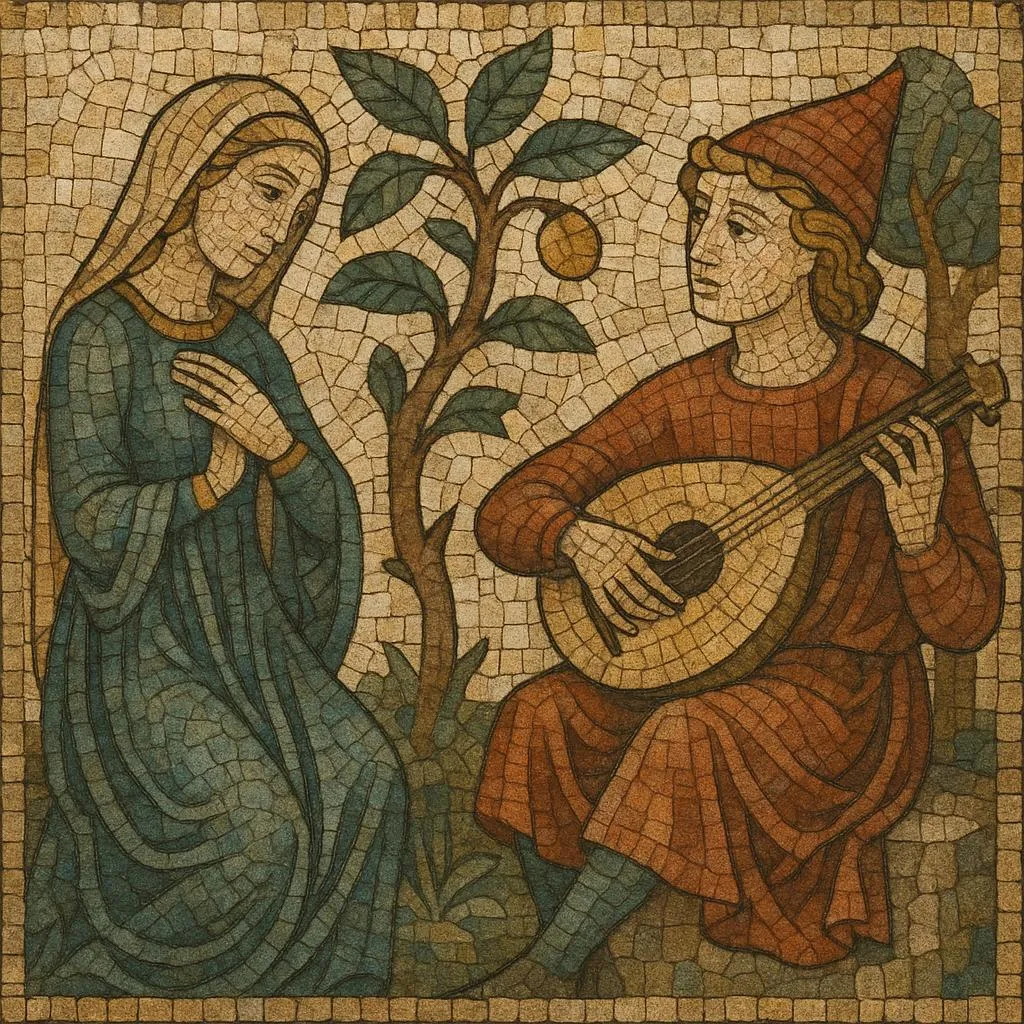
Musically it consists mainly of monophonic, strophic songs (Minnelieder) in bar form (AAB: two Stollen followed by an Abgesang). Texts are in Middle High German, crafted with refined rhyme and meter. Performance was typically by poet‑singers (Minnesänger) who either sang unaccompanied or with discreet accompaniment on medieval instruments such as harp, vielle (fiddle), or lute. While closely comparable to the Occitan troubadours and Old French trouvères, Minnesang is regarded as an original German contribution to courtly lyric.
History
Minnesang emerged in the German‑speaking courts of the Holy Roman Empire in the mid‑1100s, in the cultural orbit of—but not derivative from—the troubadour and trouvère traditions. Early figures such as Der Kürenberger and Dietmar von Aist established the poetic and musical outlines: elevated diction, courtly love themes, and strophic melodies in modal style.
By the late 12th and early 13th centuries Minnesang reached its classical phase. Poets like Reinmar der Alte codified the ethos of hohe Minne (reverence for an often unattainable lady), while Walther von der Vogelweide balanced courtly ideals with greater emotional range and political acuity. Wolfram von Eschenbach and Heinrich von Morungen enriched the tradition with sophisticated imagery and tonal nuance. Neidhart von Reuental introduced rural and dance‑song inflections, and Tannhäuser bridged courtly and more popular currents.
The typical Minnelied uses bar form (AAB) with clear stanzaic design and memorable melodic contours in modal scales (Dorian, Mixolydian, etc.). Surviving melodies and attributions are preserved in major manuscripts: the Kleine Heidelberger Liederhandschrift, the Weingartner and Jena songbooks, and most famously the Codex Manesse (early 14th century), whose illuminations portray Minnesänger in idealized courtly settings.
After c. 1300, courtly Minnesang waned, but its poetic–musical models seeded the urban Meistersinger tradition and, over the long term, the German Lied. Its strophic forms, bar‑form architecture, and union of refined poetry with singable melody became organizing principles for later German song—from late medieval guild practice to the Romantic art song of Schubert and Schumann. Modern historical performance and neo‑medieval scenes have revived Minnesang repertory in concerts and recordings.
-
•
Draft a stanza in AAB form with a clear rhetorical arc.
•Set a modal melody for the A section; repeat it for the second Stollen.
•Compose a complementary B section that broadens range or cadence pattern.
•Add discreet accompaniment (drones, arpeggiated chords) that never obscures the text.