Your digging level

For this genre
0/8
🏆
Sign in, then listen to this genre to level up

Description

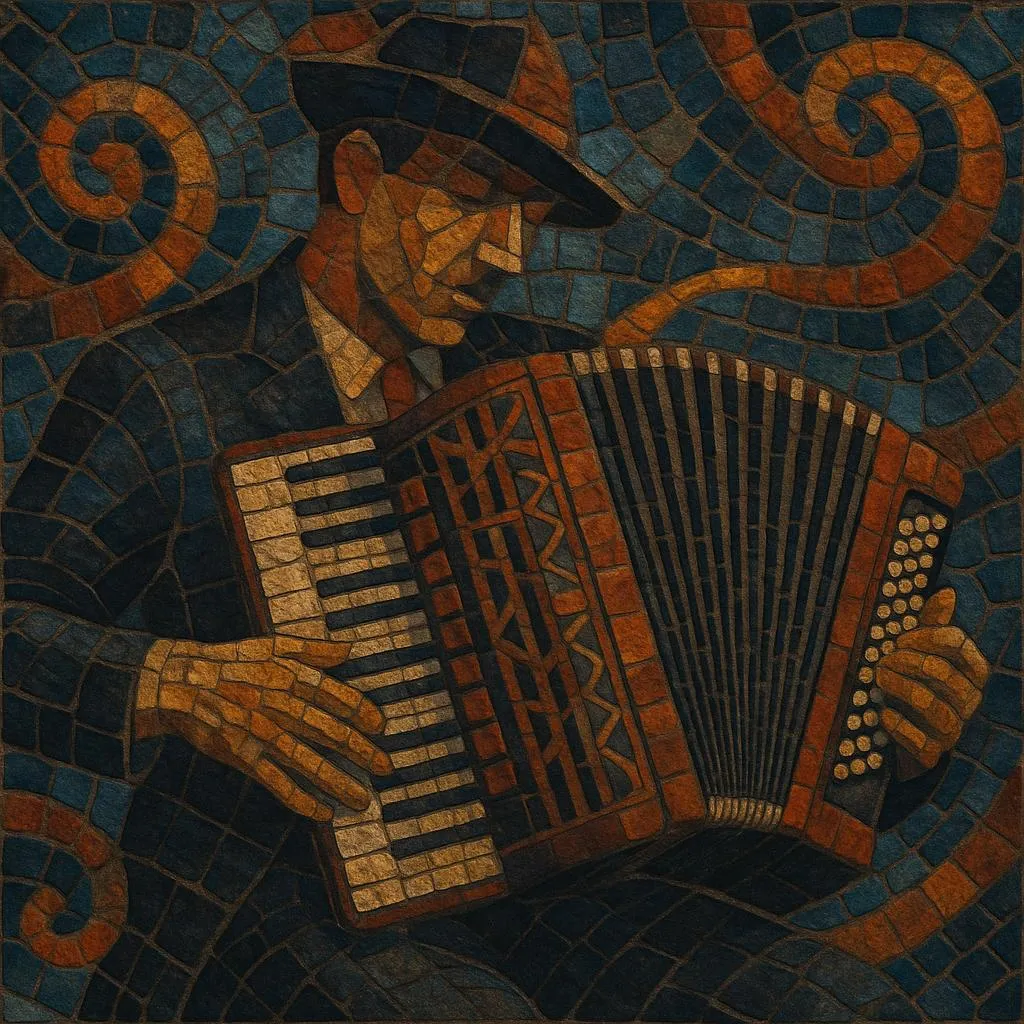
Jazz accordion is a jazz practice that features the accordion—either piano accordion or chromatic button accordion—as a principal improvising and comping instrument.

It adapts swing-time phrasing, bebop vocabulary, and modern jazz harmony to the bellows-driven mechanics of the accordion. The right hand typically carries melodic lines and solos, while the left hand provides bass motion and harmonic support, either via the traditional stradella bass system or a free-bass system that enables walking bass and rootless voicings. In European contexts the style often draws on musette waltzes and Parisian café idioms; elsewhere it readily blends with tango, Latin, and chamber-like small-group settings.

The result ranges from fleet, guitar-like single‑note runs and elegant chord‑melody textures to luminous, reed‑choir timbres—capable of both lively swing and intimate, lyrical ballad playing.


Sources: Spotify, Wikipedia, Discogs, Rate Your Music, MusicBrainz, and other online sources

History

Early emergence (1930s–1940s)

Jazz-compatible accordion techniques crystallized in interwar Europe, especially in Paris, where musette players absorbed American swing. Figures like Gus Viseur and Jo Privat fused musette waltzes with the harmonic movement and phrasing of jazz, effectively inventing a Parisian “musette-jazz” approach. In parallel in the United States, the accordion began to surface in small jazz groups and radio orchestras, setting the stage for fully jazz-dedicated accordion leaders.

Postwar development and stylistic definition (1940s–1960s)

After World War II, the instrument’s role in jazz solidified through virtuosic small‑group leaders. Art Van Damme’s quints and sextets modelled the accordion as a frontline improviser alongside guitar, vibes, bass, and drums, applying bebop and cool-jazz concepts to the bellows. Tommy Gumina, Joe Mooney, and Johnny Meijer further expanded the vocabulary—some retaining the signature stradella bass “oom‑pah,” others adopting more linear, walking approaches.

Modernization and global perspectives (1970s–1990s)

As jazz diversified, the accordion followed. In Europe, players integrated chamber textures and folk idioms (e.g., Gypsy jazz and Scandinavian folk) into jazz formats. Frank Marocco brought studio polish and West Coast sensibilities, while innovators such as Guy Klucevsek and Gil Goldstein embraced contemporary harmony and cross‑genre collaboration, positioning the accordion within modern jazz and new music settings.

Contemporary scene (2000s–present)

A new generation treats the accordion as a flexible, worldwide jazz voice. Artists often use chromatic button accordions and free‑bass systems to realize extended voicings, voice‑leading, and contrapuntal bass lines. Collaborations with guitar trios, string ensembles, and world‑music rhythm sections are increasingly common, and the instrument now appears in mainstream jazz festivals and recordings with an idiomatic command comparable to piano or guitar.

How to make a track in this genre

Instrumentation and setup
•   Core small-group settings: accordion + guitar (or vibes), double bass, and drums; or a Gypsy-jazz lineup (two guitars, bass) with accordion as lead. •   Choose piano accordion or chromatic button accordion; a free‑bass system broadens left‑hand linearity for walking bass and inner voices.
Rhythm and feel
•   Master swing eighths at medium to uptempo, plus 3/4 musette waltz feels and Latin grooves (bossa, tango, milonga) to reflect the style’s European–American blend. •   Comp with light off‑beat stabs or four‑to‑the‑bar shell voicings; when using free‑bass, craft walking bass lines that lock with the ride cymbal.
Harmony and voicings
•   Center on jazz progressions (ii–V–I, turnarounds, rhythm‑changes) with extended/altered chords (9ths, 11ths, 13ths; b9/#9/#11/b13). •   Right‑hand chord‑melody: drop‑2/3‑style grips adapted to the keyboard/button layout; left hand supplies roots/guide‑tones or contrapuntal bass. •   Employ modal episodes (Dorian, Mixolydian, Lydian) and chromatic approach tones for bebop‑inflected lines.
Melody and improvisation
•   Craft clear “head” statements with lyrical bellows phrasing; ornament with grace notes, slides, and rapid arpeggios that suit the reeds’ attack. •   Improvise using chord‑scale language and bebop enclosures; punctuate with rhythmic motifs and call‑and‑response between hands.
Timbre and articulation
•   Use register switches to contrast reed choirs (clarinet/tremolo settings for warmth vs. dry reeds for modern clarity). •   Shape dynamics with the bellows: subtle swells for ballads, precise accents for swing lines.
Repertoire and arrangement
•   Arrange jazz standards and musette waltzes side‑by‑side; reharmonize musette melodies with extended jazz voicings. •   In ensembles, alternate roles: lead melody, comping, and occasional solo bass interludes to showcase the instrument’s polyphonic capacity.

Top tracks

Locked
Share your favorite track to unlock other users’ top tracks
Influenced by
Has influenced
No genres found
Challenges
Digger Battle
Let's see who can find the best track in this genre

Download our mobile app

Get the Melodigging app and start digging for new genres on the go
© 2026 Melodigging
Melodding was created as a tribute to Every Noise at Once, which inspired us to help curious minds keep digging into music's ever-evolving genres.
Buy me a coffee for Melodigging