

Your digging level
For this genre
0/8
🏆
Sign in, then listen to this genre to level up
Description
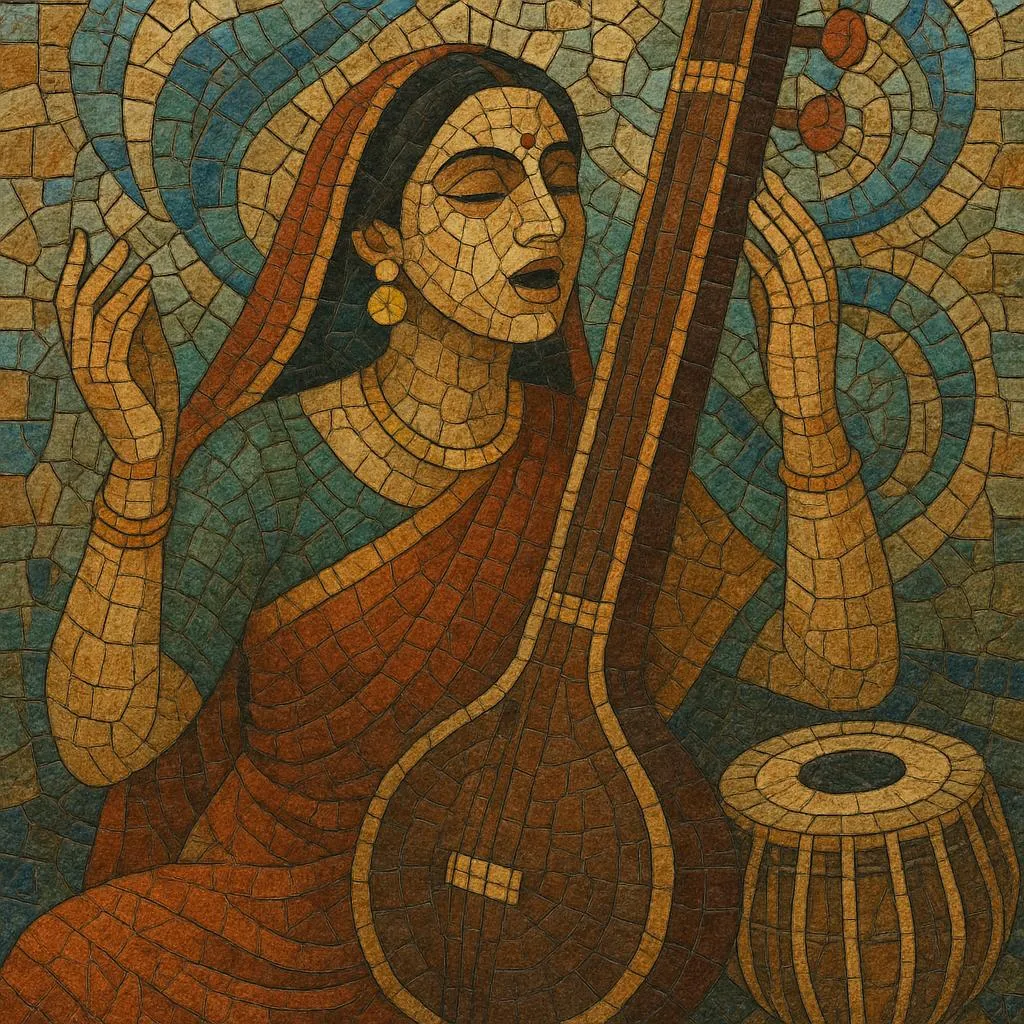
Hindustani vocal music is the North Indian tradition of raga-based singing, centered on improvisation within melodic frameworks (ragas) and cyclic meters (talas).
Its core concert vocabulary today revolves around major vocal forms such as dhrupad (the most ancient concert form), khayal (the modern, highly ornamented style), and tarana, with related “light-classical” idioms like thumri, dadra, and bhajan surrounding the classical core. A typical performance unfolds from a slow, unmetered alap to metered development and virtuosic passages (taan, sargam, bol‑taan), all over a tanpura drone and percussion (pakhawaj for dhrupad; tabla for khayal and lighter forms).
History
Origins and early forms
• The roots of Hindustani vocal practice draw on liturgical chant and early Sanskrit musical theory; dhrupad is the earliest surviving concert form linked to these roots and is widely described as the “oldest” Hindustani style. Its lineages trace devotional, courtly, and temple milieus.
Sultanate–Mughal era consolidation (c. 15th–17th centuries)
• Under Rajput and Mughal patronage, dhrupad flourished (Gwalior, Delhi, Agra), evolving the long unmetered alap and the pakhawaj‑accompanied bandish in four parts. Canonical figures such as Tansen and Swami Haridas are central to this formation.
From dhrupad to khayal (c. 17th–18th centuries)
• From dhrupad’s gravitas emerged khayal—literally “imagination”—a shorter, more melismatic and highly ornamented vocal form that eventually eclipsed dhrupad in urban courts. Khayal’s two‑section bandish (vilambit and drut) enabled greater virtuosity (taan, sargam) while retaining raga grammar. Transitional forms such as sadra illustrate the stylistic bridge between dhrupad and khayal.
Gharanas and the modern concert ethos (19th–20th centuries)
• Distinct gharanas (stylistic schools) codified pedagogy, repertoire, and nuance—e.g., Dagar (dhrupad) and numerous khayal gharanas (Kirana, Jaipur‑Atrauli, Gwalior, Agra, Indore, Patiala, Rampur‑Sahaswan). The concert format stabilized around alap → vilambit → drut with tabla replacing pakhawaj outside dhrupad.
Contemporary presence and satellites
• While khayal dominates the classical platform, dhrupad has revived through dedicated lineages and societies; light‑classical and popular streams (thumri, ghazal, filmi/“Bollywood”) draw heavily on Hindustani vocal idioms, transmitting raga aesthetics into mass culture and global fusion.
Tonal center and drone
• Tune tanpuras meticulously to the raga’s tonal center (sa) and fifth/fourth (pa/ma). The unwavering drone is the gravitational field for intonation and phrasing.
Raga architecture and development
• Select a raga and internalize its scale, dominant/secondary tones (vadi/samvadi), key phrases (pakad), and time/mood associations. Begin with a slow, non‑metric alap to reveal the raga’s swaras and micro‑ornamentation (meend, andolan, gamak), moving from low to high registers. Dhrupad alap favors austere, syllabic vocables; khayal alap is freer with bol‑banav.
Meter and repertoire
• Introduce a bandish (composition) in a chosen tala. For dhrupad, use pakhawaj and four‑part text settings; for khayal, present a vilambit (slow) bandish with tabla, followed by a drut (fast) bandish. Transitional or allied forms (e.g., sadra) can diversify tala choices and rhythmic play (layakari).
Improvisation vocabulary
• Expand via bol‑alap (texted improvisation), sargam (solfège), and taans (fast, scalar patterns). Balance architecture (chalan/pakad) with invention; maintain raga grammar while exploring rhythmic cross‑accents against the tala cycle.
Voice production and aesthetics
• Aim for pure intonation against the drone, elastic breath control, and clarity of bols. Dhrupad timbre tends toward open, resonant projection; khayal privileges agility and a palette of ornamentations (murki, khatka, gamak).

Best playlists

Top tracks
Locked
Share your favorite track to unlock other users’ top tracks
Upcoming concerts
in this genre
