Your digging level
Description
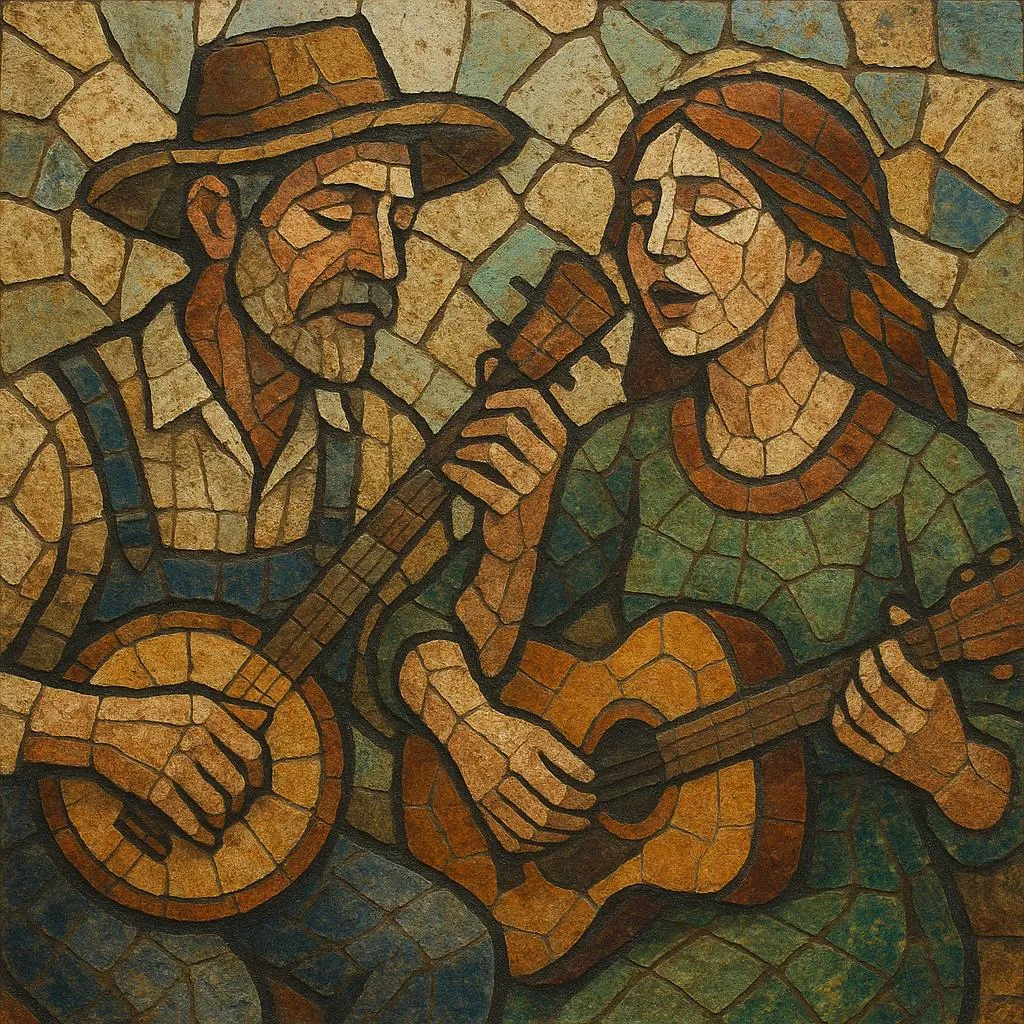
Hillbilly music is the earliest commercial form of what later became known as country music. The term was used by record companies and radio programmers in the 1920s–1930s to market rural Southern and Appalachian string-band music, solo ballad singing, and sacred songs to a growing national audience.
Characterized by fiddles, banjos, acoustic guitars, mandolins, autoharp, and close-harmony vocals, hillbilly music blended British–Irish–Scottish balladry and dance tunes with African American blues, gospel, and string-band rhythms. Songs often feature simple I–IV–V harmony, strong two-step or waltz meters, narrative lyrics about love, labor, trains, religion, hardship, and local events, and performance touches like yodeling and distinctive guitar styles such as the “Carter scratch.”
Although the term “hillbilly” later became viewed as pejorative and fell out of industry use by mid-century, the sound, repertoire, and artists associated with hillbilly music laid the foundation for country, bluegrass, western swing, honky-tonk, and eventually rockabilly and rock and roll.
History
The commercial category "hillbilly music" emerged in the early 1920s, when record labels sought to market the sounds of rural white Southerners—especially from Appalachia and the Southeast. Field recordings and studio sessions captured fiddlers, ballad singers, and string bands whose music fused Anglo-Celtic ballads and dance tunes with African American blues and sacred repertoire.
Seminal moments included Fiddlin’ John Carson’s 1923 sides for Okeh Records and the groundbreaking 1927 Bristol Sessions (Victor Records, produced by Ralph Peer), which introduced the Carter Family and Jimmie Rodgers to a national audience. Radio barn-dance programs (e.g., WSM’s Grand Ole Opry, 1925) amplified the style across the United States.
Hillbilly recordings featured fiddles, banjos, guitars, mandolins, and autoharp, with strong two-step (2/4 or 4/4) and waltz (3/4) feels. Harmony was predominantly I–IV–V, with modal inflections (often Mixolydian), and melodies frequently derived from British–Irish–Scottish balladry and old-time fiddle tunes. Artists incorporated blues phrasing, “blue notes,” call-and-response, and, in some cases, yodeling.
During the 1930s, hillbilly music diversified: string bands grew more virtuosic; harmony duos and family groups flourished; and sacred songs and gospel harmonies gained popularity. Touring circuits, mail-order catalogs, and radio sponsorships (e.g., flour and patent-medicine shows) built artist careers.
As the music industry professionalized, the label "hillbilly" fell out of favor due to its classist overtones. Trade publications and broadcasters adopted "country and western" by the 1940s, and later simply "country." Yet the hillbilly era’s repertoire, techniques, and stars directly shaped bluegrass, honky-tonk, western swing, and rockabilly, and indirectly fed into early rock and roll, as well as the later Americana movement.
The core aesthetics—string-band instrumentation, narrative songwriting, close harmony, driving rhythms, and a blend of secular and sacred themes—remain central to American roots music. Canonical hillbilly recordings continue to serve as templates for traditional country and modern roots revivals.