Your digging level

For this genre
0/8
🏆
Sign in, then listen to this genre to level up

Description

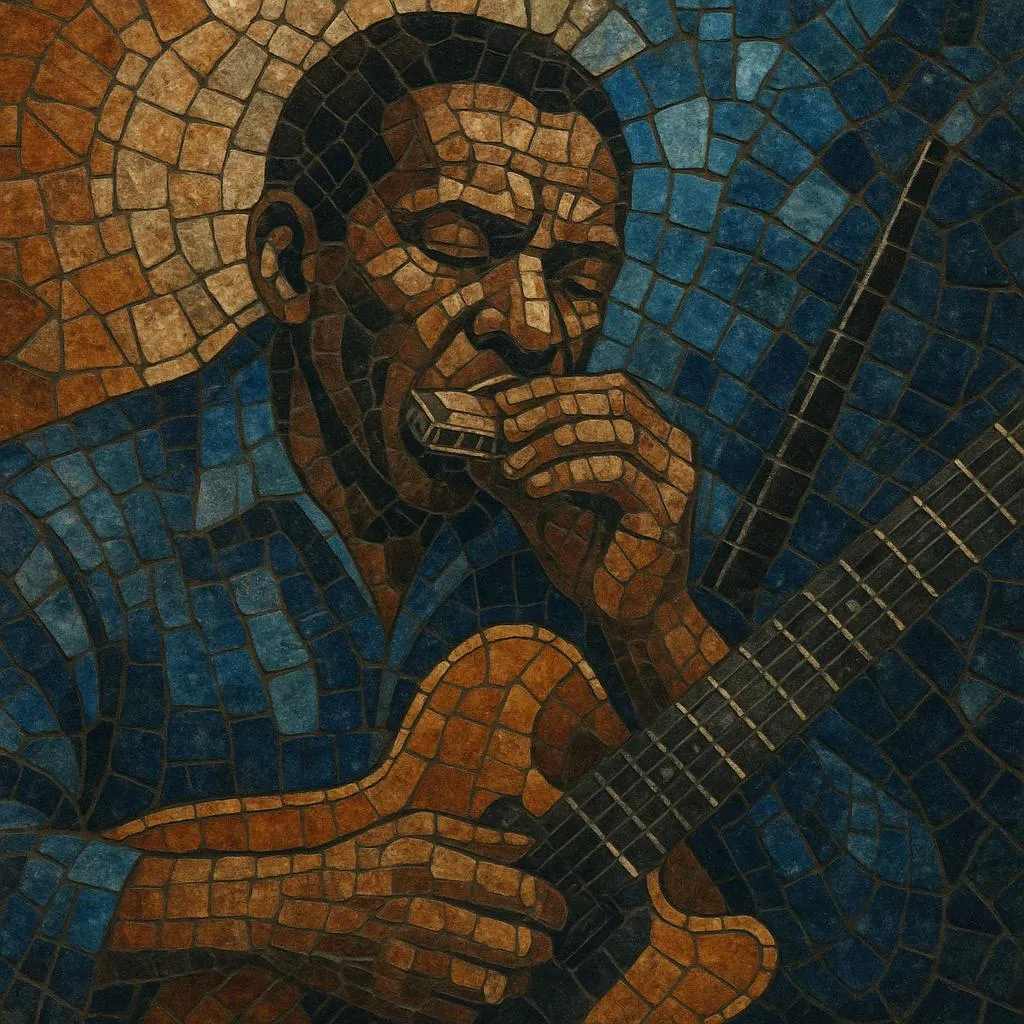
Harmonica blues is a style of blues that foregrounds the harmonica player, using the instrument as a principal lead voice alongside or in call‑and‑response with vocals and guitar.

It spans unamplified country/Delta traditions and the later, urban amplified sound associated with Chicago. Players exploit bends, warbles, tongue‑blocking, hand‑wahs, and (in electric settings) cupped bullet microphones into small tube amps to create a vocal, reed‑like timbre that cuts through shuffles, boogies, and slow blues. The idiom typically follows 12‑bar I–IV–V forms, the minor/major blues scale, and highly syncopated, swinging rhythms.


Sources: Spotify, Wikipedia, Discogs, RYM, MB, user feedback and other online sources

History

Origins (1920s–1930s)

Early blues harmonica emerged in the American South, where inexpensive diatonic harps let itinerant musicians add portable melody and rhythm. Pre‑war figures such as Jaybird Coleman and Noah Lewis (with the Memphis Jug Band) showcased acoustic harmonica over country/Delta blues chords and jug‑band grooves. In 1937, Sonny Boy Williamson I (John Lee Williamson) helped codify the harmonica as a lead blues voice on record.

Post‑war Urbanization and Amplification (1940s–1950s)

The Great Migration carried Southern players to cities—especially Chicago—where amplification transformed the instrument’s role. Little Walter’s groundbreaking Chess recordings (often with cupped bullet mic into small tube amps) defined the fat, horn‑like “amplified harp” tone and virtuosic phrasing. Contemporaries including Big Walter Horton, Jimmy Reed, Junior Wells, and Howlin’ Wolf expanded the vocabulary across shuffles, stomps, and slow blues.

Expansion and Crossover (1960s–1970s)

Blues revivals and rock’s British‑American dialogue brought the blues harp to new audiences. Artists like Paul Butterfield and Charlie Musselwhite bridged club blues and rock stages, while James Cotton and Carey Bell carried the Chicago tradition forward. The instrument also filtered into swamp blues (Slim Harpo) and influenced emerging blues‑rock and garage scenes.

Modern Era

Harmonica blues remains central to electric and acoustic blues performance and education. Contemporary players draw on classic Chicago phrasing and pre‑war acoustics while integrating modern amps, pedals, and recording techniques. Workshops, festivals, and online pedagogy have preserved signature techniques—second‑position (cross‑harp) playing, expressive bends, rhythmic train beats—ensuring the style’s continuity and global reach.

How to make a track in this genre

Instruments and Setup
•   Lead diatonic harmonica (10-hole), typically played in second position (cross-harp) for a bluesy draw-bend palette; choose harp a fourth above the song key (e.g., key of D song → G harp). •   Acoustic setting: voice, acoustic guitar (fingerstyle or flatpicked), optional upright bass and light percussion. •   Electric setting: cupped bullet mic (e.g., Astatic JT‑30, Shure 520DX) into a small tube amp (Champ/Princeton), light slapback delay and spring reverb; manage feedback with tight hand cup and conservative gain.
Harmony and Form
•   Default 12‑bar blues (I–I–I–I | IV–IV–I–I | V–IV–I–V), with common variations (quick‑change, minor blues). •   Use the blues scale (1–b3–4–b5–5–b7) and Mixolydian color tones; emphasize chord tones at bar changes.
Rhythm and Feel
•   Groove on swung eighths and triplet undercurrent; common feels are mid‑tempo shuffle, walking boogie, and slow drag. •   Lock call‑and‑response: vocal line → short harp fill; leave space on downbeats and answer on bars 2–4 and 6–8.
Harmonica Technique
•   Core bends: draw bends on holes 1–4 and 6; expressive 3‑draw microtonal control (whole/half‑step) for blue notes. •   Tongue‑blocking for octaves and slaps; warbles (rapid alternation between adjacent holes) for intensity; hand‑wahs to shape vowels. •   Turnarounds: craft distinctive two‑bar licks (bars 11–12) to cue the next chorus.
Arrangement Tips
•   Intro: 2–4 bar harp pickup or classic turnaround sets key and tempo. •   Solo chorus: build from motif to climax; avoid overplaying—contrast sustained reeds with percussive slaps. •   Tone: prioritize breath control and dynamic swells; in electric contexts, keep amp just breaking up and let embouchure drive expression.

Top tracks

Locked
Share your favorite track to unlock other users’ top tracks

Upcoming concerts

in this genre
Influenced by
Has influenced

Download our mobile app

Get the Melodigging app and start digging for new genres on the go
© 2026 Melodigging
Melodding was created as a tribute to Every Noise at Once, which inspired us to help curious minds keep digging into music's ever-evolving genres.
Buy me a coffee for Melodigging