Your digging level

For this genre
0/8
🏆
Sign in, then listen to this genre to level up

Description

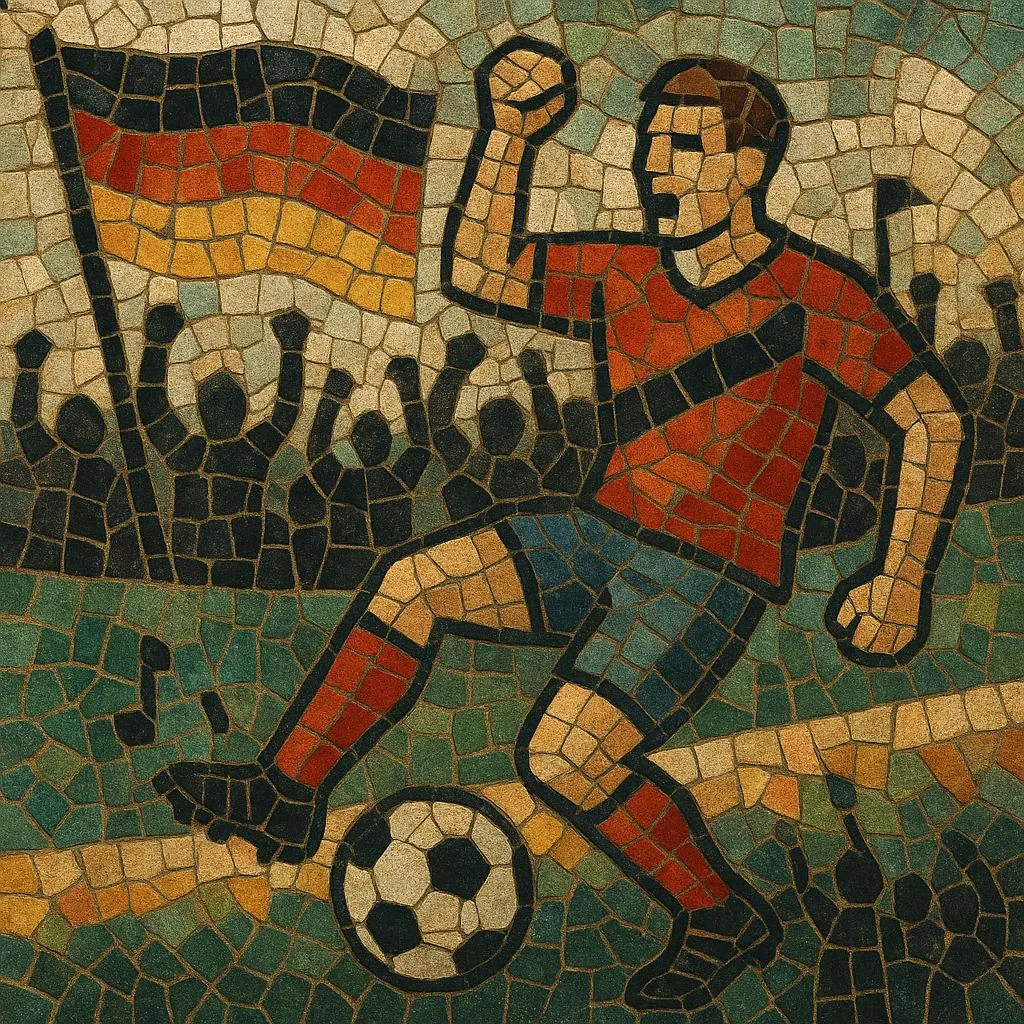
Fussball is a German-language umbrella tag for football (soccer) songs, terraces anthems, and club or national-team hymns made for match days, tournaments, and fan culture. It blends sing‑along Schlager and volkstümliche hooks with straightforward pop/rock backlines, making it easy for entire stadiums to chant in unison.

Stylistically, fussball tracks favor strong, major‑key melodies, call‑and‑response refrains, marching or four‑on‑the‑floor rhythms, and communal lyrics about teams, colors, cities, and shared pride. Arrangements range from brass‑and‑accordion "Oompah" textures to electric guitars, drums, and crowd samples, with frequent key‑change lifts and clapping patterns designed for maximum participation.


Sources: Spotify, Wikipedia, Discogs, RYM, MB, user feedback and other online sources

History

Early roots (1950s–1970s)

Germany’s football‑song tradition coalesced as postwar fan culture and broadcast media grew. While terrace chants adapted well‑known folk and Schlager melodies, officially recorded football songs rose with televised tournaments and club marketing. National‑team and club squads occasionally recorded their own singles, and marching/anthemic idioms helped solidify the sing‑along format.

Stadium era and club anthems (1980s–1990s)

By the 1980s and 1990s, clubs leaned into dedicated hymns and entrance music. Terraces popularized adaptations of global sing‑alongs (e.g., You’ll Never Walk Alone) alongside localized anthems like Bayern München’s "Stern des Südens" or FC Köln’s carnival‑flavored songs. The production palette spanned brass‑driven volkstümliche arrangements and rock‑band backlines, but always prioritized simple refrains a whole stand could shout.

Global tournaments and pop crossover (2000s)

The 2006 FIFA World Cup in Germany catalyzed a flood of crossover pop hits and unofficial anthems that spilled into mainstream charts. Big‑chorus rock, Schlager‑pop, and radio‑ready hooks became templates for tournament singles and broadcaster soundtracks. Tracks from pop and hip‑hop artists sat alongside fan chorales, with TV montage usage turning several songs into de facto national soundtracks during campaigns.

Today

Contemporary fussball cuts still center on chantability: major‑key melodies, steady 4/4, handclaps, and repeated slogans. Production ranges from brass‑heavy party Schlager to modern pop‑rock and EDM‑tinged stadium builds. The genre remains a living feedback loop between recorded music and terraces—hits become chants, and chants become hits.

How to make a track in this genre

Core feel and tempo
•   Aim for 100–130 BPM in a steady 4/4; both marching (oom‑pah) feels and four‑on‑the‑floor pop/rock grooves work well. •   Keep drums punchy with prominent snare on beats 2 and 4; layer claps and crowd “hey!” samples for terrace energy.
Harmony and melody
•   Use bright, major‑key progressions: I–V–vi–IV or I–IV–V are common; add an end‑chorus key change (+1 or +2 semitones) for a lift. •   Write short, stepwise melodic cells that sit in a singable range (D3–D4 for mass male voices; avoid wide leaps in refrains).
Lyrics and form
•   Themes: club colors, city pride, teamwork, triumph, and togetherness—use inclusive pronouns ("wir/uns"). •   Rhyme simply and repeat slogans; craft a hook that can be chanted on loop (4–8 notes max). •   Structure: intro (drums/claps) → verse (story/setup) → pre‑chorus (rising energy) → big chorus (chant) → repeat; finish with a breakdown call‑and‑response and crowd sing‑out.
Instrumentation and texture
•   For Schlager/volkstümlich flavor: add brass (trumpets/trombones), tuba/EBass on oom‑pah, accordion, and gang vocals. •   For pop/rock flavor: guitars (open‑chord strums), bass (pedal roots), and synth pads doubling hooks. •   Layer terraces: multi‑tracked crowd vocals an octave below/above the lead; group shouts on downbeats.
Production tips
•   Emphasize chant intelligibility: compress and group‑bus gang vocals; add short room reverb to emulate stadium space. •   Arrange dynamic swells (snare rolls, cymbal rises) into the chorus; automate crowd noise to “enter” on hooks. •   Consider dialect/club references for authenticity; embed drumline fills and clap patterns aligned to terrace rhythms.

Top tracks

Locked
Share your favorite track to unlock other users’ top tracks

Upcoming concerts

in this genre
Influenced by

Download our mobile app

Get the Melodigging app and start digging for new genres on the go
© 2026 Melodigging
Melodding was created as a tribute to Every Noise at Once, which inspired us to help curious minds keep digging into music's ever-evolving genres.
Buy me a coffee for Melodigging