Your digging level
Description
Folclore português (Portuguese folklore) is the umbrella term for Portugal’s regional folk music, songs, and dances as they are preserved, staged, and transmitted by community ensembles (ranchos folclóricos) and revival groups. It draws on centuries-old rural and maritime traditions and presents them in identifiable regional styles.
Typical dance-forms include the lively vira (often in 6/8), the showy chula with percussive footwork, the fandango (notably in Ribatejo), the fast corridinho from the Algarve, and circle or line dances from Minho and Trás-os-Montes. Songs range from work chants and narrative romances (ballads) to love lyrics and improvised verse duels (desgarradas), often sung antiphonally or in robust choruses.
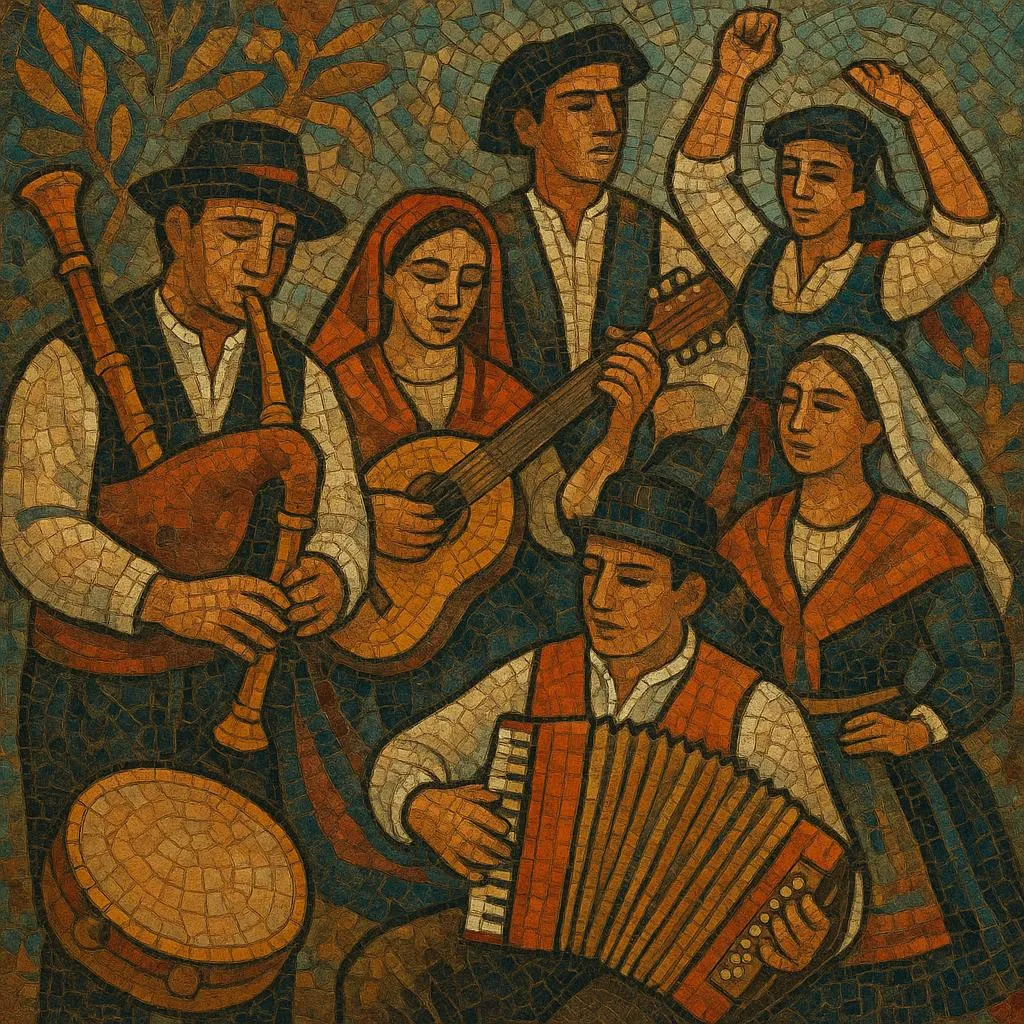
Characteristic instruments include regional violas (viola braguesa, viola campaniça), cavaquinho, rabeca chuleira (folk fiddle), adufe (square frame drum), ferrinhos (triangle), castanholas (clappers), bombo (bass drum), gaitas-de-foles (bagpipes: e.g., gaita transmontana/mirandesa), concertina (diatonic accordion), and sometimes the Portuguese guitar. Melodies frequently favor modal colors (Mixolydian, Dorian) with straightforward, dance-driven harmonies.
History
Portuguese folk song and dance practices took shape over centuries in agrarian villages, market towns, and port communities. Northern regions (Minho, Trás‑os‑Montes) developed vigorous circle and line dances accompanied by bagpipes, concertinas, and regional violas; central and southern areas cultivated frame-drum and choral traditions, while coastal and river zones preserved work songs and narrative ballads (romances). Many core dance-forms—vira, chula, fandango, corridinho—are attested in local festivities and life-cycle rituals.
While the traditions are older, the modern category “folclore português” coalesced in the early 20th century and was strongly institutionalized from the 1930s onward. Community ensembles (ranchos folclóricos) emerged to present regional repertoires on stage in stylized costumes. During the Estado Novo period, folklore was promoted at festivals, radio, and state exhibitions, fixing choreographic versions and costume archetypes and encouraging inter-regional showcases while preserving local identities.
From the mid‑20th century, ethnographers and musicians carried out extensive fieldwork and recording, galvanizing preservation and informed performance. After 1974, a folk revival brought renewed attention to rural styles, regional languages (including Mirandese), and dance repertoires, now framed both as heritage and as creative resources. Folklore festivals, interceltic gatherings in the north, and dance camps expanded audiences and participation.
Today, folclore português lives through thousands of ranchos, local cultural associations, and professional or semi‑professional revival groups. Ensembles balance historical research with stage practicality, often assembling suites that flow through multiple regional dances. Instrument makers, luthiers of regional violas, and concertina circles sustain craft lineages, while contemporary folk and world‑music artists fuse traditional grooves and timbres with modern arrangements.