Your digging level
Description
Folclore jujeño is the regional folk music of Jujuy Province in Northwest Argentina, shaped by the Andean highland (Puna and Quebrada de Humahuaca) environment and the living traditions of Kolla/Quechua and Aymara communities.
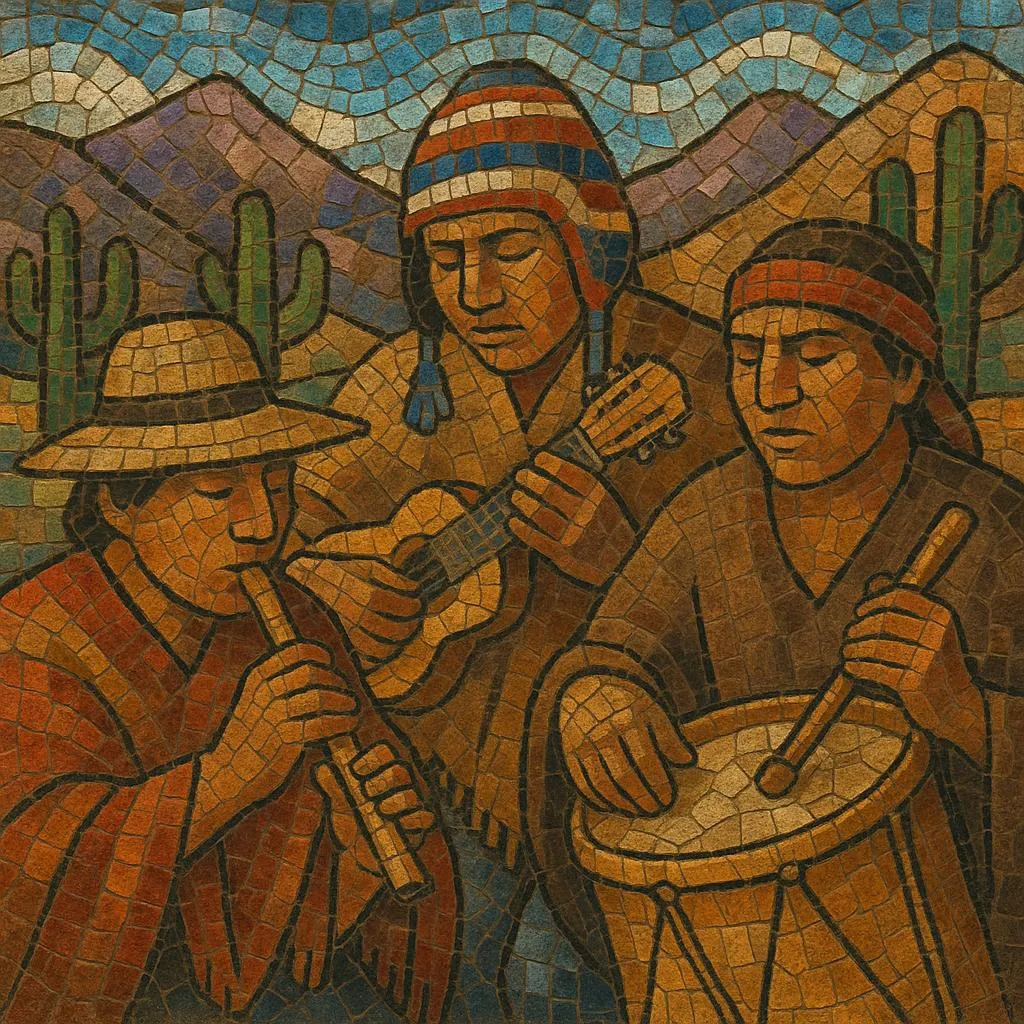
It blends indigenous Andean song forms and scales with criollo instruments and Argentine folk practices. Typical song types include carnavalito, bailecito, huayno-influenced pieces, coplas accompanied by caja coplera, and deeply plaintive bagualas and vidalas sung a cappella or with minimal percussion. Its timbral palette is defined by charango, quena, sikus/zampoña, erke, bombo legüero, and caja, producing bright, breathy winds over earthy drum grooves and pentatonic or modal melodies.
Lyrically, folclore jujeño evokes the landscape (Pachamama, puna winds, quebradas), community rituals (Carnaval, comparsas), migration, and memory, often in octosyllabic quatrains (coplas) with Spanish interwoven with Quechua/Aymara words.
History
Folclore jujeño emerges from centuries of Andean musical practice in the highlands that predate the nation-state, later meeting Spanish colonial poetics and criollo performance habits. By the 1800s, regional song forms (coplas, bagualas, vidalas) were already rooted in community rituals, agricultural cycles, and Carnival, typically sung in open air with caja coplera and conch or long horns (erke) signaling communal gathering.
In the mid‑20th century, Argentina’s folklore boom brought national attention to Northwest traditions. Recordists and artist‑researchers like Leda Valladares documented jujeño copleras and the Quebrada de Humahuaca’s vocal practices, helping to canonize these repertoires beyond their local contexts. The charango and Andean winds joined guitar and bombo legüero on larger stages, and regional ensembles (e.g., Los de Jujuy) toured nationally, framing jujeño sound within the broader Argentine folk revival.
From the 1990s onward, artists such as Ricardo Vilca, Tomás Lipán, and later Los Tekis and Bruno Arias refreshed the style—some preserving its austere, contemplative edge; others energizing Carnaval aesthetics for festival stages. The UNESCO listing of the Quebrada de Humahuaca (2003) further spotlighted the region’s intangible culture. Today, folclore jujeño informs Andean fusion, Argentine folk‑rock, and Latin alternative scenes, while local copleras continue to sustain communal singing during Carnival and Pachamama ceremonies.