Your digging level

For this genre
0/8
🏆
Sign in, then listen to this genre to level up

Description

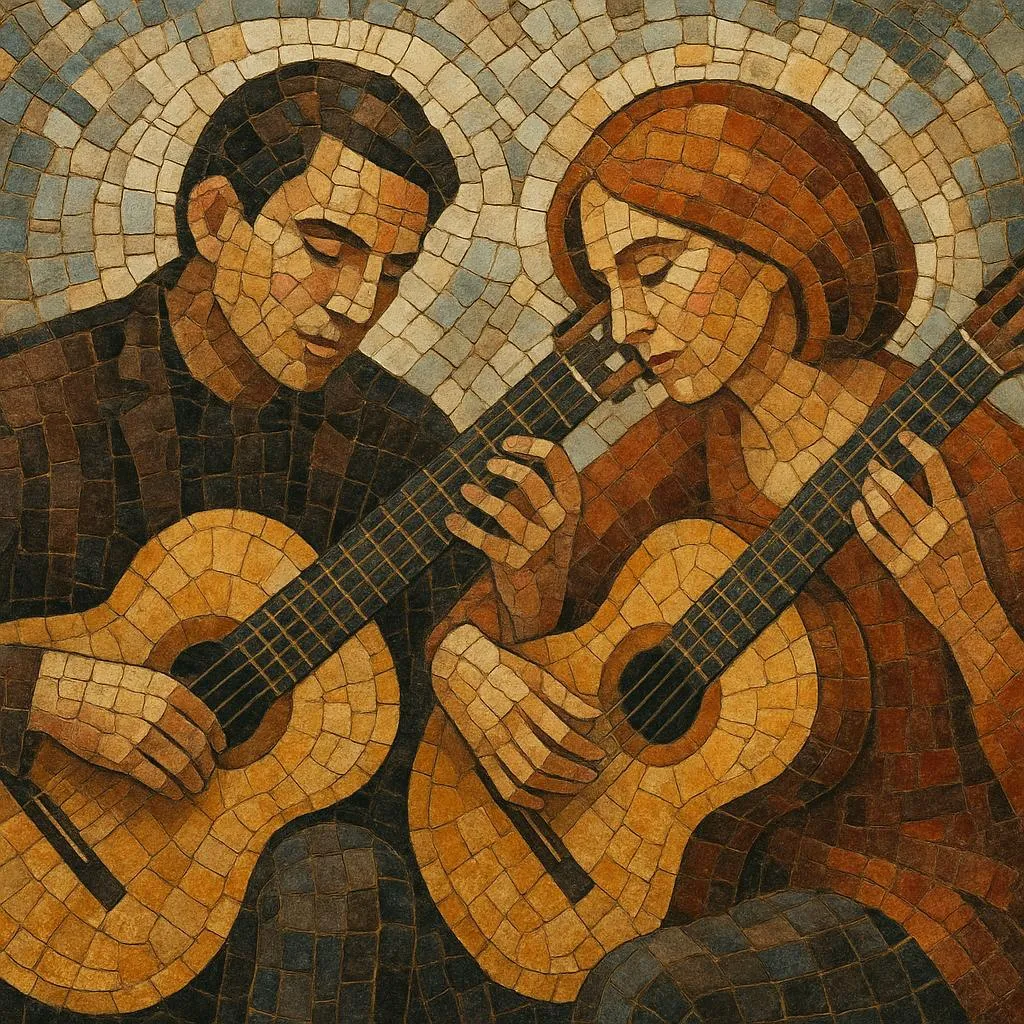
Classical guitar duo is a chamber-music format centered on two nylon‑string (Spanish) guitars performing together as equal partners. The duo draws on an extensive repertoire of original 19th‑ and 20th‑century works as well as artful arrangements from the Baroque, Classical, Romantic and modern eras.

Musically, the idiom balances contrapuntal clarity (two independent polyphonic instruments) with blended timbre and subtle colors—rest and free strokes, natural/artificial harmonics, sul tasto/sul ponticello, tambora, golpe and selective rasgueado. Textures range from two-part counterpoint and chorale writing to arpeggiated figurations, hocketing lines and antiphonal dialogue.

While rooted in European classical tradition (Sor, Giuliani, Carulli), the contemporary duo scene also embraces Latin American voices (Piazzolla, Gnattali, Brouwer, Assad) and sensitive transcriptions of keyboard, orchestral and vocal works.


Sources: Spotify, Wikipedia, Discogs, RYM, MB, user feedback and other online sources

History

Early 19th century: salon and teaching repertory

The guitar’s rise in the late 18th–early 19th century created natural settings for two instruments to share melody and accompaniment in small rooms. Composers‑performers such as Fernando Sor (Spain), Mauro Giuliani (Italy/Vienna) and Ferdinando Carulli (Italy/Paris) wrote substantial duos that codified idiomatic voicing, campanella effects and alternating accompanimental patterns. These works, published for the growing amateur market, established the duo as a refined but accessible chamber format.

Late 19th–early 20th century: eclipse and revival

As pianism and violin/voice repertoires dominated concert life, the guitar (and its duos) receded from major stages. The 20th‑century solo revival under Andrés Segovia refocused attention on the classical guitar, which, in turn, rekindled interest in chamber uses of the instrument—including the two‑guitar duo. Editors and performers revived Sor/Giuliani/Carulli duets and began transcribing Baroque keyboard and ensemble music.

Mid‑20th century: iconic virtuoso duos

From the 1950s, Ida Presti & Alexandre Lagoya professionalized the format at the highest artistic level, commissioning new works and crafting benchmark transcriptions. In Latin America, Sérgio & Eduardo Abreu set new technical/ensemble standards in the 1960s–70s.

Late 20th–21st century: global expansion and new repertoire

Since the 1970s, the Assad Brothers (Sérgio & Odair) have commissioned and inspired a flood of original duo works (e.g., by Leo Brouwer, Radamés Gnattali) and stylistically flexible programs (from Bach to Piazzolla). Numerous internationally touring duos (Eden‑Stell, Katona Twins, Duo Melis, Amadeus Guitar Duo, Duo Siqueira Lima, Montenegrin Guitar Duo) have broadened the canon with new commissions, historically informed 19th‑century practice (on period guitars) and sophisticated transcriptions of orchestral/keyboard music.

Today, the classical guitar duo is a vibrant, conservatory‑trained chamber genre, with competitions, festivals and publisher/recording support sustaining a living repertoire that bridges European art music and Latin American modernism.

How to make a track in this genre

Instrumentation and setup
•   Two nylon‑string classical guitars in standard tuning (E–A–D–G–B–E), matched or complementary in timbre. •   Think in primo/secundo roles, but avoid relegating one guitar to perpetual accompaniment—alternate roles to maintain equality and color variety.
Texture and voicing
•   Exploit the duo’s strength: transparent two‑ to four‑voice counterpoint distributed across two polyphonic instruments. Write independent lines that interlock without crossing awkwardly. •   Plan registers so each line sits in a resonant range; use campanella fingerings for bell‑like sustain. •   Blend unison octave melodies for weight; split inner voices between guitars to reduce hand stretches and maintain legato.
Rhythm and articulation
•   Alternate arpeggio patterns between parts (e.g., broken‑chord figurations traded by bar) to create motion without tiring a single player. •   Contrast tirando (free stroke) for warmth and apoyando (rest stroke) for projection of cantabile lines. Use tremolo sparingly for highlight. •   For dance‑derived pieces (minuet, habanera, milonga), encode characteristic rhythms in one part while the other states melody/counter‑melody.
Harmony and form
•   Idiomatic keys favor open‑string resonance (E, A, D, G major/minor). Leverage pedal tones and open basses. •   Write sectional forms (binary/ternary/variation) that allow color changes: sul tasto vs. sul ponticello, ponticello echoes, harmonics, tambora and subtle rasgueado as color (not flamenco compás). •   Cadences should allow synchronized damping to avoid over‑ring; stagger releases in legato textures to preserve clarity.
Notation and ensemble craft
•   Provide detailed fingerings where color matters (RH i‑m‑a patterns, LH shifts/guide fingers). Indicate timbral directives and balance markings. •   Orchestrate dynamics antiphonally (crescendo in one guitar against decrescendo in the other) to shape phrases. •   When arranging keyboard/orchestral music, redistribute voices so no part exceeds comfortable stretch; avoid dense block chords that choke resonance—prefer broken textures and divisi.
Practice/recording tips
•   Rehearse with a focus on attack/noise uniformity (nail shape, angle) and synchronized releases. •   In recording or amplification, separate mics slightly and EQ for complementary spectra to prevent masking.

Top tracks

Locked
Share your favorite track to unlock other users’ top tracks

Upcoming concerts

in this genre
Influenced by
Has influenced

Download our mobile app

Get the Melodigging app and start digging for new genres on the go
© 2026 Melodigging
Melodding was created as a tribute to Every Noise at Once, which inspired us to help curious minds keep digging into music's ever-evolving genres.
Buy me a coffee for Melodigging