Your digging level

For this genre
0/8
🏆
Sign in, then listen to this genre to level up

Description

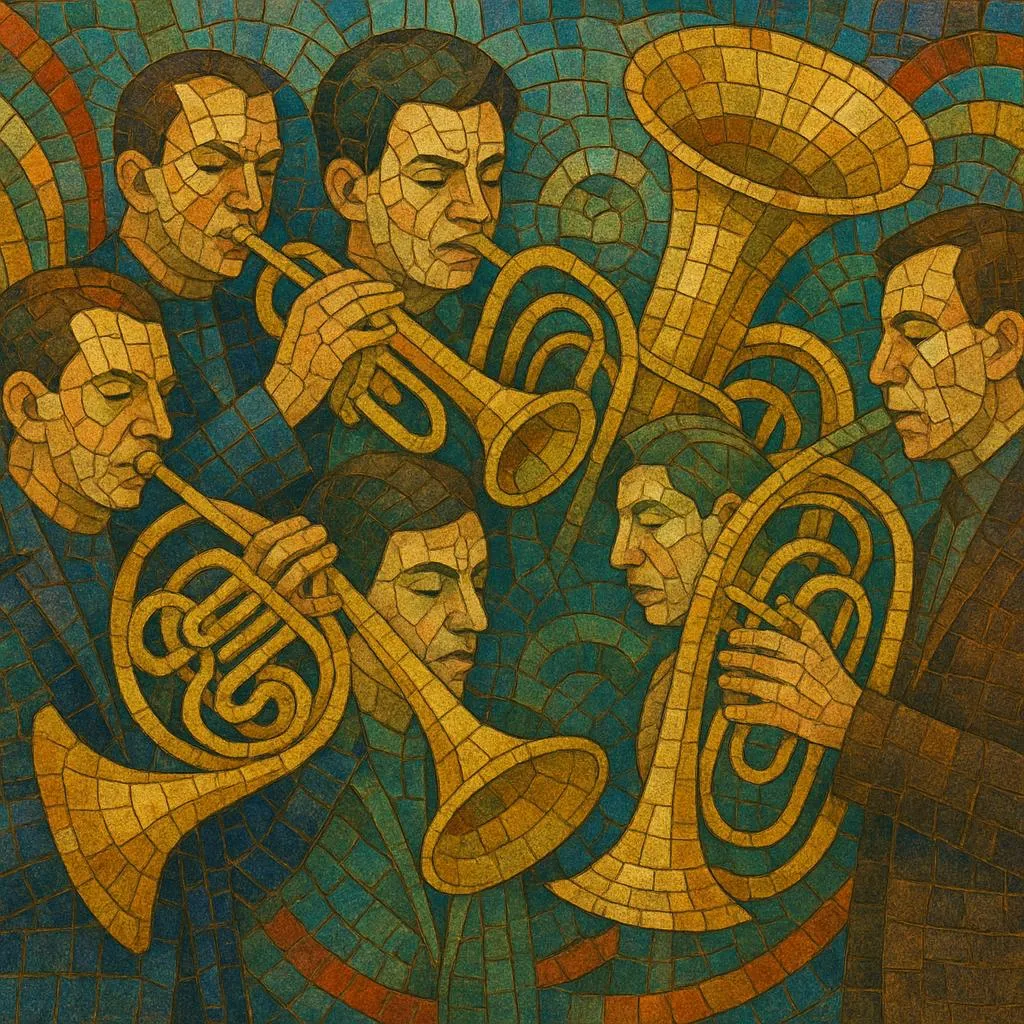
A brass quintet is a chamber-music ensemble built around five brass instruments—typically two trumpets, horn, trombone, and tuba. It is one of the most flexible small ensembles in Western classical music, capable of fanfare brilliance, chorale-like warmth, contrapuntal clarity, and even jazz-inflected color.

While early substantial repertoire was written by Victor Ewald in the late 19th century, the modern brass quintet as a standardized performing ensemble coalesced in the mid-20th century. Since the 1950s it has become a core medium for new commissions, arrangements (from Renaissance dances to Broadway and jazz standards), and virtuosic concert performance, appearing in concert halls, churches, schools, and on recordings worldwide.


Sources: Spotify, Wikipedia, Discogs, RYM, MB, user feedback and other online sources

History

Early roots (late 19th–early 20th century)

The first significant Romantic-era works for a five-part brass ensemble are commonly attributed to Victor Ewald (c. 1888–1912) in Russia. These pieces, often scored for two cornets, horn, trombone, and tuba (or ophicleide), proved that brass could sustain chamber idioms beyond fanfares and marches. Yet a stable, widely accepted instrumentation and performing tradition had not fully crystallized.

Standardization and growth (1950s–1970s)

In the 1950s, US-based groups such as the New York Brass Quintet (founded 1954) and the American Brass Quintet helped standardize the modern instrumentation—two trumpets, horn in F, tenor trombone, and tuba—and established professional touring, commissioning, and recording practices. This period saw a surge of original works by composers including Malcolm Arnold, Jan Koetsier, Ingolf Dahl, and later John Cheetham and Anthony Plog.

Popularization and global reach (1970s–1990s)

Ensembles like Empire Brass and Canadian Brass popularized the brass quintet through virtuosic playing, charismatic stagecraft, and wide-reaching recordings and media appearances. The repertory diversified through transcriptions (Renaissance dances, Baroque canzonas, chorales, and fugues), as well as contemporary works exploring new sonorities and extended techniques. European ensembles (e.g., Spanish Brass, Stockholm Chamber Brass) further broadened the repertory through competitions and commissions.

Today

The brass quintet is a fixture of conservatory curricula, professional chamber series, and community outreach. Its literature spans Romantic staples (Ewald), neoclassical and modern works, cinematic and jazz arrangements, and holiday programs. Composers continue to exploit the ensemble’s spectrum—from antiphonal fanfares to intimate lyricism—making the brass quintet one of the most active commissioning platforms in contemporary chamber music.

How to make a track in this genre

Instrumentation and roles
•   Standard instrumentation: 2 trumpets (B♭/C, occasional piccolo), horn in F, tenor trombone, tuba. Some ensembles substitute bass trombone for tuba in select literature. •   Typical roles: trumpets carry fanfares, melodies, and high counterpoints; horn binds the texture and provides inner warmth; trombone anchors tenor lines and counter-melody; tuba supplies the bass foundation and can take melodic or rhythmic ostinati.
Range, color, and balance
•   Write idiomatically: avoid sustained high tessitura for long stretches, especially for trumpets; give breathing space and phrase marks. •   Exploit color: specify mutes (straight, cup, harmon, bucket) for timbral contrast; use antiphonal echoing between trumpets/trombone and horn/tuba for spatial dialogue. •   Balance the pyramid: ensure the tuba’s foundation supports harmonic clarity; voice inner parts so the horn is not buried by trumpets and trombone.
Harmony, counterpoint, and texture
•   Effective textures include: homorhythmic chorale (rich triads, added 6ths/9ths), contrapuntal canzona/fugato (clear subject entries), and mixed textures (melody + rhythmic punctuations). •   Harmonic language ranges from diatonic/neo-tonal to jazz-inflected extended chords; use open fifths and planed triads for bright, brassy sonorities.
Rhythm and style
•   Brass quintets excel at crisp rhythms: fanfares with dotted figures, syncopated dance grooves (tuba on ostinato, trombone on backbeats), and metric shifts for contemporary pieces. •   Consider borrowing from Renaissance dance meters (pavan/galliard) and Baroque canzonas, or incorporate swing/Latin feels when appropriate.
Form and pacing
•   Common forms: fanfare–chorale–fugue suite; multi-movement works (fast–slow–fast); theme and variations; single-movement arches. •   Pace endurance: rotate lead lines, alternate tutti with chamber duos/trios, and write rests to preserve embouchure.
Extended techniques and notation
•   Idiomatic effects: flutter-tongue, half-valve/pitch bends (trumpets), glissando (trombone), multiphonics or vocalizations with tuba, stopped horn, and air effects for contemporary color. •   Notation: clearly indicate transpositions (C score vs. transposed parts), mute changes with adequate time, and articulations (marcato vs. tenuto) essential to brass clarity.
Arranging tips
•   Transcriptions work best when re-voiced for breath and resonance: redistribute fast keyboard passages among parts; convert sustained pedal points to tuba + horn dovetailing; preserve counterpoint clarity by spacing voices in open voicings.

Top tracks

Locked
Share your favorite track to unlock other users’ top tracks

Upcoming concerts

in this genre
Influenced by
Has influenced

Download our mobile app

Get the Melodigging app and start digging for new genres on the go
© 2026 Melodigging
Melodding was created as a tribute to Every Noise at Once, which inspired us to help curious minds keep digging into music's ever-evolving genres.
Buy me a coffee for Melodigging