Your digging level
Description
Analog horror is an internet-born horror style that foregrounds the texture and limits of obsolete media. It is characterized by lo‑fi, band‑limited sound, tape hiss, wow and flutter, and the sonic vocabulary of public‑access TV, VHS cassettes, emergency broadcast signals, and numbers stations.
In narrative terms, it tends toward cryptic, surreal plots presented as faux archival broadcasts, training films, or interrupted transmissions. Musically, the idiom leans on drones, minimal motifs, degraded samples, and detuned analog synths, using period‑authentic processing to evoke dread, nostalgia, and the uncanny.

History
Analog horror emerged on YouTube and other video platforms in the 2010s, where creators staged fictional archival broadcasts and emergency interruptions. Its sound drew from dark ambient, tape music, and 1970s–1990s library cues, wrapped in the artifacts of aging consumer media (VHS, cassette, U‑Matic). Hauntology and vaporwave’s fixation on retro media memory were crucial conceptual precursors.
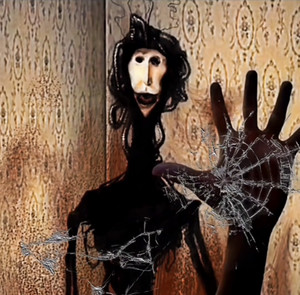
Series such as Local58 (2015–), Gemini Home Entertainment, The Mandela Catalogue, and later Backrooms adjacent works helped codify the idiom: stark title cards, liminal educational film cues, and oppressive drones punctuated by EAS tones and interstitial static. The audio language—detuned analog synths, sine sweeps, tape hiss, and clipped PA narration—became as important as the visuals.
The style internalized techniques from tape music, musique concrète, electroacoustic practice, and industrial/ambient hybrids: found sound, degraded loops, acousmatic imagery, and microphone/noise floor as dramaturgy. Horror‑synth minimalism (à la Carpenter), Berlin‑school pads, and library music pastiche supplied the harmonic palette; radio hums, 50/60 Hz mains buzz, and dropouts provided texture and pacing.
By the early 2020s, analog horror aesthetics spread into indie game soundtracks, "liminal space" compilations, and online microgenres, encouraging a resurgence of interest in tape coloration, wow/flutter plug‑ins, and period‑correct broadcast sonification. The approach also cross‑pollinated with techno‑/digital‑era horror, yielding a broader techno‑horror ecosystem that still privileges the uncanny power of degraded media.