Your digging level
Description
Agbadza is a prominent social dance-music tradition of the Ewe people, centered in Ghana’s Volta Region and southern Togo. It evolved from older Ewe war-dance repertories into an inclusive community dance suitable for festivals, funerals, and celebrations.
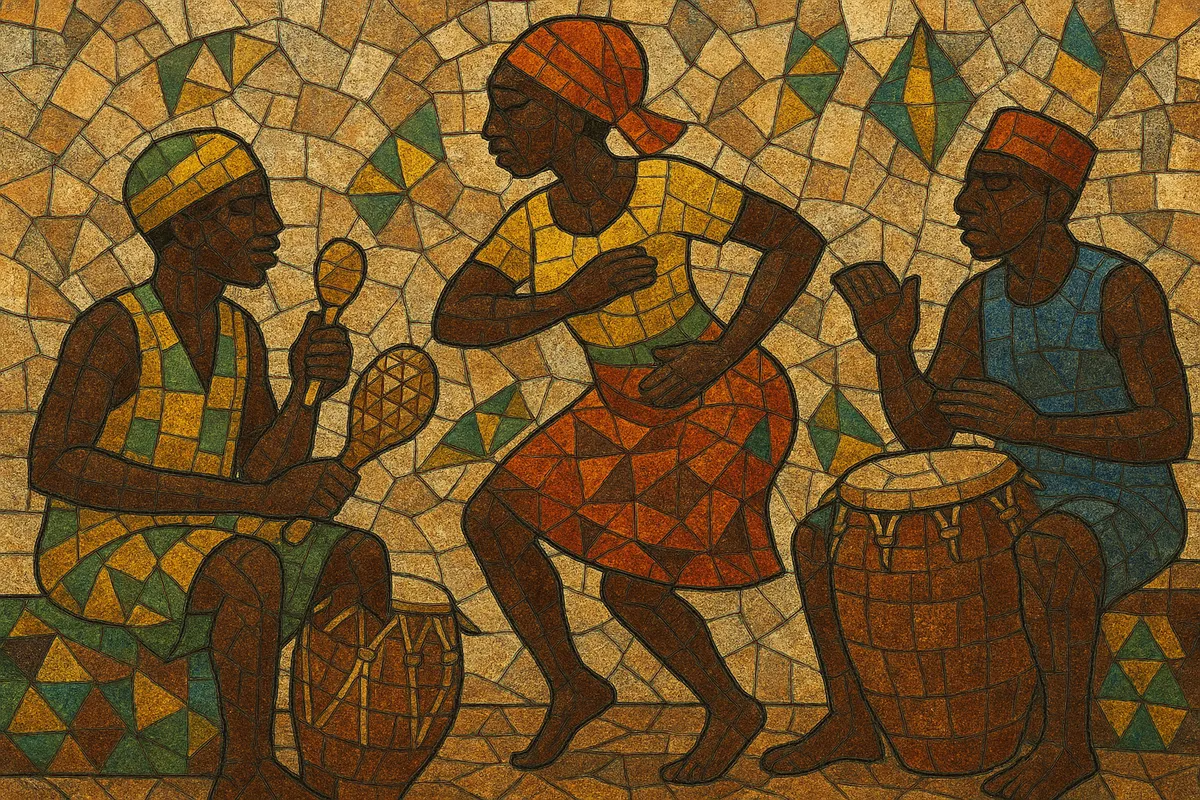
Its music is polyrhythmic and typically set in a 12/8 feel anchored by the gankogui (iron bell) timeline and axatse (gourd rattle), with interlocking patterns on kaganu, kidi, and sogo drums. A lead drummer cues sections and dance breaks, while a lead singer engages the chorus in call-and-response songs rich in proverbs, social commentary, and local history.
The dance emphasizes cyclical motion, torso and shoulder articulation, and relaxed but propulsive stepping—embodying both dignity and exuberance. Because it is community-based, participation spans generations, making Agbadza a living emblem of Ewe identity and cultural continuity.
History
Agbadza emerges from Ewe martial traditions—particularly the transformation of older war-dance repertories into a social, non-martial community practice. As warfare declined in the late 19th and early 20th centuries, performance settings shifted from the battlefield and training grounds to festivals, funerals, and civic ceremonies.
By the early 1900s, Agbadza had coalesced into a recognizable suite performed by interlocking percussion, a bell timeline, and responsorial singing. Its accessibility made it a common dance at public gatherings, where everyone—from elders to youth—could participate.
Agbadza typically unfolds in cyclical sections at medium-to-fast tempos in 12/8. The gankogui bell establishes the time-line, the axatse rattle reinforces the groove, small drums maintain timeline-aligned patterns, and the lead drum shapes dynamics and cues transitions. Songs use call-and-response, drawing on Ewe proverbs, local histories, praise, and social reflection.
Throughout the mid–late 20th century, Agbadza was preserved and staged by national and university ensembles in Ghana and taught by Ewe master drummers abroad. It is now widely performed in cultural festivals, religious and life-cycle events, and educational contexts worldwide.
Agbadza’s polyrhythmic vocabulary and communal aesthetics informed Ghanaian stage presentations and contributed (directly and indirectly) to the rhythmic palette that nourished highlife and later global fusions. Today it stands as a key emblem of Ewe cultural identity and a cornerstone of West African drum-and-dance pedagogy.