Genres
Artists
Albums
Make Music
Sign in
Sign in
Artists
Classical
Artists
Classical
Yevgeny Svetlanov
2006
·
1 album
Listen
2
/5
Genres
Saint Petersburg School
The Saint Petersburg school refers to interrelated circles of 19th-century Russian Western Classical composers centered in Saint Petersburg. Its core aim was to develop a distinctly Russian national style within Western art-music forms, blending European conservatory craft (symphony, opera, chamber music) with Russian-language declamation, folk-like melodic turns, Orthodox-tinged sonorities, and programmatic subjects drawn from Russian history and literature. In practice, the term often overlaps with the so‑called “Mighty Handful” (Balakirev’s circle) and their broader St. Petersburg milieu, where national-romantic aesthetics were pursued alongside vigorous debate with more academically oriented musicians.
Discover
Listen
Orchestral
Orchestral music refers to compositions written for an orchestra—a large ensemble typically built around a string section (violins, violas, cellos, double basses), complemented by woodwinds, brass, percussion, and often harp, keyboard, or other auxiliary instruments. A conductor coordinates the ensemble, shaping balance, phrasing, and expression. The style emphasizes coloristic timbre combinations, dynamic range from the softest pianissimo to explosive tuttis, and textures that can shift seamlessly between transparent chamber-like writing and monumental masses of sound. Orchestral writing underpins concert genres such as symphonies, overtures, and tone poems, as well as opera, ballet, and modern film and game scores. While orchestral writing evolved across centuries, its core craft centers on melody, counterpoint, harmony, register, and orchestration—the art of assigning musical ideas to instruments to achieve clarity, contrast, and narrative impact.
Discover
Listen
Classical
Classical music is the notated art-music tradition of Europe and its global descendants, characterized by durable forms, carefully codified harmony and counterpoint, and a literate score-based practice. The term “classical” can refer broadly to the entire Western art-music lineage from the Medieval era to today, not just the Classical period (c. 1750s–1820s). It privileges long-form structures (such as symphonies, sonatas, concertos, masses, and operas), functional or modal harmony, thematic development, and timbral nuance across ensembles ranging from solo instruments to full orchestras and choirs. Across centuries, the style evolved from chant and modal polyphony to tonal harmony, and later to post-tonal idioms, while maintaining a shared emphasis on written notation, performance practice, and craft.
Discover
Listen
Albums
2006
1
/5
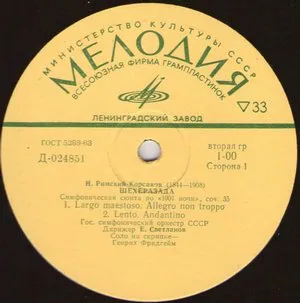
Шехерезада
Nikolai Rimsky-Korsakov Николай Римский-Корсаков / State Academic Symphony Orch…
Saint Petersburg School
Similar artists
4
/5
London Symphony Orchestra
Classical
Ballet
Concerto
4
/5
Herbert von Karajan
Classical
Symphonic Poem
Symphony
4
/5
Pyotr Ilyich Tchaikovsky
Classical
Moscow School
Ballet
3
/5
Chicago Symphony Orchestra
Classical
Choral Symphony
Concerto
3
/5
Slovak Radio Symphony Orchestra
Classical
Opera
Orchestral
3
/5
Neeme Järvi
Classical
Orchestral
Concerto
3
/5
Valery Gergiev
Classical
Saint Petersburg School
Ballet
3
/5
Modest Mussorgsky
Classical
Saint Petersburg School
Orchestral
3
/5
Carlo Maria Giulini
Classical
Opera
Requiem
3
/5
Theodore Kuchar
Classical
Orchestral
Saint Petersburg School
Download our mobile app
Get the Melodigging app and start digging for new genres on the go
Download on the App Store
Get it on Google Play
© 2026 Melodigging
Give feedback
Legal
Melodding was created as a tribute to
Every Noise at Once
, which inspired us to help curious minds keep digging into music's ever-evolving genres.