

Your digging level
Description
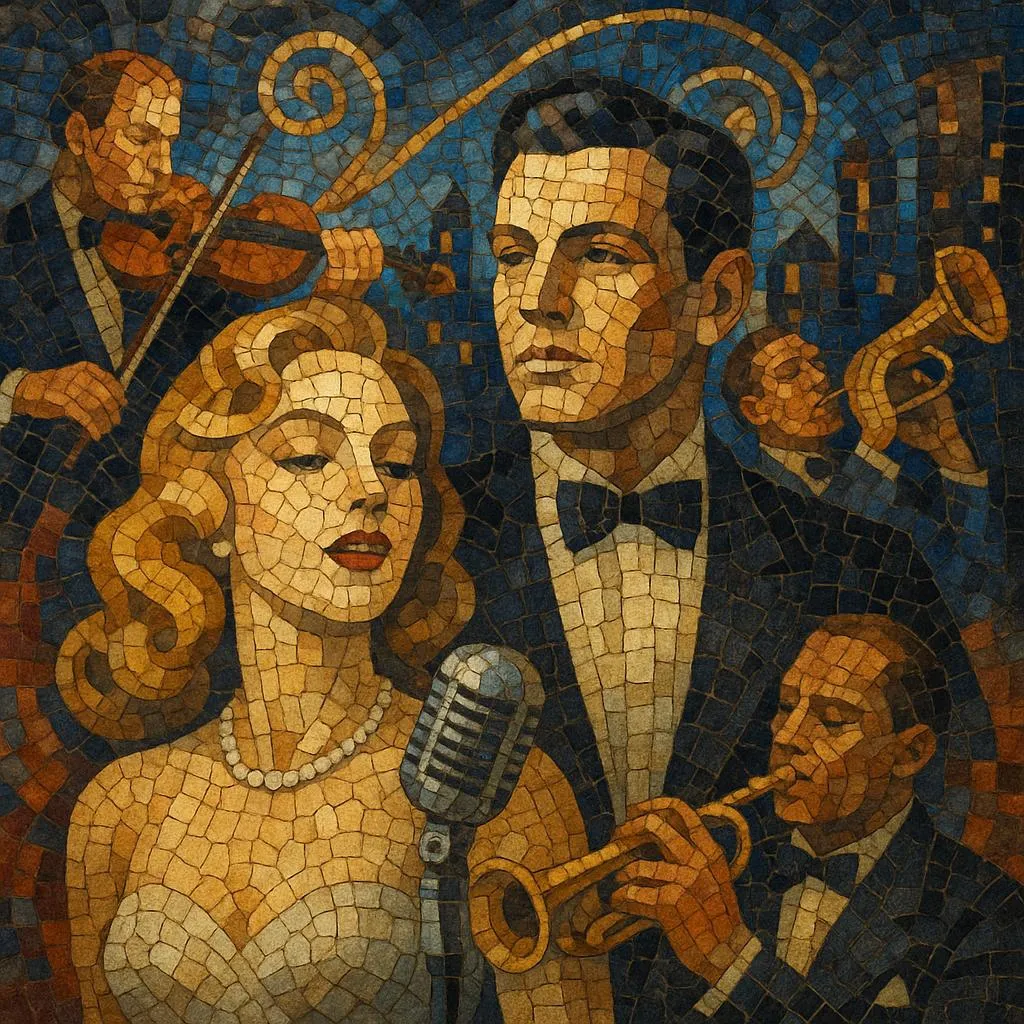
Vintage Hollywood denotes the lush orchestral and song-driven sound world associated with the Golden Age of American cinema, roughly the 1930s through the 1950s. It blends late‑Romantic European symphonic language with American Tin Pan Alley songwriting, big‑band swing, and traditional pop crooning.
Expect sweeping string melodies, heroic brass fanfares, woodwind filigree, and harp and celesta sparkle, often organized around memorable leitmotifs. In musicals, this palette sits beside elegant AABA standards and show‑tune choruses, delivered with impeccable studio‑era diction and a glamorous sense of stagecraft.
Beyond film scores, the “Vintage Hollywood” vibe encompasses studio orchestras, star vocalists, and dance-band numbers heard onscreen and on records—music engineered for romance, spectacle, and the aura of old Hollywood glamour.
History
With the arrival of synchronized sound in the late 1920s, Hollywood rapidly built in‑house music departments. European émigré composers—steeped in late‑Romantic and post‑Romantic idioms—met American songcraft from Tin Pan Alley and the energy of jazz and swing. Max Steiner’s King Kong (1933) and Erich Wolfgang Korngold’s swashbuckling scores set the template for symphonic film music built on leitmotifs, rich counterpoint, and cinematic orchestration.
Studios like MGM, Warner Bros., Fox, and Paramount institutionalized the sound: full symphony orchestras, top‑tier orchestrators, and star singers. Alfred Newman, Franz Waxman, Miklós Rózsa, Dimitri Tiomkin, and Bernard Herrmann expanded the grammar—romantic love themes, noir tension, exotic color, and psychological scoring—while screen musicals (Busby Berkeley spectacles, MGM’s Freed Unit) fused show tunes, big‑band swing, and elegant ballads. Performers such as Judy Garland and Gene Kelly embodied the era’s glamorous blend of song and dance.
Changing tastes, television, and the rise of pop/rock tilted film scoring toward jazz combos, easy listening, and song-led soundtracks. Yet the Vintage Hollywood orchestral voice persisted in epics and prestige pictures, and its techniques informed TV scoring’s fast, modular workflows.
John Williams’s 1970s scores reasserted the Golden Age symphonic model for blockbusters, while periodic revivals and retro‑inspired projects (including Disney musicals and prestige period films) kept the style current. Today, “Vintage Hollywood” also labels contemporary works that emulate Golden Age orchestration and songwriting to evoke nostalgia, romance, and classic glamour.
-
•
Sketch a 16‑bar soaring theme in a major key with a secondary‑dominant lift into the B section.
•Orchestrate strings in rich three‑ or four‑part harmony; add horn countermelodies and harp arpeggiation.
•Support with gentle brush kit and upright bass for song cues; omit drum set for pure underscore.
•Introduce a contrasting minor‑mode bridge or modulation for dramatic lift, then restate the main theme grandly.



