Your digging level

For this genre
0/8
🏆
Sign in, then listen to this genre to level up

Description

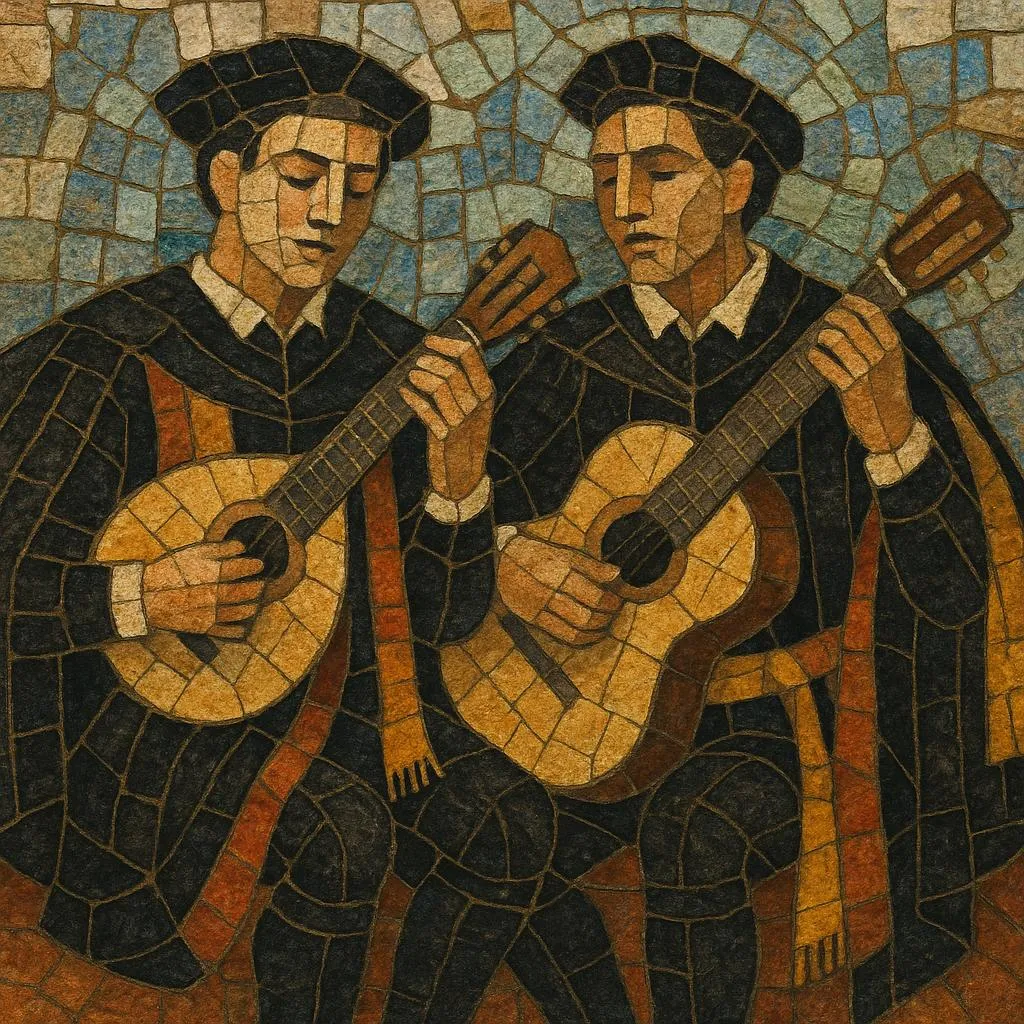
Tuna universitaria is a historic Iberian student music tradition in which university ensembles perform serenades and street songs while wearing medieval-style academic dress (cape, ribbons, and sashes). Typical instrumentation centers on plucked string choir timbres—bandurria, laúd, and Spanish guitar—supported by tambourine and hand percussion, with rich male (and today also female) choral harmonies.

The repertoire mixes romantic serenades, pasacalles (processional pieces), jotas, boleros, habaneras, and other popular Spanish and Latin American songs. Performances take place in plazas, taverns, and festivals, as well as in formal “certámenes” (competitions) where different tunas showcase arrangements, vocal blend, and stagecraft. The style emphasizes camaraderie, humor, courtship, and the folklore of student life, balancing refined vocal polyphony with lively strummed rhythms designed for walking and dancing.


Sources: Spotify, Wikipedia, Discogs, RYM, MB, user feedback and other online sources

History

Roots (Middle Ages to 18th century)

The tuna tradition traces back to medieval and early modern Iberian student minstrels—often called "sopistas"—who sang and played stringed instruments in the streets to earn meals and celebrate student life. Serenading and processional singing became associated with universities in cities such as Salamanca, Coimbra, and Madrid.

19th‑century codification

In the 1800s, the modern form of the tuna universitaria crystallized around university faculties and formal ensembles. Distinctive academic attire (capes adorned with ribbons from admirers and travels) and a shared songbook of serenades, pasacalles, jotas, boleros, and habaneras became standardized. Famous groups like the Estudiantina Española Fígaro gained international attention, showcasing the format at exhibitions and tours and inspiring similar ensembles abroad.

20th century: Expansion and competitions

Throughout the 20th century, tuna culture spread across Spain, Portugal, and Latin America via academic exchanges and diaspora. University-based tunas formed by faculty (law, medicine, engineering) organized regular rondas (night serenades) and festivals. "Certámenes de tunas" emerged as competitive events evaluating vocal blend, arrangements, instrumental fluency (notably bandurria and laúd), choreography, and traditional showmanship.

Contemporary scene

Today, tuna universitaria thrives as a living heritage practice. While it upholds traditional repertoire and visual identity, many tunas incorporate Latin American standards, new harmonizations, and mixed-gender ensembles. The tradition remains a symbol of collegiate fellowship, musical craftsmanship, and Iberian cultural memory, with active circuits in Spain, Portugal, and throughout the Spanish- and Portuguese-speaking world.

How to make a track in this genre

Instrumentation and ensemble
•   Core plucked-string choir: bandurria (lead/obbligato), laúd (inner voices), Spanish guitars (harmony and rhythm). •   Percussion: tambourine (pandereta) and hand percussion; occasional contrabass or guitar-bass reinforcement. •   Vocals: unison leads with 2–4 part choral refrains; call-and-response between soloist and coro.
Rhythm and strumming
•   Pasacalles: lively 2/4 or 4/4 with steady walking pulse; employ bright rasgueado patterns for projection. •   Serenades and boleros: moderate 4/4 with arpeggiated guitar and gentle off‑beat accent; bandurria provides lyrical countermelodies. •   Habanera: characteristic dotted rhythm (♪ ♩ ♪ ♩) with relaxed lilt. •   Jotas and waltzes: 3/4 with occasional hemiolas (2×3 vs. 3×2 feel) for lift.
Harmony and melody
•   Diatonic tonal language (major/minor) with functional progressions (I–IV–V; I–vi–IV–V). •   Frequent secondary dominants for brightness and brief modulations to the dominant. •   Melodies are tuneful and singable; bandurria doubles/answers the vocal line with ornamentation (grace notes, tremolo).
Lyrics, form, and performance practice
•   Themes: romance, humor, friendship, and student lore; frequent serenade narratives. •   Forms: verse–refrain; add instrumental interludes for bandurria/laúd features; end with rousing choral codas. •   Stagecraft: tight vocal blend, dynamic swells, tambourine flourishes, and choreographed movement suitable for street performance. •   Attire and ethos: embrace academic garb (cape, ribbons) and the sociable “ronda” spirit to connect with audiences.
Arranging tips
•   Voicing: SATB‑like distribution across instruments—bandurria (soprano), laúd (alto/tenor), guitars (tenor/baritone), voices (lead + coro). •   Balance brightness (plucked trebles) with warm guitar body; ensure tambourine articulates downbeats and cadences. •   Keep keys singer‑friendly; plan modulations for climactic refrains.

Top tracks

Locked
Share your favorite track to unlock other users’ top tracks

Upcoming concerts

in this genre
Influenced by
Has influenced

Download our mobile app

Get the Melodigging app and start digging for new genres on the go
© 2026 Melodigging
Melodding was created as a tribute to Every Noise at Once, which inspired us to help curious minds keep digging into music's ever-evolving genres.
Buy me a coffee for Melodigging