Your digging level
Description
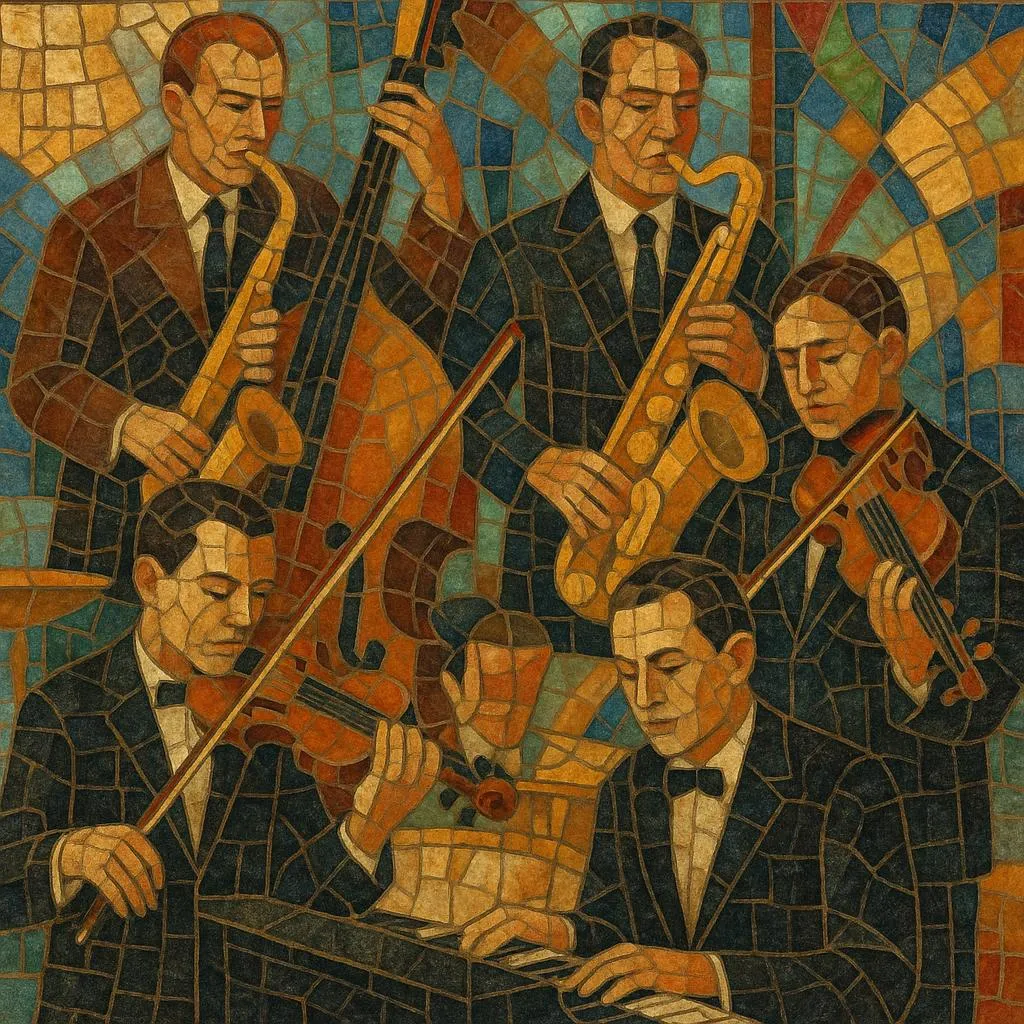
Tanzorchester (literally “dance orchestra”) denotes the German large‑ensemble tradition that provided fashionable social dance music for ballrooms, cafés, and—after 1945—radio and television. In practice it functioned as the German counterpart to the American big band, but typically with an added string choir alongside saxophone and brass sections, plus a rhythm section (piano/guitar, bass, drums). Repertoires mixed foxtrots, waltzes, tangos, rumbas and later swing, as well as arrangements of Schlager and film tunes.
The format crystallised in the Weimar era and matured around Germany’s broadcasting system: house dance orchestras accompanied singers in studios, cut 78‑rpm discs, and filled daily schedules with “leichte Unterhaltung” (light entertainment). Compared with US swing bands, Tanzorchester often foregrounded lush string melodies, with reeds and brass providing riffs and countermelodies—an aesthetic that carried into postwar radio dance orchestras.
History
The term “Tanzorchester” predates jazz (Johann Strauss II already led a dance orchestra), but the modern style coalesced when ragtime and early jazz reached Germany after World War I. Berlin bandleaders such as Marek Weber (resident at the Hotel Adlon), Dajos Béla, and Barnabás von Géczy popularised elegant, tightly arranged dance music on records and in grand hotels, establishing the core instrumentation and ballroom function.
Dance music continued but was ideologically policed. To provide a “safe” alternative to jazz, the state created the Deutsches Tanz‑ und Unterhaltungsorchester (DTUO) for radio in 1942, stressing melody and strings over hot swing. This quasi‑symphonic dance orchestra—co‑led by Franz Grothe and Georg Haentzschel—documents how the Tanzorchester model adapted under censorship.
In 1945 Michael Jary formed the Radio Berlin Tanzorchester (RBT), performing swing‑oriented dance music for the revived Berliner Rundfunk; it was soon led by Horst Kudritzki with Erwin Lehn as co‑leader. In the Western sectors, Werner Müller founded the RIAS Tanzorchester in 1948, accompanying star vocalists and touring widely. Across the new Federal Republic, public broadcasters kept house Tanzorchester that supplied daily light music programming.
Several broadcaster Tanzorchester later pivoted toward dedicated jazz big bands: the Hessischer Rundfunk’s Tanz‑ und Unterhaltungsorchester became the hr‑Bigband (1972); the WDR Tanzorchester was reformed into the WDR Big Band (1980); and the NDR’s Radio‑Tanzorchester lineage culminated in today’s NDR Bigband. These institutional successions illustrate Tanzorchester’s lasting infrastructure and its role in Germany’s postwar big‑band jazz ecosystem.