

Your digging level
Description
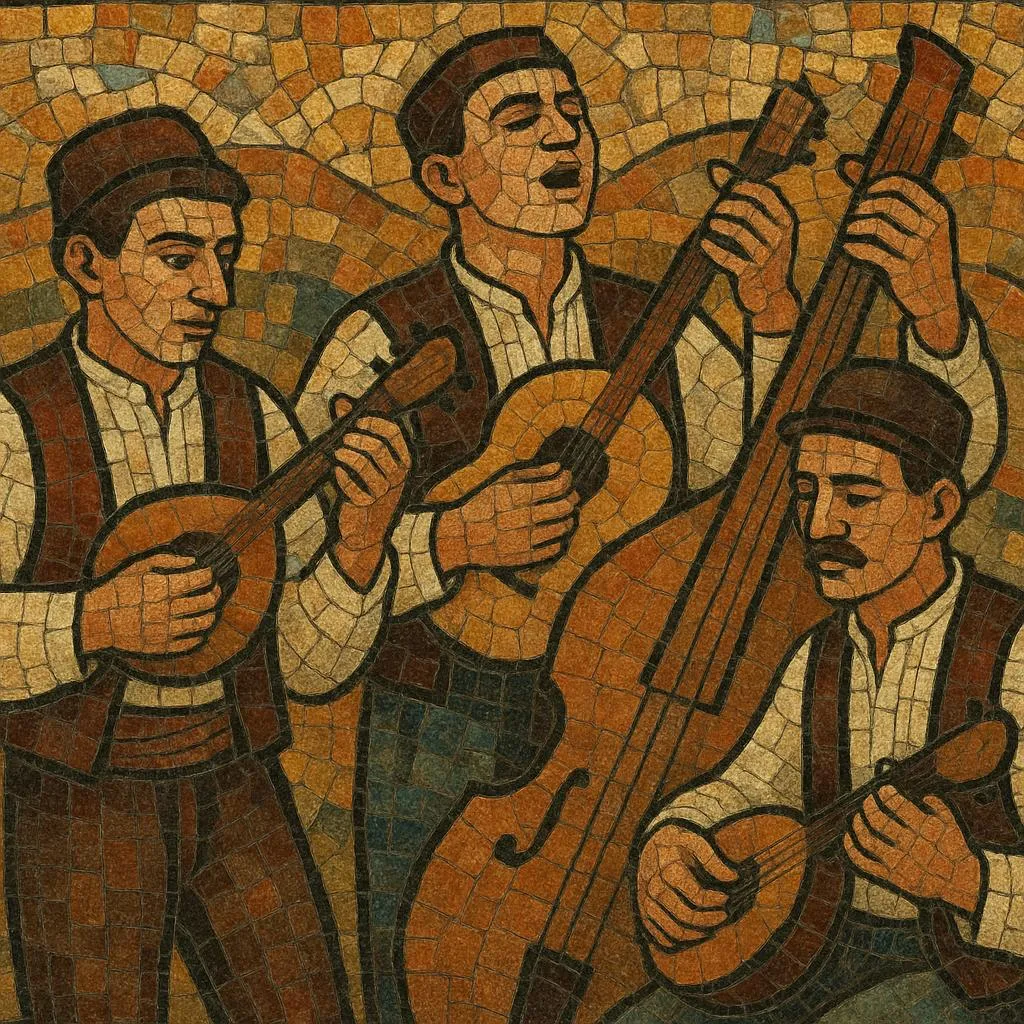
Tamburitza (tamburica) is a South Slavic/Pannonian string-ensemble folk tradition centered on the long‑necked, fretted tambura family of instruments. It is most strongly associated with Slavonia (eastern Croatia), Vojvodina (northern Serbia), and the Hungarian regions of Baranya and Bačka, where Croat (Šokci), Bunjevac, Serb, and Hungarian communities have cultivated it for village dances, weddings, harvest feasts, and urban salon music.
Typical ensembles combine high‑pitched lead tamburas (prim/bugarija/kontra, brač) with mid‑range “čelo” parts and a plucked bass (berda/bajs). The style blends bright, plectrum‑driven melody, nimble counter‑melody, chordal off‑beats, and a walking or two‑beat bass, supporting communal singing (bećarac couplets, love songs) and regional kolos. While primarily in duple and triple meters, local kolos and csárdás‑like pieces shape tempo and phrasing. The repertoire ranges from rustic dance tunes to urbanized arrangements with close vocal harmonies.
History
The tambura family descends from Middle Eastern tanbur lineages that spread into the Balkans during Ottoman times. By the early–mid 19th century, the instrument was indigenized in the Pannonian plain. In Slavonia (Osijek and surroundings), local makers standardized sizes (prim, brač, čelo, berda) and plectrum technique. Community dance music, bećarac verse‑singing, and civic music circles created the social settings in which tamburitza flourished.
From the 1840s onward, organized tamburitza societies and orchestras appeared in Slavonia and later across Vojvodina and Hungarian Baranya/Bačka, aligning the music with national and regional cultural life. Urban arrangers expanded two‑ or three‑part village textures into orchestrated parts (lead, counter‑melody, harmonic rhythm, bass), while maintaining the dance functions (kolo, csárdás‑influenced pieces) and strophic song forms.
In the interwar and socialist periods, radio ensembles and gramophone records spread tamburitza across Yugoslavia and the Carpathian Basin. Professional and semi‑professional groups refined tight sectional writing and close‑harmony singing. Large post‑war migrations created a vibrant North American tamburitza scene (e.g., Pittsburgh, Cleveland, Chicago), where Croatian and Serbian diaspora ensembles preserved and modernized the tradition, influencing repertoire, instrument construction, and stage presentation.
Today, tamburitza thrives at festivals and on media in Croatia, Serbia (Vojvodina), and Hungary, and within diasporic communities. Ensembles range from strictly traditional to crossover, blending tambura with pop‑folk (“novokomponovana”) idioms or singer‑songwriter aesthetics. Instrument building continues to evolve (stable intonation, projection), while pedagogy in cultural societies and music schools ensures intergenerational continuity.


