Your digging level
Description
Tahitian traditional music is the indigenous musical heritage of Tahiti and the Society Islands, centered on vigorous drum ensembles, choral "himene" singing, nose flutes, and dance-led performance. Its best-known stage expressions are ʻori Tahiti (the dance tradition) with the fast, percussive ʻoteʻa and the expressive, hand-gestured aparima, both of which are organized around interlocking drum patterns and chant-like melodic formulas.
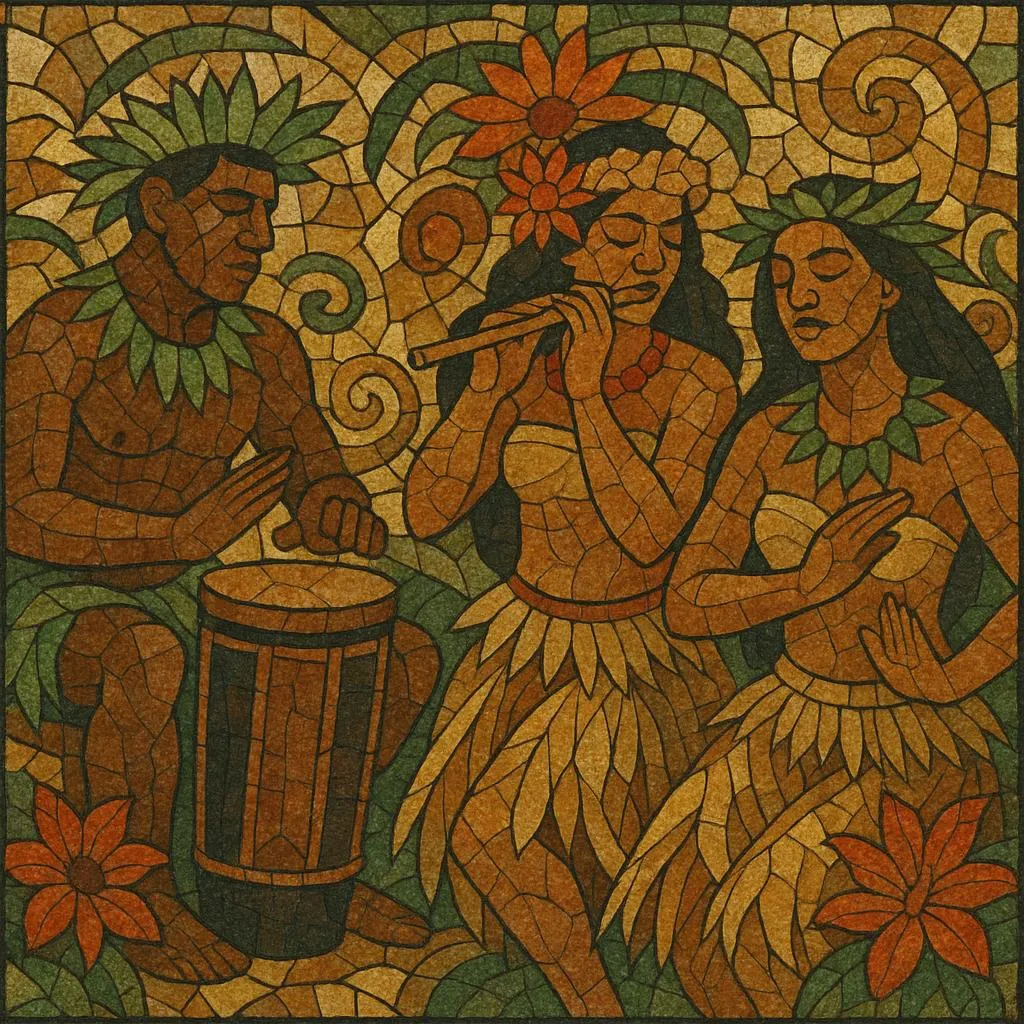
Before European contact, music accompanied ritual, oratory, and social gatherings using log drums (toʻere), skin drums (pahu and faʻatete), conch shell (pu), and the end-blown nose flute (vivo). In the 19th century, Christian missions introduced hymnody, which Tahitians transformed into polyphonic, heterophonic choral styles (himene tarava) that coexist with precontact drumming and dance. Modern performances often add ukulele and guitar, but the heartbeat remains the layered rhythms, call-and-response singing, and the inseparable bond with dance and costume.
History
Tahitian traditional music grew from the ceremonial and social life of the Society Islands. Music and dance were tightly woven with oral poetry, chiefly lineages, and community rites. Core instruments—especially the slit-log drum (toʻere), the large pahu, the higher-pitched faʻatete, and the conch shell—anchored dances like the fast ʻoteʻa and the mimetic aparima. Melodies tended to be narrow-ranged and chant-like, following the accent and prosody of the Tahitian language, while rhythm carried the dramatic engine of performance.
European contact in the late 18th century brought cultural disruption and missionary pressure, which at times suppressed older practices such as certain dances and gatherings. Yet Tahitians also reshaped the imported hymn tradition into their own aesthetic, developing powerful multi-part communal singing known as himene (notably himene tarava), characterized by robust bass drones, overlapping inner parts, and soaring upper voices—all rendered in Reo Tahiti.
In the 20th century, public festivals (the Tiurai, renamed Heiva i Tahiti) became focal points for the revival and codification of styles. Troupes standardized drum sections, choreography, and costuming (e.g., ʻmore skirts, flower and fiber adornments), while choirs preserved and innovated within himene forms. Recordings and radio later expanded the reach of Tahitian sound while maintaining community-based transmission through families, churches, and dance schools.
Today, Tahitian traditional music thrives both at home—where competitions, village choirs, and school programs sustain it—and abroad, through touring troupes and workshops. Ensembles often blend older instruments with ukulele and guitar, yet retain the signature drum architecture, language, and dance-driven structures. The genre has influenced global "world music" stages and Polynesian performance circuits while continuing to serve as a living emblem of Tahitian identity.