Your digging level
Description
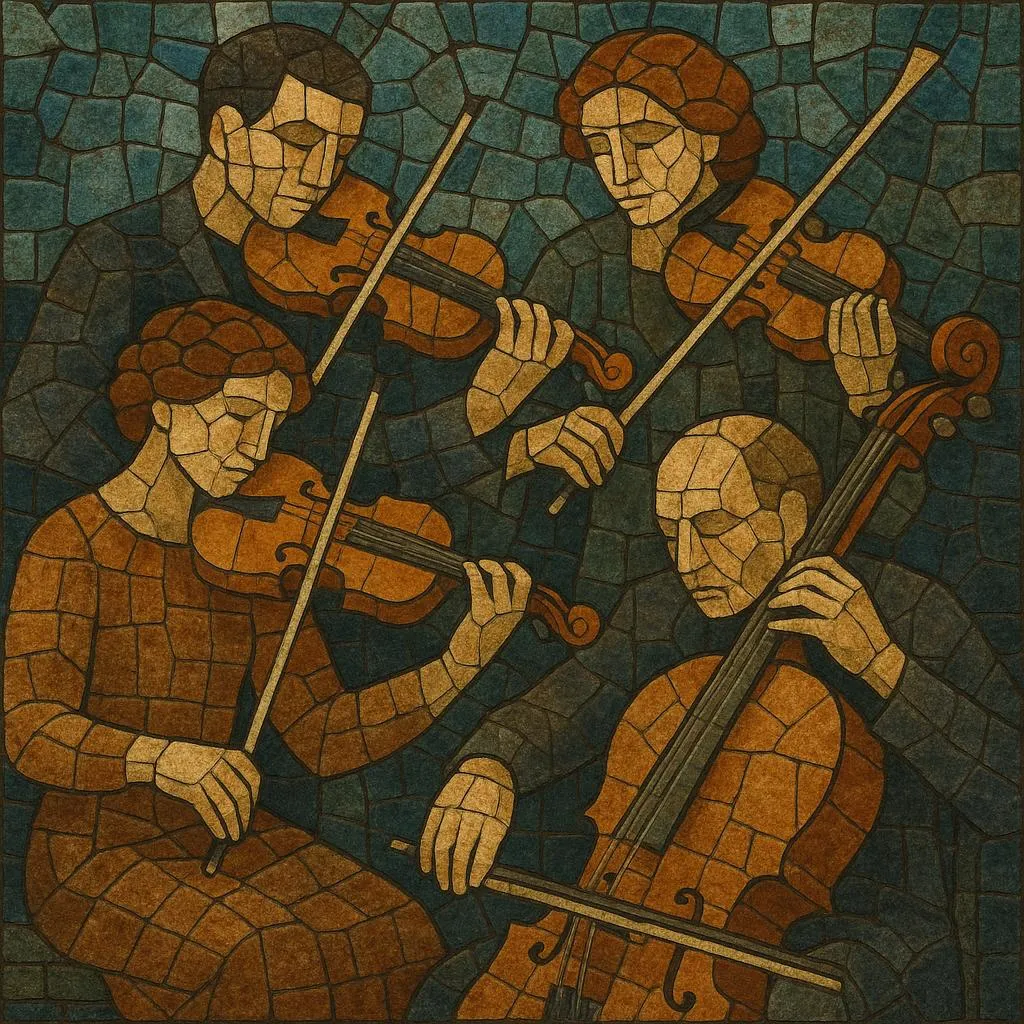
Streichquartett (string quartet) denotes both an ensemble of two violins, viola, and cello, and the repertory written for that combination. It is the central genre of chamber music in the Western classical tradition.
The idiom is defined by a conversational texture among four independent yet interlocking voices. Classical-era works typically unfold in clear forms (especially sonata form), elegant phrase structures, and transparent counterpoint. Across the 19th and 20th centuries the quartet became a crucible for harmonic innovation, structural experimentation, and extended string techniques, while retaining its intimate scale and emphasis on musical dialogue.
Because every part is exposed, the medium prizes balance, clarity, and economy of material: a few motives can generate entire movements through imitation, variation, and development.
History
The string quartet coalesced in the Habsburg lands during the 1760s as composers transformed social outdoor genres (divertimento, cassation, serenade) into serious indoor chamber music. Joseph Haydn synthesized the galant style, Baroque contrapuntal habits, and sonata principles to create balanced four-voice textures with individual personality in each part.
Wolfgang Amadeus Mozart deepened the idiom’s lyrical and contrapuntal finesse, while Ludwig van Beethoven expanded formal scale, motivic integration, and expressive range—from the Op. 18 quartets through the radical late quartets that introduced fugues, cyclic links, and extreme contrasts. The genre became the prestige laboratory of the Classical style.
Composers such as Franz Schubert, Felix Mendelssohn, Robert Schumann, Johannes Brahms, Bedřich Smetana, and Antonín Dvořák invested the quartet with heightened lyricism, harmonic richness, and national color, yet preserved its chamber intimacy. Formal norms (fast–slow–minuet/scherzo–finale) remained a reference point, even as cyclic design and thematic transformation gained ground.
Claude Debussy and Maurice Ravel introduced modal color and timbral nuance; Béla Bartók integrated folk modalities, polymeter, and percussive string writing; Dmitri Shostakovich forged a confessional, multi-movement diary across fifteen quartets. New techniques—sul ponticello, harmonics, col legno, micro-metric canons—expanded the palette while the quartet stayed a vehicle for concentrated, abstract thought.
Minimalism, spectralism, and postmodern currents brought new textures, tuning concerns, and cross-genre collaborations. Ensembles like Kronos and Arditti catalyzed an explosion of commissions, electronics-augmented works, and global idioms, ensuring the quartet remains a living, innovative medium.
Write for two violins, viola, and cello. Distribute musical importance among all four parts: let motives migrate, allow inner voices to sing, and give the cello melodic turns (not only bass). Keep registral spacing idiomatic (avoid chronically high viola writing; give the cello room to resonate).
A classic four-movement plan works well: 1) fast sonata-allegro; 2) slow lyrical movement (ternary, variations, or through-composed); 3) minuet or scherzo with trio (often rhythmic or rustic); 4) lively finale (sonata, rondo, or fugal). Unify the work with a small motive that recurs and transforms across movements.
Exploit conversational counterpoint and invertible textures. Use imitation and canons in short spans to keep clarity. Alternate homophonic blocks (for impact) with transparent polyphony. Cadences should be well signposted but can be softened by suspensions and inner-voice motion.
For Classical style, favor diatonic clarity, functional progressions, and modulatory plans (to V/III in expositions; adventurous but logical developments). Romantic inflection invites chromatic neighbor/lower neighbors, third-relations, and intensified dominant color. Modern idioms may use modality, quartal/quintal stacks, pandiatonic clusters, or ostinati. Rhythmic vitality comes from off-beat accents, hemiolas, hocketing, and metric feints—always keeping ensemble playability in mind.
Write idiomatically: singable lines, alternation of slur and articulation, and clear bow distribution. Coloristic tools include pizzicato, con sordino, sul tasto/sul ponticello, natural/artificial harmonics, tremolo, col legno, and occasional double-stops (balanced to avoid thickness). Reserve extremes (high violin, low cello) for expressive peaks.
Mark dynamics precisely and shape phrases with hairpins. Cue critical entries across parts; ensure rests align to aid counting. Keep divisi rare (it is a one-player-per-part medium). Test passages at slow tempo to confirm independence and balance.
Consider electronics (fixed media or live processing), microtonal inflections, or extended techniques, but introduce them with clear context. Cross-cultural materials work best when integrated motivically and rhythmically rather than quoted wholesale.