Your digging level

For this genre
0/8
🏆
Sign in, then listen to this genre to level up

Description

Sámi music is the musical expression of the Indigenous Sámi people of Sápmi (northern Norway, Sweden, Finland, and Russia’s Kola Peninsula). At its heart is the joik (North Sámi: luohti; South Sámi: vuelie; Skolt Sámi: leu’dd; Inari Sámi: livđe) — a vocally driven tradition in which a person, place, animal, spirit, or moment is evoked rather than described. Joiks use short, motif-like phrases, vocables, flexible meter, and modal or pentatonic pitch collections.

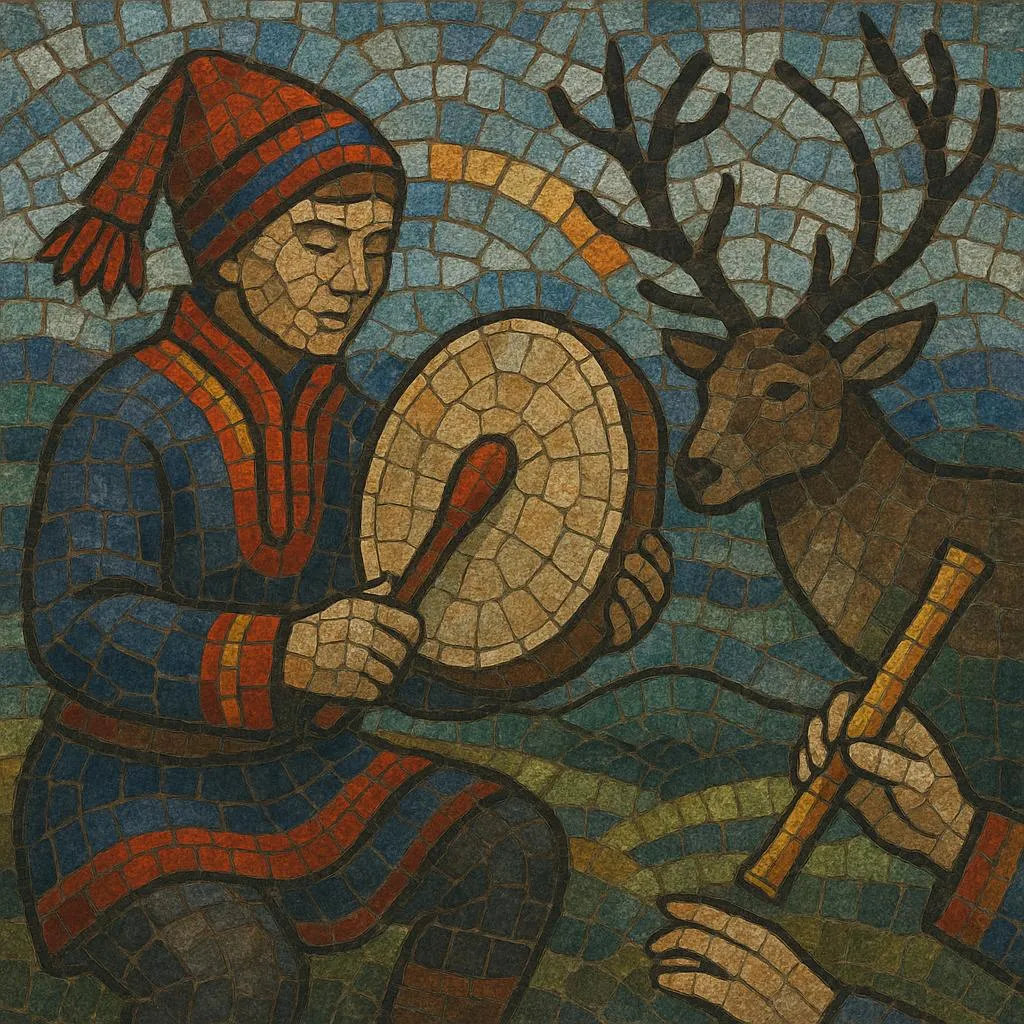
Traditional accompaniment includes the Sámi frame drum (goavddis), wooden or bone idiophones, the fadno (an angelica-stem reed flute), and, in later periods, Scandinavian fiddles and Jew’s harp. Since the late 20th century, Sámi artists have fused joik with jazz, rock, pop, ambient, and electronic production, creating a contemporary Sámi sound that travels easily between the festival stage, film/TV, and concert hall while keeping a clear line back to the ancestral voice.


Sources: Spotify, Wikipedia, Discogs, Rate Your Music, MusicBrainz, and other online sources

History

Origins and early record

The joik tradition predates written sources and is likely far older than the earliest accounts by Scandinavian clergy and travelers in the 1600s. Joik functioned as a social, spiritual, and mnemonic practice: to joik a person or landscape is to bring it present through sound.

Suppression and survival (17th–19th centuries)

Christianization (including Lutheran and Laestadian movements) targeted drums and joik as “pagan,” leading to confiscations of drums and discouragement of public practice. Despite pressure, joik persisted in family circles, reindeer-herding camps, and gatherings, with regional variants (luohti, vuelie, leu’dd, livđe) continuing in oral transmission.

Cultural awakening and revival (1960s–1990s)

Post-war Sámi political and cultural awakening, culminating in events like the Alta controversy (1979–81), catalyzed renewed pride and public performance. Pioneers such as Nils-Aslak Valkeapää (Áillohaš) and later Mari Boine brought joik to international stages, often blending it with contemporary jazz, folk, and rock idioms.

Contemporary fusion and global reach (2000s–present)

A new generation expanded the palette: electronic and ambient joik (e.g., Wimme Saari), pop and rock crossovers, and hip-hop- and R&B-adjacent projects. Composer Frode Fjellheim’s “Vuelie” framed Disney’s Frozen with a South Sámi-inspired choral opening, while artists like KEiiNO and Jon Henrik Fjällgren introduced joik-inflected hooks to mainstream TV and Eurovision audiences. Today, Sámi music thrives simultaneously as a living oral art, a site of language revitalization, and a dynamic platform for genre-spanning innovation.

How to make a track in this genre

Core vocal approach (joik)
•   Start with a short, memorable motif that “is” your subject (person, animal, place) rather than describing it. Use vocables (e.g., “loi, lai, yo”) freely. •   Keep rhythm flexible: joiks often float in free or elastic meter, but can lock into pulse when accompanied. •   Use modal or pentatonic pitch materials and narrow ambitus; emphasize repetition with subtle variation, ornamentation, glottal attacks, and timbral shifts.
Traditional instrumentation
•   Frame drum (goavddis): provide a steady, earthy beat or heartbeat-like pulse; vary dynamics and stroke area for color. •   Fadno (angelica-stem reed flute) or simple flutes: add drones, sustained tones, or echo the vocal motif. •   Add regional folk fiddle or Jew’s harp for timbral variety; keep textures sparse to foreground the voice.
Contemporary fusion
•   For folk-rock/pop settings: place the joik motif over 4/4 at 70–110 BPM, with low drums and drones (bowed strings, synth pads). Keep harmony simple (i–VII–VI or i–VI–III progressions; modal vamping on i–VII). •   For ambient/electronic: layer breathy pads, granular textures, and environmental field recordings (wind, reindeer bells). Sidechain subtly to the drum for movement without overpowering the vocal. •   In jazz contexts: treat the joik as a head; improvise sparsely around its contour. Use modal harmony (Dorian/Aeolian) and leave space for unaccompanied vocal episodes.
Language and text
•   When using Sámi languages (North, Lule, Inari, Skolt, South), prioritize authentic phonetics and prosody. If using vocables only, respect the tradition’s intent (evocation/presence) rather than narrative lyric writing.
Form and arrangement
•   Build pieces through accretion and timbral change rather than conventional verse–chorus. Let the joik recur as refrain; interleave instrumental echoes and call-and-response with drum or flute. •   Endings can be open or fade-outs, echoing the cyclical, presence-evoking nature of the form.

Top tracks

Locked
Share your favorite track to unlock other users’ top tracks
Influenced by
Challenges
Digger Battle
Let's see who can find the best track in this genre

Download our mobile app

Get the Melodigging app and start digging for new genres on the go
© 2026 Melodigging
Melodding was created as a tribute to Every Noise at Once, which inspired us to help curious minds keep digging into music's ever-evolving genres.
Buy me a coffee for Melodigging