Your digging level
Description
Salsa Puertorriqueña (Puerto Rican Salsa) is a vibrant and rhythmically complex style of salsa that developed in Puerto Rico and among the Puerto Rican diaspora in New York. While sharing the fundamental Afro-Cuban roots of son, mambo, and cha-cha-chá with other salsa styles, it distinguishes itself through the integration of indigenous Puerto Rican rhythms like Bomba and Plena.
Musically, it is characterized by a strong emphasis on the 'sonero' (lead singer) who improvises lyrics (soneos) over a call-and-response chorus (coro). The instrumentation typically features a powerful horn section, often favoring trombones or a combination of trumpets and trombones, alongside a rich percussion section of congas, bongos, and timbales. In the 1980s, the Puerto Rican style became the epicenter of 'Salsa Romántica,' a smoother, more commercially viable subgenre focused on love and heartbreak, which contrasted with the grittier 'Salsa Dura' of the 1970s.
History
The history of Salsa Puertorriqueña is deeply intertwined with the migration of Puerto Ricans to New York City and the subsequent cultural exchange between the island and the diaspora.
In the mid-20th century, Puerto Rican musicians in New York, playing alongside Cuban artists, were instrumental in the development of the 'Salsa' sound. Figures like Tito Puente and Tito Rodríguez laid the groundwork by blending Cuban rhythms with big band jazz. The founding of Fania Records in 1964, led by Johnny Pacheco and Jerry Masucci, catalyzed the movement, with Puerto Rican artists like Willie Colón and Héctor Lavoe becoming its biggest stars.
Simultaneously, orchestras in Puerto Rico were developing their own distinct sound. El Gran Combo de Puerto Rico, founded in 1962 by Rafael Ithier, became the institution of the genre, known for their disciplined rhythm and distinctly Puerto Rican cadence. La Sonora Ponceña, founded by Quique Lucca, incorporated jazz harmonies into the traditional Cuban conjunto format, creating a sophisticated 'Salsa Dura' style.
In the 1980s and 1990s, Puerto Rico became the driving force behind 'Salsa Romántica' (Romantic Salsa). This new style slowed down the tempo, polished the arrangements, and focused on romantic lyrics to appeal to a broader, younger audience. Artists like Eddie Santiago, Frankie Ruiz, and Gilberto Santa Rosa became international superstars, cementing Puerto Rico's status as a primary exporter of salsa music globally.
Composing Salsa Puertorriqueña requires a deep understanding of Afro-Caribbean polyrhythms and specific structural elements.
Rhythm and Clave
The foundation is the 'Clave' (usually Son Clave in 2-3 or 3-2 direction). All instruments must align with this pattern. The bass plays a 'tumbao' pattern that anticipates the downbeat (playing on the 'and' of 2 and the 4), while the piano plays a syncopated arpeggio pattern known as a 'montuno'.
Instrumentation
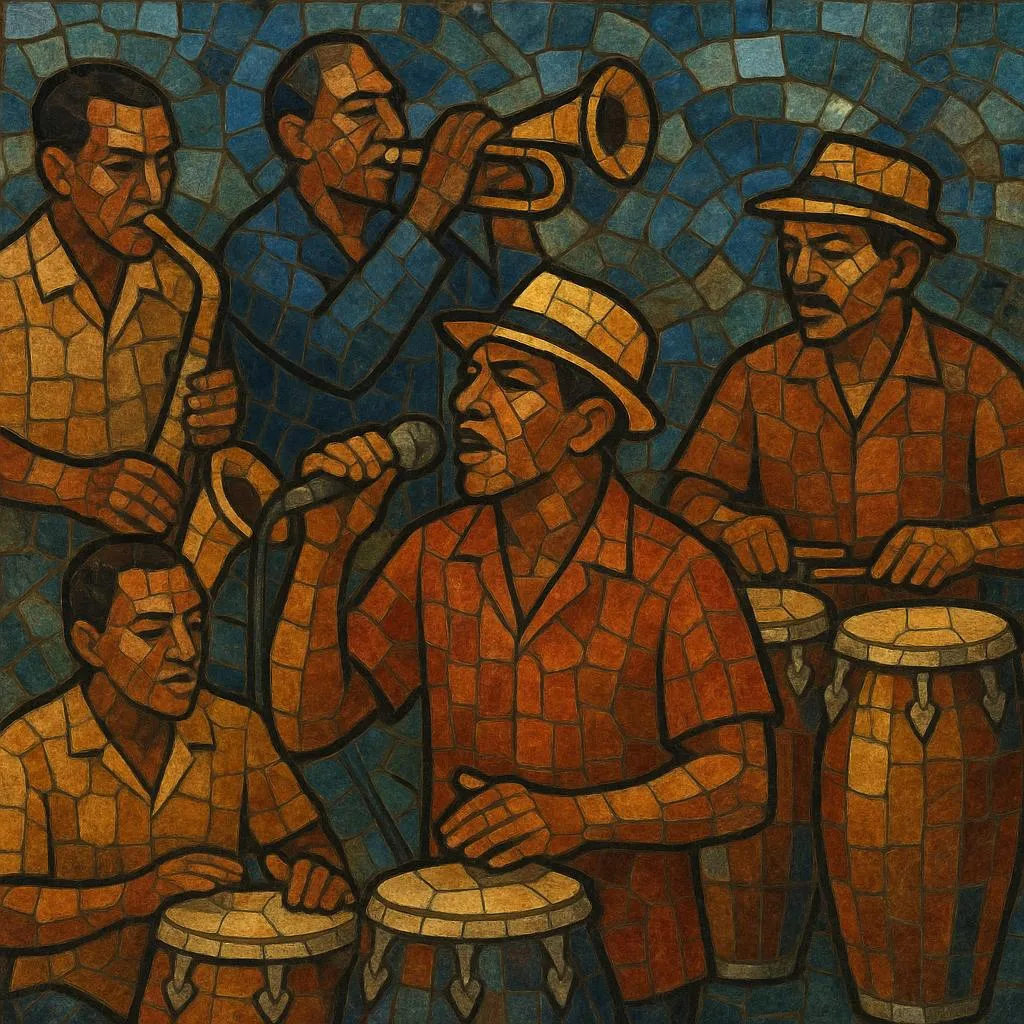
Use a standard salsa ensemble: a percussion section (congas, bongos, timbales, maracas, guiro), a harmonic section (piano, bass), and a melodic/horn section (trumpets, trombones, and sometimes saxophones). Trombones are particularly characteristic of the aggressive 'Salsa Dura' sound favored in classic Puerto Rican salsa.
Structure
Start with an Intro, followed by the Verso (verse) where the main melody is presented. Transition into the Montuno section, which is the heart of the song; here, the lead singer (sonero) improvises (soneos) in call-and-response with a fixed choral refrain (coro). Include Mambos (horn interludes) and Moñas (improvised horn lines) to build tension before the Outro.
Lyrics
For classic style, focus on narratives about daily life, social issues, or street tales. For 'Romántica' style, focus on themes of love, heartbreak, and desire, often using a softer vocal delivery.