Your digging level
Description
Pizzica is a fast, trance-inducing folk music and dance tradition from Salento in Apulia (southern Italy), considered a regional branch of the broader tarantella family.
It is closely tied to the historical ritual of tarantism, in which insistent rhythms and circular dances were believed to heal victims of the tarantula bite (or psychosomatic afflictions) through cathartic movement.
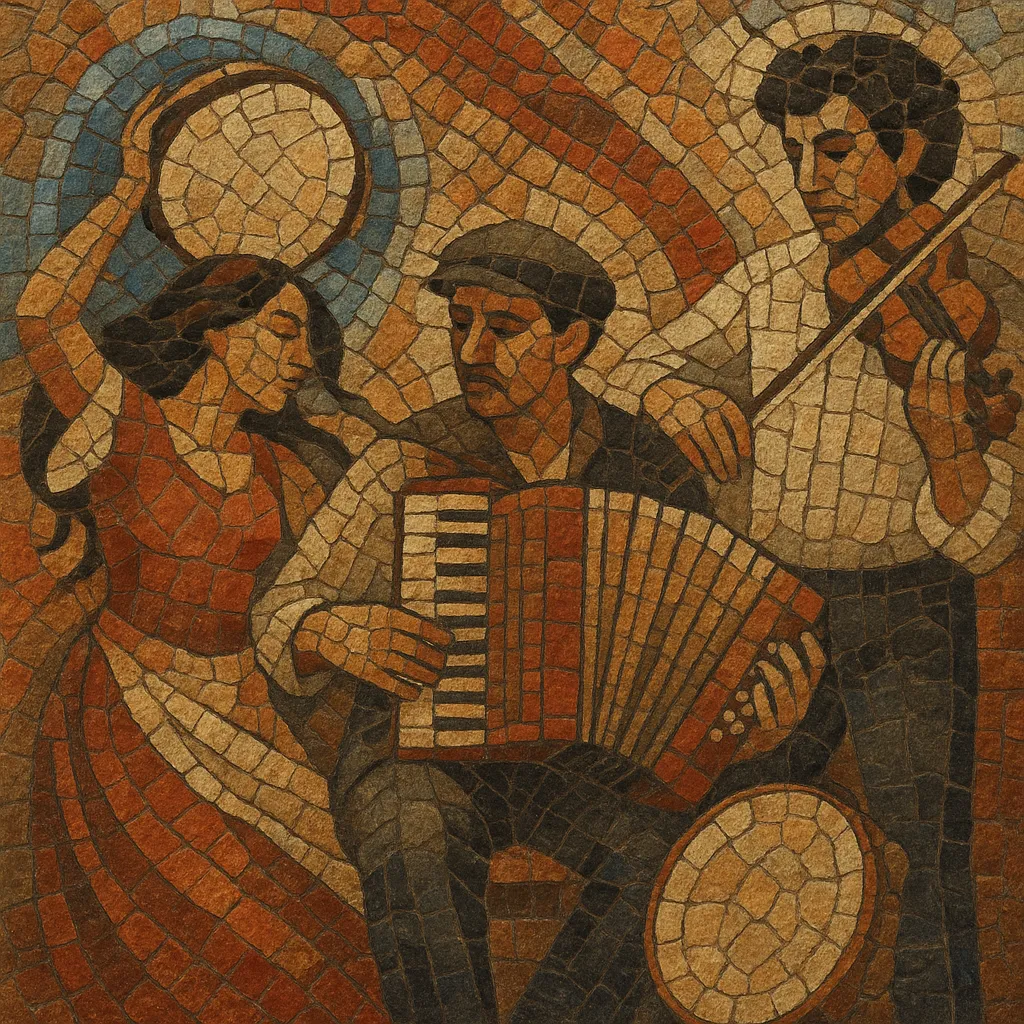
Its sound is driven by the tamburello (large frame drum), organetto (diatonic button accordion), guitar (often chitarra battente or strummed classical guitar), violin, and call-and-response vocals in the Salentino and Griko (Greek-Salentinian) dialects.
Today, pizzica thrives both as a social dance music at festivals and as a contemporary concert style, blending tradition with modern arrangements while preserving its communal, ecstatic energy.
History
Pizzica emerged in Salento as part of the tarantella family, intertwined with the local phenomenon of tarantism. Historical accounts from early modern Italy describe healing rites where musicians played rapid, cyclical patterns while the afflicted (the "tarantate") danced for hours, sometimes days, to purge the malaise. The music’s driving tamburello and minor-mode melodies supported a collective, semi-ritual performance that blended folk practice with Catholic symbolism (notably the cult of St. Paul in Galatina).
Through the 20th century, tarantism waned as a medical and social framework, yet the music and dance persisted at village feasts and family gatherings. Field recordings and early folklore studies helped document repertories, instruments, and dance figures. Local musicians maintained strophic songs and dance tunes, often in 6/8 or 12/8, with flexible tempos shaped by the needs of dancers.
In the late 20th century, ethnomusicologists and local cultural associations supported a revival. Ensembles modernized instrumentation, introduced stage arrangements, and brought pizzica to broader audiences. The founding of La Notte della Taranta festival (1998) in Salento accelerated this transformation, pairing tradition-bearers with guest music directors and cross-genre collaborators.
Pizzica is now a vibrant symbol of Salentinian identity and a pillar of the Mediterranean folk circuit. Artists fuse pizzica with rock, electronic, and global folk idioms while community dance remains central. Annual festivals and workshops keep participatory dance practices alive, and recordings emphasize both archival fidelity and creative renewal.