

Your digging level
For this genre
0/8
🏆
Sign in, then listen to this genre to level up
Description
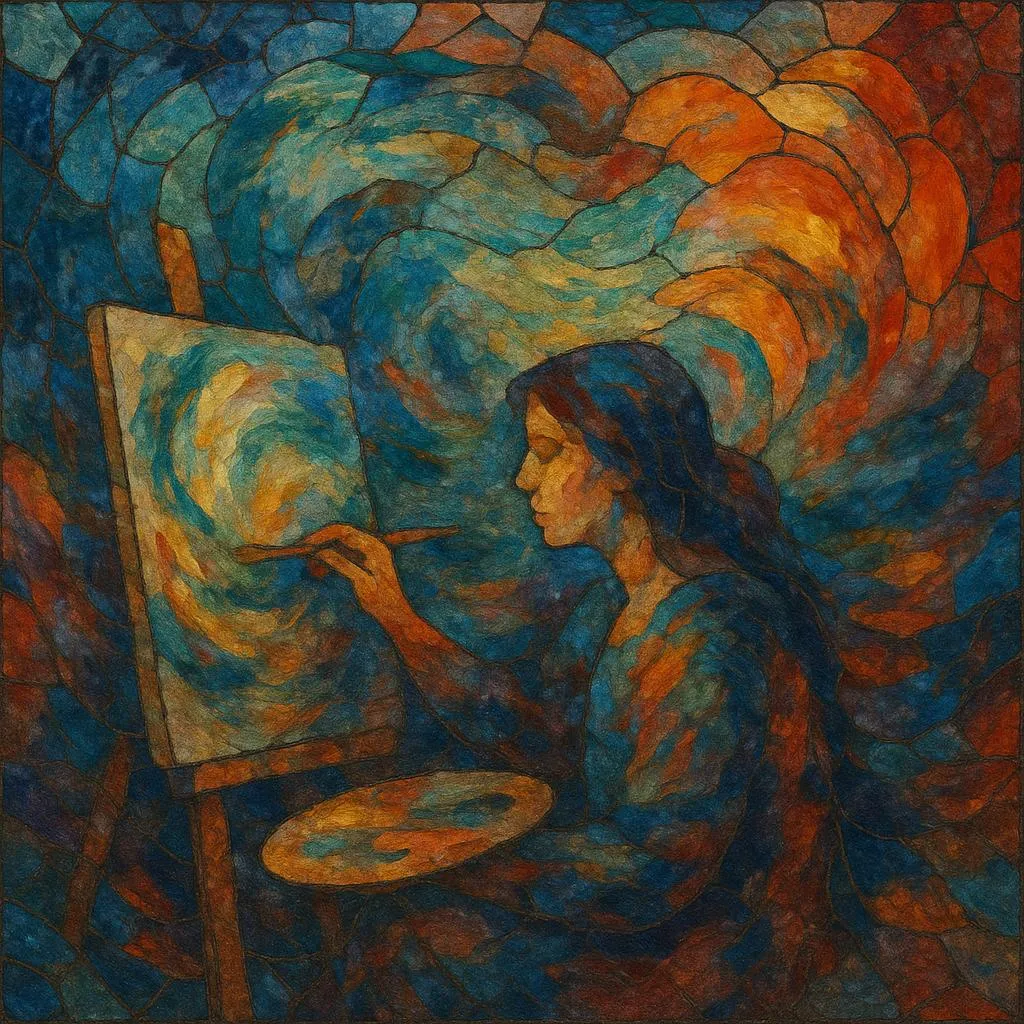
Paint-on-glass animation is a frame-by-frame animation technique in which an artist manipulates wet media (typically oil paint, gouache, or acrylics kept workable with additives) directly on panes of glass placed under a camera. Each incremental change is photographed, creating fluid, painterly motion when played back.
Because the artwork is reworked continuously on the same surface (often on multiple layers of glass for depth), the results feature dissolving shapes, smudged transitions, and rich color blending that are difficult to achieve with cels or digital tools. The method is slow and highly artisanal, but prized for its dreamlike, impressionistic look.
History
Origins (1940s–1960s)
• Early precedents for painting directly for the camera arose in avant‑garde contexts. A landmark is Oskar Fischinger’s Motion Painting No. 1 (1947), produced in the United States, in which the artist built a film out of a continuously reworked painting photographed frame by frame on glass.
• Through the 1950s–60s, European studios (notably in Poland and Eastern Europe) experimented with painterly and reworked-surface techniques that laid the groundwork for sustained paint‑on‑glass practices.
Consolidation and Recognition (1970s–1990s)
• The technique matured in the 1970s with Caroline Leaf (Canada/USA), whose films demonstrated how oil paint on glass could deliver intimate character acting and liquid transitions.
• In Poland, Witold Giersz pioneered painting-in-motion approaches, showcasing how color and gesture could be shaped directly under the camera.
• The late 1980s–1990s brought a wave of festival acclaim. Aleksandr Petrov (Russia) refined multilayer glass setups and slow-drying oils to achieve luminous depth of field and living brushwork, culminating in international awards and broader recognition of the method.
International Acclaim (1990s–2000s)
• Paint‑on‑glass became a signature of personal, auteur animation. Filmmakers in Switzerland, France, Canada, and Russia developed distinct aesthetics while sharing the core process of reworking wet paint between exposures.
• The approach influenced the look of certain commercials, title sequences, and music videos seeking organic, hand-made motion.
Contemporary Practice (2010s–present)
• While digital animation dominates, paint‑on‑glass endures as a specialist, gallery‑friendly, and festival‑favored form. Some artists hybridize workflows—shooting painted animation and grading or compositing digitally—preserving the tactile qualities while easing production.
• The technique remains a touchstone for painterly motion in contemporary animation pedagogy and a reference for digital “painterly” simulation and non‑photorealistic rendering.
Materials and Setup
• Use a horizontal glass pane (or a multiplane stack) on a rostrum or down‑shooting stand with a secured camera. Under‑ or back‑lighting helps reveal translucency and brush texture.
• Choose slow‑drying oils (often cut with linseed oil, stand oil, or clove/glycerin additives) so the paint remains workable between frames. Keep soft brushes, rubber shapers, rags, and cotton swabs for smearing and erasing.
Frame‑by‑Frame Method
• Block major shapes and color fields first; photograph a frame. Then rework edges, smear transitions, and push/pull highlights before the next exposure.
• To animate a character, think in terms of gesture and silhouette; repaint or subtly reshape each pose, allowing forms to melt into one another. For parallax or depth, use multiple glass layers and move/alter each independently.
Visual Grammar and Rhythm
• Embrace metamorphosis: the medium excels at fluid morphs, memory‑like dissolves, and impressionistic motion. Plan scenes where transformation is motivated (emotion beats, time passing, weather, states of mind).
• Use limited, harmonious palettes to keep repainting manageable and to unify tone. Reserve high‑chroma strokes and crisp accents for focal beats.
Soundtrack and Sound Design
• Score with music that supports continuous motion—ambient, minimalist, modern classical, or acoustic textures work well. Avoid overly percussive cuts that fight the medium’s fluid cadence.
• Layer soft foley and subtle atmospheres (cloth, brush, wind, distant room tone) to reinforce the tactile, intimate feel of paint moving in time.
Workflow Tips
• Shoot tests to confirm exposure and color consistency; oil films can shift under lights. Photograph in RAW if possible for grading latitude.
• Work in passes: rough motion, clarifying silhouettes, then detail and accents. Keep a printed dope sheet and onion‑skin/checkback on a monitor to control drift.
• Accept painterly artifacts—smears and lift marks—as expressive signatures rather than flaws.

Top albums
Best playlists
Top tracks
Locked
Share your favorite track to unlock other users’ top tracks
Upcoming concerts
in this genre
