Your digging level
Description
Musiqi-ye zanan (music of women) refers to the body of Iranian music led, voiced, and often composed by women across classical, folk, and popular traditions.
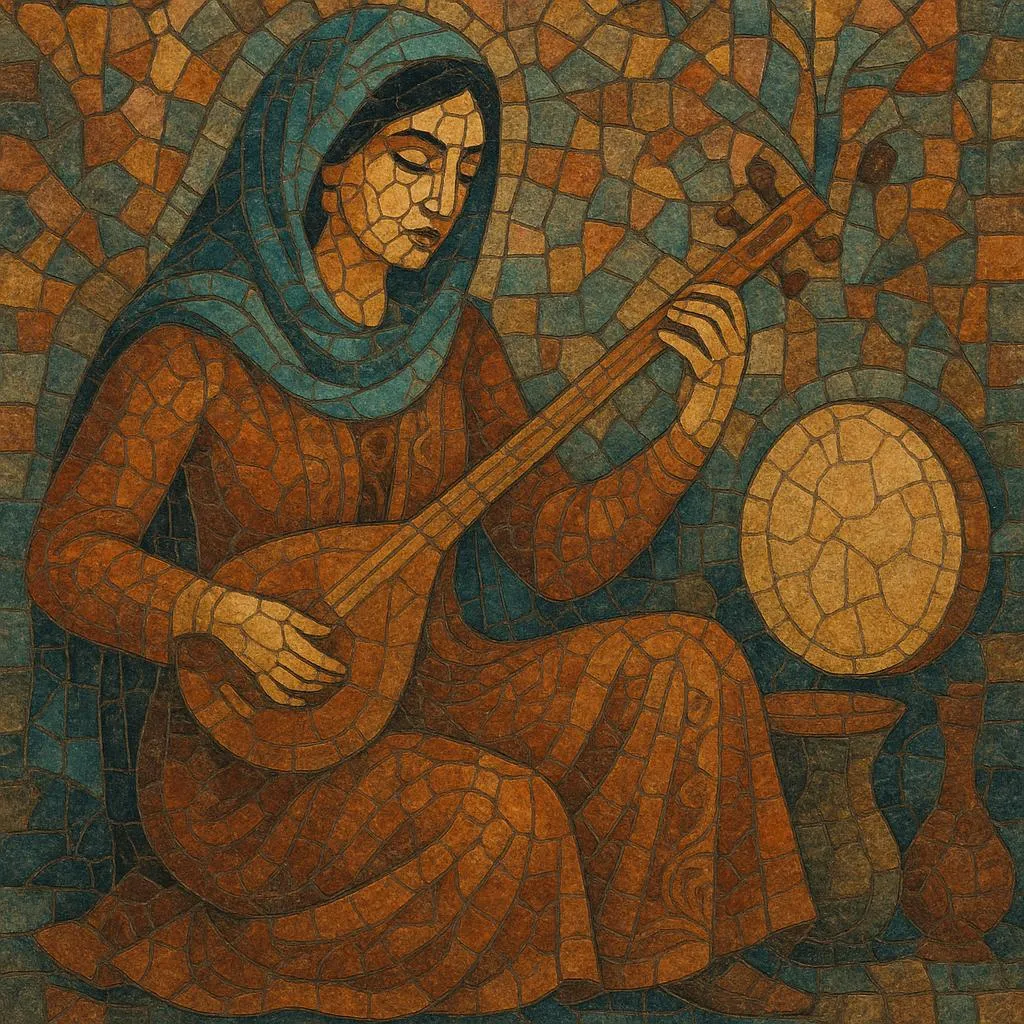
It spans unaccompanied or minimally accompanied art-song (avaz) in the Persian dastgah system, regional folk repertoires, and urban pop/ballad styles shaped by radio, cinema, and later diaspora studios. Characteristic features include highly ornamented vocal delivery (tahrir), poetic lyrics drawing on ghazal and modern verse, and a timbral palette that ranges from tar/setar/santur/ney and tombak/daf to string orchestra, piano, and contemporary band or electronic instrumentation.
As a cultural category it is also defined by its social context: pre‑1979 mainstream stardom on national media; post‑1979 restrictions on women’s solo voices in mixed-gender public settings inside Iran; and the flourishing of women-led performance and recording in the diaspora and, increasingly, in semi-private and online spheres within Iran.
History
Women’s public musical performance in Iran entered a new phase in the late Qajar and early Pahlavi eras. By the 1920s–30s, pioneering vocalists were appearing in concert halls and making early recordings, bringing women’s solo avaz and song to wider audiences as Radio Tehran (est. 1940) amplified their reach. Repertoires combined classical dastgah-based song, theater and cabaret music, and emerging urban popular styles.
The growth of state orchestras, cinema, and television fostered a star system. Women vocalists recorded orchestral ballads, tangos, waltzes, and 6/8 dance songs alongside classical and folk projects. Arrangers fused Western harmony and instrumentation with Persian modal practice, while poets and songwriters provided sophisticated lyric content. This era set many of the vocal, poetic, and production templates still associated with women’s Persian song.
Following the 1979 Revolution, women’s solo singing for mixed-gender public audiences inside Iran became heavily restricted, pushing women’s professional careers toward diaspora hubs (notably Los Angeles) and into private, women-only concerts or choral/ensemble formats at home. Diaspora studios preserved and modernized the repertoire with pop, jazz, and electronic elements; meanwhile, inside Iran, women continued to cultivate classical, folk, and experimental practices in semi-private, academic, and online spaces.
The internet enabled a new generation to record and circulate music despite institutional limits. Contemporary musiqi-ye zanan spans traditional radif-based performance, regional folk revivals, indie/alternative, electronic pop, and interdisciplinary projects. Collaborations with poets and filmmakers, as well as renewed interest in historical icons, have reinforced the genre’s continuity while encouraging new production aesthetics and global reach.