Your digging level

For this genre
0/8
🏆
Sign in, then listen to this genre to level up

Description

Musica piemonteisa refers to the traditional and vernacular music of Piedmont (Piemonte) in north‑western Italy, performed in the Piedmontese language and in the region’s Occitan and Franco‑Provençal (Arpitan) areas.

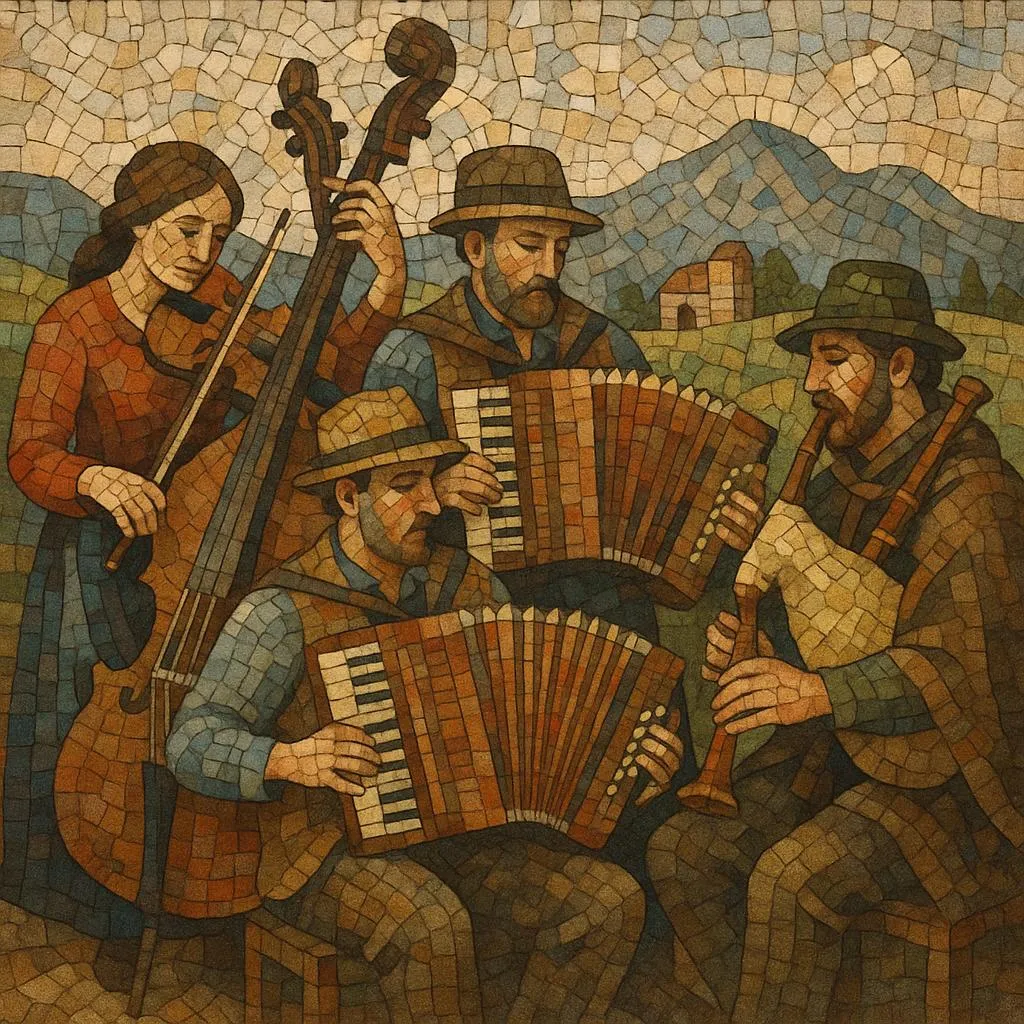
It centers on dance repertoires such as the courenta/courente, monferrina, giga, polka, mazurka, and waltz, and on strophic narrative and lyric songs transmitted orally. Typical timbres include organetto (diatonic accordion), hurdy‑gurdy, piffero/oboe-like double reeds, bagpipes, violin, guitar, and frame percussion. Themes range from rural life, love, work, and emigration to carnival satire and local history, giving the genre a strong sense of place and identity.

In the late 20th century a folk revival reanimated village repertoires on stage and record, connecting archival collection with contemporary performance. Today the style spans intimate ballad singing and energetic bal folk dance sessions, with dialect poetry and communal participation at its core.


Sources: Spotify, Wikipedia, Discogs, RYM, MB, user feedback and other online sources

History

Origins and early formation

Piedmont’s musical identity coalesced through village dance music and oral song across the 18th and 19th centuries. Courtly and pan‑European dance forms (courante/courenta, monferrina from Monferrato, waltz, polka, mazurka) mingled with older local airs and work songs. As the organetto, fiddle, hurdy‑gurdy, and small bagpipes spread through the Alps, they shaped the region’s characteristic drone‑rich, rhythmic dance sound.

Oral song and dialect

Strophic narrative ballads, serenades, and comic songs circulated in Piedmontese and in the Occitan/Franco‑Provençal valleys. Lyrics focussed on love, seasonal labor, military conscription, religious feasts, and village satire, preserving regional speech and memory. Transmission was primarily oral, with melodies adapted to local dance steps and communal chorus refrains.

Documentation and revival (20th century)

From the mid‑20th century, Italian ethnomusicologists and local researchers recorded village musicians and singers, cataloguing tune families and dialect repertoires. In the 1970s–1990s folk revival, Piedmontese ensembles brought the courenta, monferrina, and ballads to concert stages and recordings, often pairing archival sources with contemporary arrangements and multi‑part vocals. This period also strengthened ties with adjacent Alpine traditions (Occitan and Franco‑Provençal) and the wider Italian folk scene.

Contemporary practice

Today musica piemonteisa thrives in festivals, dance evenings (bal folk), and community choirs. Instrument builders and workshops support organetti, hurdy‑gurdies, and pifferi; dancers maintain regional step variants; and new writers set Piedmontese texts to traditional grooves. The style remains both a vehicle of local identity and a porous, living repertoire that welcomes subtle modern harmonies and folk‑rock textures while centering communal participation.

How to make a track in this genre

Instruments and timbre
•   Core dance ensemble: organetto (diatonic accordion in D/G or G/C), violin, guitar, and frame percussion (tambourine/hand drum). •   Coloristic voices: hurdy‑gurdy (drone + rhythmic buzz), piffero/double‑reed, small bagpipes, clarinet/recorder for melody doubling. •   Keep a bright, rustic timbre; favor drones (tonic/dominant) and heterophonic ornamenting lines.
Rhythm and form
•   Courenta/monferrina/giga: typically in compound meters (6/8 or 3/4/6/8) at lively tempos (≈ 112–132 BPM feeling in dotted beats), with clear two‑part “AABB” forms for dancing. •   Polka/mazurka/waltz: 2/4 (polka), 3/4 with lifted second beat (mazurka), 3/4 flowing (waltz). Keep phrasing square (8‑ or 16‑bar strains) for dancers. •   Use pedal drones or alternating bass (oom‑pah) in guitar/accordion; accent downbeats to support steps.
Melody and harmony
•   Modes: mainly major/minor with mixolydian and dorian shades; melodic ranges are singable and fiddle‑friendly. •   Ornamentation: appoggiaturas, mordents, quick grace notes (especially on fiddle and reeds); hurdy‑gurdy buzz‑accents to articulate rhythm. •   Harmony: simple triads (I–IV–V) with occasional II or bVII in modal tunes; cadences often end squarely on I.
Singing and text
•   Language: Piedmontese (and, in mountain areas, Occitan/Franco‑Provençal). Keep texts concrete and local—love, work, seasons, fairs, and village satire. •   Forms: strophic verses with refrains; encourage call‑and‑response or communal choruses. •   Delivery: unforced, speech‑like phrasing; allow slight rubato in ballads, but keep dance songs tightly in pulse.
Arrangement tips
•   Start with solo voice + drone (hurdy‑gurdy or organetto left hand), then add fiddle counter‑line and guitar rhythm. •   For dance sets, chain two or three related tunes (same key/relative keys) with brief turnarounds. Modulate by fifths for energy. •   Keep mixes dry and intimate; prioritize clarity of pulse and step‑feel over heavy production.
Suggested ranges and tempos
•   Dance tunes: 110–132 BPM (compound feel); polka 116–126 BPM; waltz 84–96 BPM. •   Ballads: 60–84 BPM with steady accompaniment and clear diction.

Top tracks

Locked
Share your favorite track to unlock other users’ top tracks

Upcoming concerts

in this genre
Influenced by

Download our mobile app

Get the Melodigging app and start digging for new genres on the go
© 2026 Melodigging
Melodding was created as a tribute to Every Noise at Once, which inspired us to help curious minds keep digging into music's ever-evolving genres.
Buy me a coffee for Melodigging