Your digging level
Description
Música maranhense is the umbrella term for the popular and folkloric music of Maranhão, a state in Brazil’s Northeast. It blends Afro-Brazilian drumming, Indigenous melodic inflections and narratives, and Luso-Brazilian songcraft into a colorful, festival-centered sound.
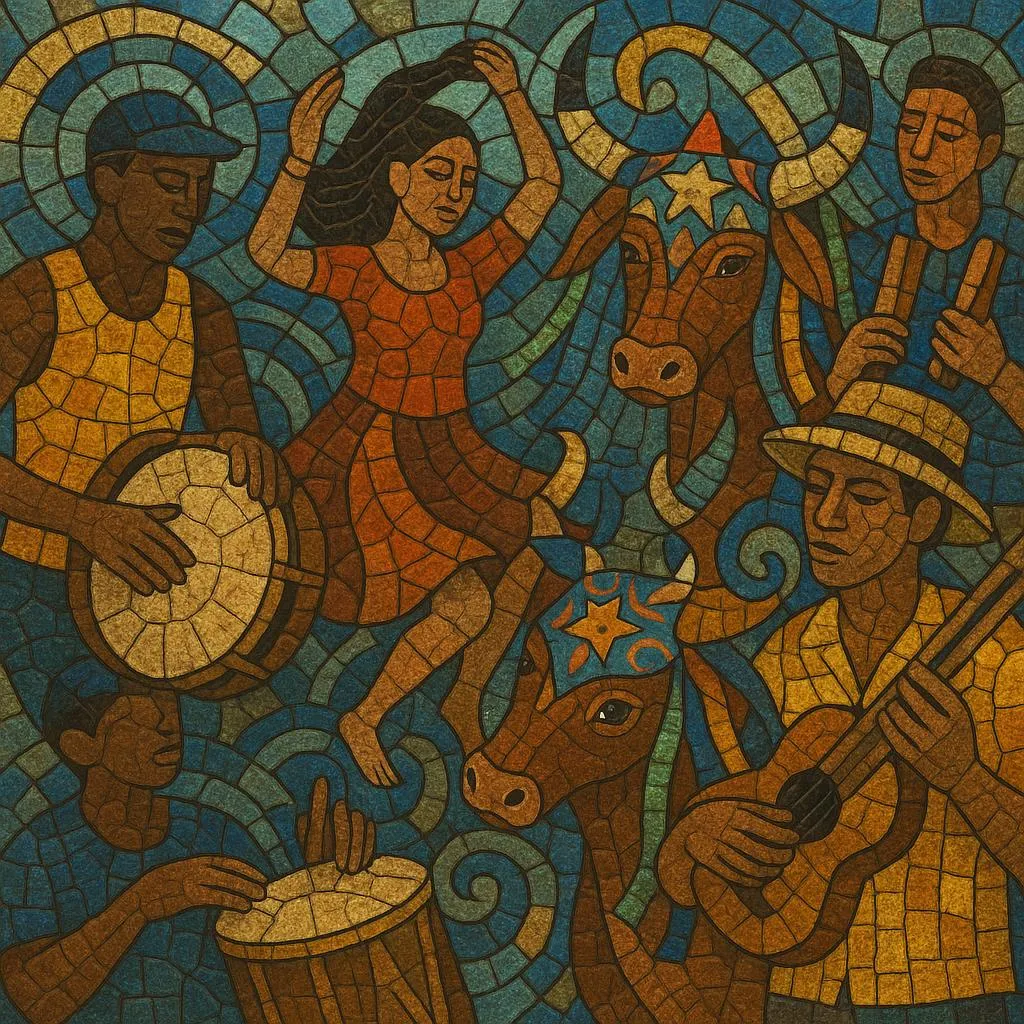
At its core are the toadas (songs) and rhythms associated with the June festivities (Festas Juninas), especially Bumba‑meu‑Boi, alongside the circular dance and call‑and‑response of Tambor de Crioula, the sensual swing of Cacuriá, and the slower, bass‑heavy pulse of Maranhão’s distinctive reggae scene. Instruments such as pandeirão (large frame drum), matracas (wooden clappers), zabumba, maracás, tambor‑onça (cuíca), rabeca (fiddle), brass, acoustic guitar, and cavaquinho are common. Harmonically, pieces often alternate between folk‑simple I–IV–V progressions and MPB‑like modal color (frequent Mixolydian b7 and borrowed chords), with choral refrains and communal responses.
The result is a repertoire that moves seamlessly from street processions and open‑air arraiais to theater stages and MPB albums, celebrating Afro‑Indigenous memory, maritime imagery, saints’ days, and regional identity.
History
Música maranhense grew from centuries of cultural exchange in Maranhão, where Afro‑descendant brotherhoods, Indigenous communities, and Luso‑Iberian settlers forged shared festive practices. By the 19th and early 20th centuries, Bumba‑meu‑Boi processions and Tambor de Crioula circles were already central to local identity, with toadas, drumming, and masked characters animating the cycle of São João celebrations.
As Brazilian popular music (MPB) began incorporating regional idioms, composers and percussionists from Maranhão brought toadas, matraca grooves, and rabeca lines to modern arrangements. This period consolidated “música maranhense” as a recognizable scene: regional poetry and Afro‑Indigenous rhythms were framed with guitars, brass, and studio production, yielding emblematic records and songbooks that traveled beyond the state.
São Luís became known as the “Brazilian Jamaica” as local sound systems (radiolas) embraced roots reggae, slowing tempos and emphasizing deep bass and romantic harmonies. This reggae maranhense sound interacted with toada songwriting and festival music, giving rise to a unique crossover where call‑and‑response choruses and local percussion met one‑drop grooves. Parallel to that, stage productions renewed Bumba‑meu‑Boi and Tambor de Crioula aesthetics for theaters and tours.
New generations continue to reinterpret traditional forms—Cacuriá, Tambor de Crioula, and the multiple “sotaques” (accents) of Boi—alongside MPB, pop, and reggae. Cultural policies, collectives, and festivals have supported documentation and transmission, while contemporary artists fold maranhense rhythms into singer‑songwriter projects, jazz inflections, and electronic textures. The scene remains rooted in community rituals yet fully engaged with Brazil’s broader musical ecosystem.