Your digging level
Description
Música Campista refers to the diverse musical traditions from Campos dos Goytacazes in Rio de Janeiro, Brazil. It is characterized by a unique blend of Afro-Brazilian rhythms, traditional Samba, and rural folk styles.
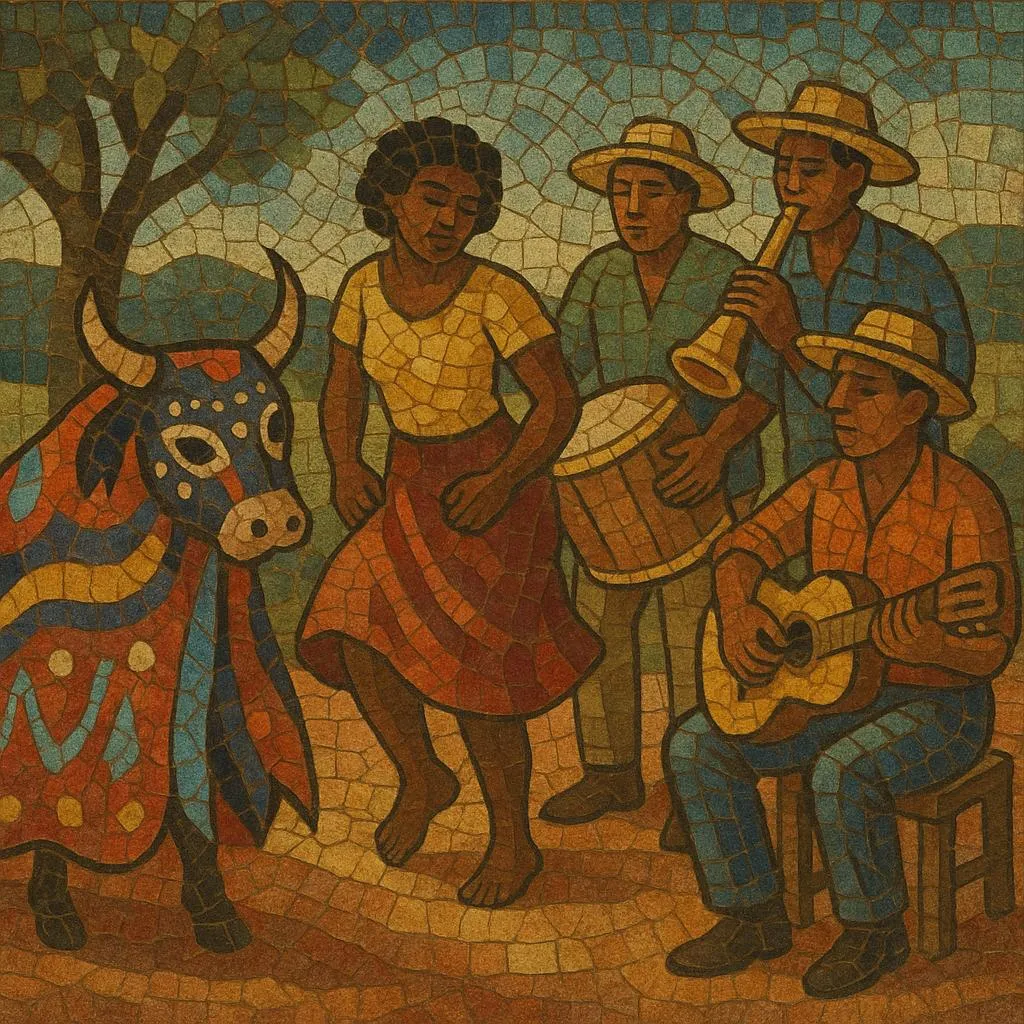
The genre is anchored by two main pillars: the 'Bois Pintadinhos' (a local carnival tradition mixing Bumba-meu-boi folklore with heavy Samba percussion) and the 'Mana-Chica do Caboio' (a rural folk dance).
It also encompasses a strong tradition of 'Lyras' (musical societies/brass bands) and a distinct style of performance popularized by local icons like Dom Américo, who blended Forró, Samba, and Marchinhas into energetic stage shows.
History
The history of Música Campista is deeply rooted in the 19th century with the formation of musical societies known as 'Lyras', such as the 'Lira de Apolo' (founded in 1870), which established a strong orchestral and brass band tradition in the city.
In the rural areas, the 'Mana-Chica do Caboio' emerged as a folk dance combining Portuguese viola, indigenous shakers, and African percussion, representing the region's cultural melting pot. Simultaneously, Campos became a cradle for Samba, producing legendary composers who would shape the national genre.
A distinct feature of the city's history is the 'Bois Pintadinhos' tradition. Unlike the Bumba-meu-boi of the Northeast, the Campista version evolved into a carnival procession driven by intense percussion (baterias) similar to Samba schools but with a distinct, faster cadence and the central figure of the 'Ox' (Boi) made of wire and fabric.
In the 20th century, the scene flourished with serestas and the rise of nationally acclaimed sambistas. The late 20th century saw the emergence of Dom Américo, a charismatic performer who synthesized the city's eclectic tastes—mixing northern Forró with Rio's Samba and Marchinhas—becoming the personification of the 'Campista' sound until his passing in 2020.
To compose in the style of Música Campista, specifically the 'Boi Pintadinho' style:
Rhythm: Use a 2/4 time signature with a heavy emphasis on percussion. The 'bateria' should feature surdos (bass drums), caixas (snare drums), and repiniques playing a driving, marching samba rhythm that is generally faster and more aggressive than the traditional Rio samba.
Instrumentation: Combine brass instruments (trumpets, trombones) typical of the 'Lyras' with a full samba percussion section. For a 'Mana-Chica' feel, incorporate acoustic guitar (viola), shakers (ganzá), and hand drums.
Lyrics: Focus on themes of local identity, folklore (the story of the ox), carnival joy, and rural life in the Norte Fluminense region. Lyrics are often call-and-response.
Harmony: Use simple major key progressions (I-IV-V) typical of Marchinhas and rural Samba, allowing the melody and rhythm to take center stage.