Your digging level
Description
Music of Occitania refers to the diverse traditional and art-music practices associated with the Occitan-speaking regions of southern France (and adjacent Occitan valleys in Italy and Spain’s Val d’Aran). It encompasses medieval troubadour song, rural dance repertoires, distinctive regional instruments (notably several bagpipe types, hurdy-gurdy, and the galoubet–tambourin pair), and contemporary revival and fusion scenes that perform in the Occitan language.
Historic strands include the 12th–13th century troubadour lyric tradition (canso, alba, planh, sirventes), later village dances such as the farandole, rondeau, and bourrée à 2/3 temps, and local polyphonic and responsorial singing. In the 20th–21st centuries, artist-collectives and folk ensembles have revitalized these repertoires, often blending them with chanson, reggae/dub, hip hop, and world-folk aesthetics, while centering Occitan identity and language.
History
The Occitan-speaking south was the cradle of the troubadours, whose courtly lyric and melodic practices (canso, alba, planh, sirventes) influenced European song-poetry. Their music interacted with liturgical currents such as Gregorian chant and with contemporaneous art styles (Ars antiqua, Ars nova, Ars subtilior—especially around Avignon). This established a prestige tradition of Occitan-language song that resonated across courts and cities.
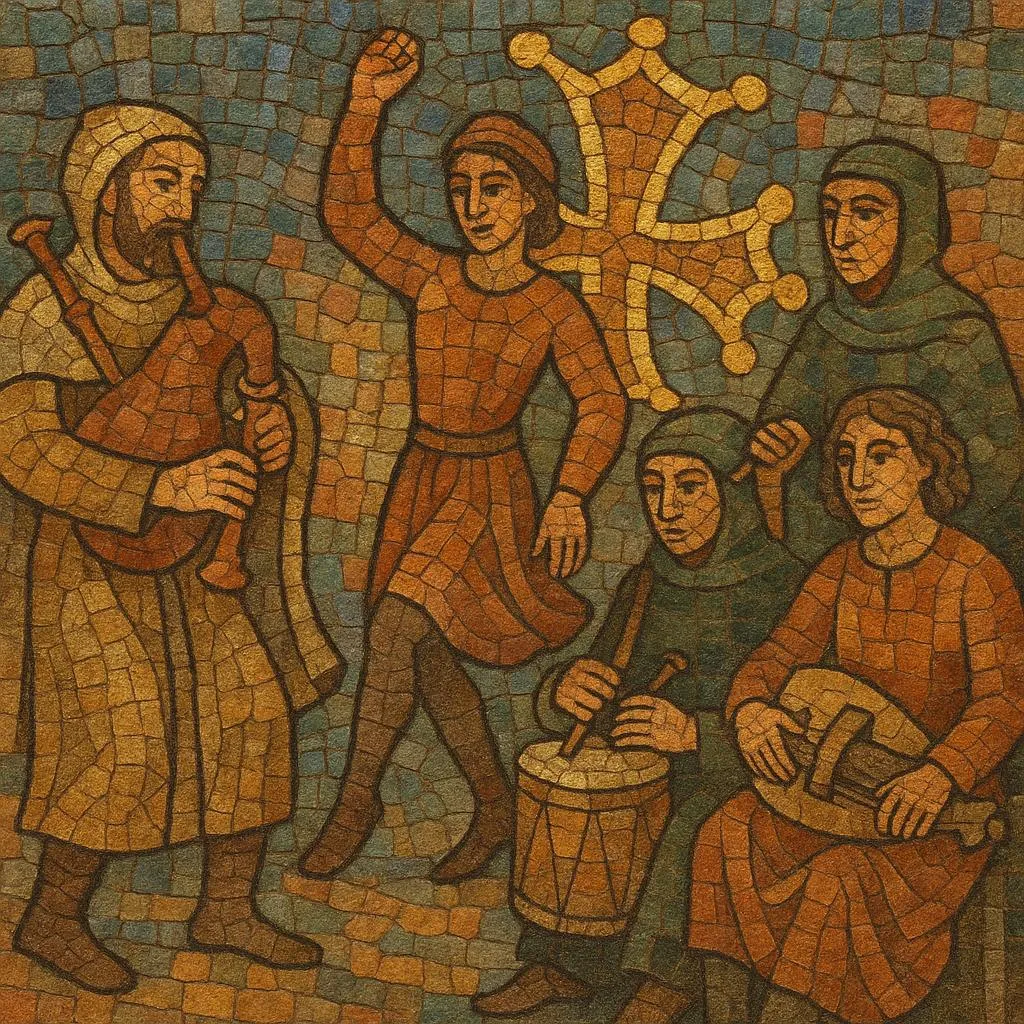
While elite courts changed, regional dance-musics flourished in towns and countryside. Chain and circle dances (farandole in Provence), the rondeau and sauts in Gascony and Béarn, and bourrées in the Occitan-speaking Massif Central were accompanied by iconic instruments: the vielle à roue (hurdy-gurdy), various bagpipes (bodega/craba in Languedoc, boha in Gascony, cabrette in Auvergne–Occitan areas), shawms (graile), oboe-like double reeds, and the Provençal galoubet–tambourin (tabor pipe and long drum). Singing styles ranged from solo narrative song to antiphonal and occasional multi-part village polyphony.
Romanticism and language activism (e.g., Félibrige) rekindled interest in Occitan culture. Post–WWII folklorists and musicians documented dance variants, tune families, and instrument craftsmanship, seeding a late-20th-century folk revival. Ensembles professionalized performance, organized bals (dance gatherings), and codified instrument making.
From the 1980s onward, groups embraced the Occitan language within contemporary forms: Marseille’s collectives fused reggae/dub and hip hop aesthetics; others modernized traditional dance sets, explored robust male polyphony, and reanimated troubadour repertories. Today the scene includes both historically grounded performance and innovative crossovers, sustaining Occitan identity across France and the Occitan diaspora.
Language and text: Write lyrics in Occitan (any regional norm such as Languedocien, Provençau, Gascon, Auvernhat, Limousin, or Niçard). Traditional themes include love, nature, pastoral life, satire, and communal memory; medieval models (canso, alba, planh) use strophic forms with consistent rhyme/meter.
•Modes and melody: Favor modal contours (Dorian, Mixolydian, Aeolian) with narrow-to-moderate ambitus and clear cadential tones. Drone-based textures suit bagpipes and hurdy-gurdy; melodic ornaments should be idiomatic but not overly chromatic.