Your digging level
Description
Music of Bengal refers to the diverse body of religious and secular song traditions from the Bengali-speaking region (today split between Bangladesh and the Indian state of West Bengal). Written and sung in the Bengali language, it encompasses folk idioms, devotional repertoires, art-song, and modern popular styles.
Across nearly a millennium, Bengali music has drawn on Hindustani classical ragas and talas while sustaining distinctive local song genres such as Baul, Bhatiali (boatmen’s songs), Bhawaiya (pastoral songs), Shyama Sangeet (Shakta devotional songs), and later modern forms like Rabindra Sangeet and Nazrul Geeti. Lyrical themes range from mysticism and devotion to nature, love, and social life, expressed through memorable melodic lines and supple rhythms.
History
Bengali song culture coalesced as the Bengali language took literary form (e.g., the Charyapada and later medieval poetry). Local folk musics intertwined with devotional currents from the Bhakti movement (Vaishnava kirtan) and Sufi practices, while professional and court musicians engaged with emerging Hindustani classical idioms.
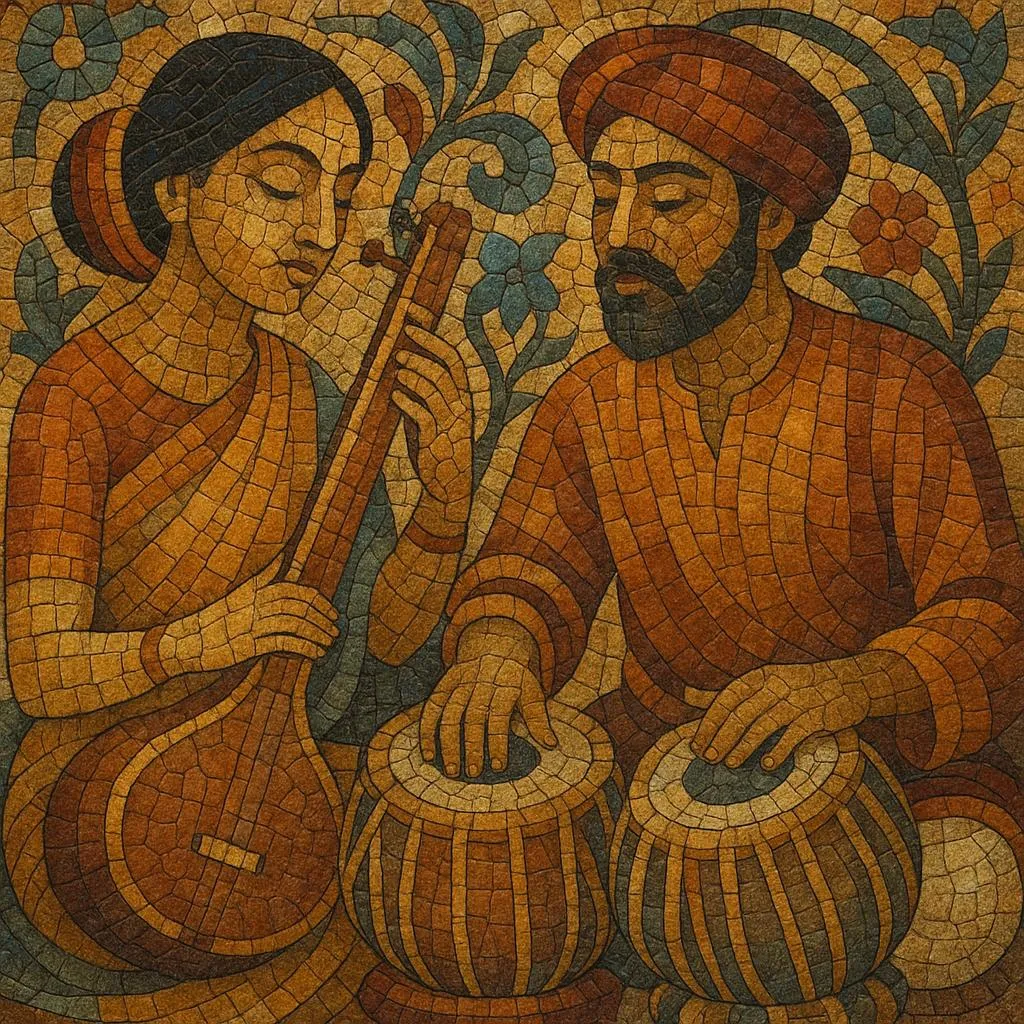
Distinct regional folk genres matured—Baul songs (mystic itinerants), Bhatiali (riverine boatmen’s songs), and Bhawaiya (pastoral songs). Shakta devotion produced Shyama Sangeet to the goddess Kali. These streams interacted with Hindustani classical forms (khyal, thumri) and instruments (esraj, sarod, sitar, flute), forming a porous ecosystem of art and folk practice.
Rabindranath Tagore systematized a vast art-song corpus—Rabindra Sangeet—blending Hindustani ragas, kirtan, Baul, and Western harmonic touches while prioritizing Bengali poetics. Kazi Nazrul Islam’s Nazrul Geeti followed with raga-based songs colored by Persian/Urdu ghazal and qawwali aesthetics. Early recording artists and radio (e.g., Pankaj Kumar Mallick) helped canonize these repertoires.
After Partition, Bengali music developed in two national contexts—East Pakistan/Bangladesh and West Bengal, India—yet remained culturally continuous. Exponents such as Abbasuddin Ahmed, Hemanta Mukherjee, Kanika Banerjee, and Suchitra Mitra popularized folk and art-songs. Urban media expanded “adhunik” (modern) Bengali songs while folk revivals kept Baul/Bhatiali vibrant.
Bengali music spans film and TV soundtracks, indie/rock scenes, and fusion projects in Kolkata and Dhaka. Conservatories and festivals sustain Rabindra Sangeet and Nazrul Geeti traditions, while researchers and grassroots musicians continue to document and perform riverine and pastoral folk genres.