Your digging level
Description
Kurpian folk music (Polish: muzyka kurpiowska) is the traditional music of the Kurpie region in north‑eastern Poland, known for its open‑throated “white voice” singing, modal melodies, and a strong ritual and seasonal function. Songs are most often performed a cappella by soloists or small women’s ensembles, with bright, non‑vibrato timbre and powerful projection.
Melodically, Kurpian tunes favor modal scales (especially Dorian, Aeolian, and Mixolydian), narrow to moderate ranges, and heterophonic textures when sung in groups. Lyrical songs are frequently in free rhythm (parlando‑rubato), while dance pieces (linked to regional mazurka and oberek variants) use asymmetrical accenting in triple meter with fluid rubato.
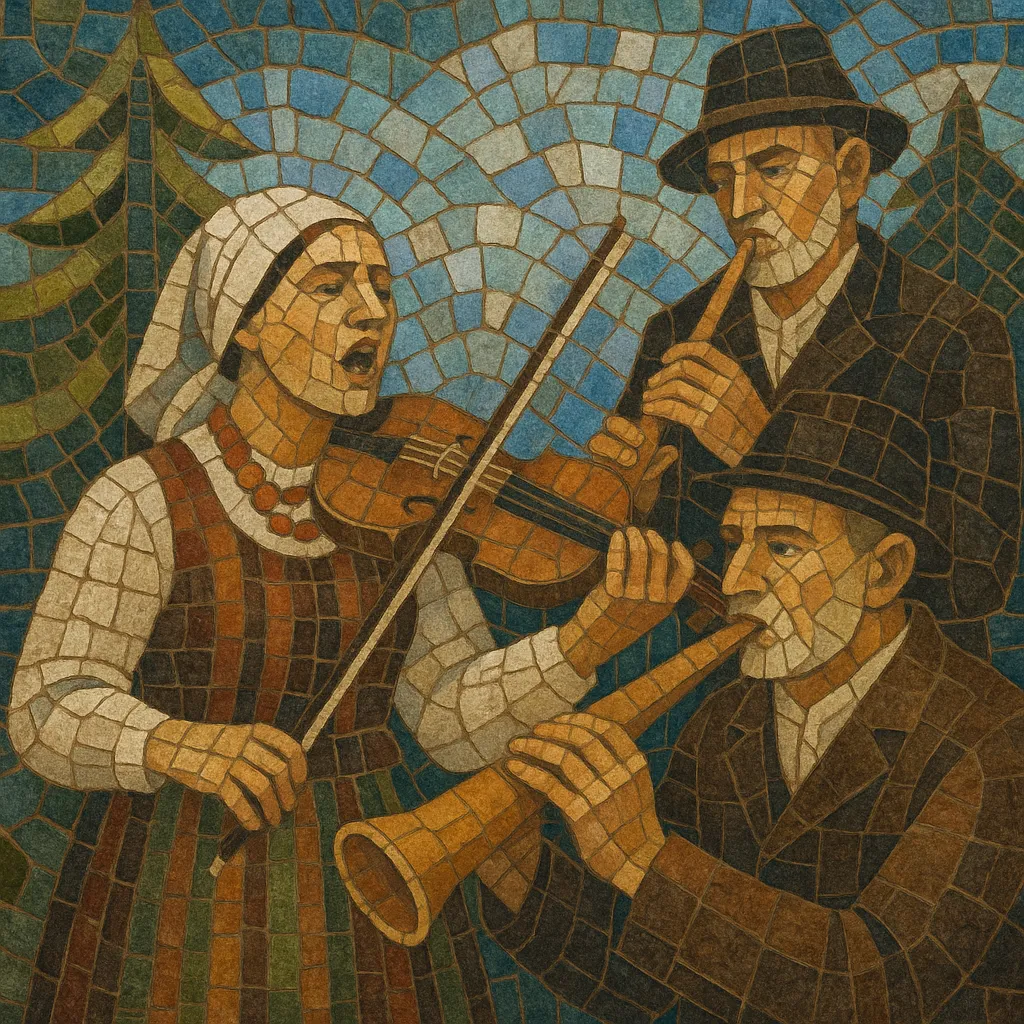
Instrumentation, when used, typically includes village fiddle bands with baraban (frame drum), basy (folk bass) or other low drones, button accordion, and the iconic seasonal wooden trumpet (ligawka) sounded during Advent. Texts draw on the Kurpie dialect and center on love, work, weddings, church year customs, and the pine‑forest landscape.
History
Kurpian folk music formed within the Kurpie (Kurpiowszczyzna) forest communities of north‑eastern Poland. Its core features—open‑throated solo and group song, modal melody, and free rhythm—emerged within an oral tradition shaped by rural work, the church year, and family rites. Seasonal signaling with the ligawka (a long wooden trumpet) is documented in local custom and reinforced the region’s distinctive soundscape.
Although the music is older, systematic documentation accelerated in the 19th century as regional identity strengthened. In the early 20th century, priest‑folklorist Władysław Skierkowski collected and published large corpora of Kurpian songs (notably in the anthology “Puszcza Kurpiowska w pieśni”), preserving texts, dialectal features, and melodies that might otherwise have been lost.
Kurpian material entered Polish art music most famously through Karol Szymanowski’s “Kurpian Songs,” Op. 58 (1930–32), a set for a cappella choir based on texts and melodies from Skierkowski’s collections. These works helped establish Kurpie as a national cultural reference and influenced choral writing through their modal harmony, open intervals, and white‑voice articulation adapted for choir.
After World War II, regional ensembles (both community groups and professional companies) presented Kurpian repertoire on stage, standardizing dance suites and costumes. Since the late 20th century, a revival driven by ethnographers and musician‑researchers has emphasized village‑style performance, white‑voice technique, and dialect texts. Contemporary folk and roots artists from Mazovia perform Kurpian songs alongside mazurkas and obereks, bringing the tradition to urban audiences.
Kurpian music remains active in ritual contexts (weddings, religious seasons) and on festival stages. Fieldwork‑based bands and vocal collectives teach white‑voice technique and transmit dialect repertory, while choirs and contemporary composers continue to reinterpret Kurpian modal language in modern settings.