Your digging level

For this genre
0/8
🏆
Sign in, then listen to this genre to level up

Description

Instrumental bluegrass is the all-instrument form of bluegrass that foregrounds virtuosic picking, tight ensemble interplay, and fiddle‑tune melody craft without lead vocals.

Built on banjo rolls, flatpicked guitar lines, mandolin tremolo and "chop" backbeats, sawing fiddles, resonator (dobro) slides, and an unshakeable 1–5 upright‑bass pulse, it prizes clarity, speed, and melodic variation. Typical repertoire includes breakdowns, rags, reels, hornpipes, and waltzes—often in AABB forms—at tempos from medium lilt to blistering.

Improvisation is central: players trade “breaks” and develop chorus‑by‑chorus variations that stay tethered to the tune’s core melody, drawing on pentatonic, Mixolydian, and blues inflections over simple I–IV–V harmony.


Sources: Spotify, Wikipedia, Discogs, RYM, MB, user feedback and other online sources

History

Origins (1940s)

Bluegrass coalesced in the 1940s around Bill Monroe’s Blue Grass Boys, whose string‑band template—mandolin, fiddle, guitar, banjo, and bass—set the standard. From the start, instrumental pieces (breakdowns, fiddle tunes, and rags) were crowd‑pleasers that showcased ensemble precision and solo virtuosity.

Mid‑century codification (1950s–1960s)

Earl Scruggs’s three‑finger banjo style revolutionized the idiom, defining the rhythmic engine of instrumental bluegrass. Fiddle standards and old‑time dance tunes were adapted into high‑octane bluegrass arrangements, while flatpicking pioneers brought lead guitar to the fore.

Expansion and crossover (1970s–1990s)

Virtuosos on mandolin, guitar, banjo, dobro, and fiddle pushed technical and harmonic boundaries. Progressive players blended jazz phrasing and modal ideas while retaining the tune‑led, chorus‑variation logic of bluegrass. Recording advances and festival culture helped canonize a shared instrumental repertoire.

Contemporary scene (2000s–present)

A new generation of pickers raised the bar for speed, accuracy, and musicality, embracing alternate tunings, crosspicking, twin‑fiddle voicings, and modern arranging. Instrumental bluegrass remains a festival staple and a proving ground for technique, while feeding into adjacent styles like new acoustic music and jamgrass.

How to make a track in this genre

Core instrumentation and roles
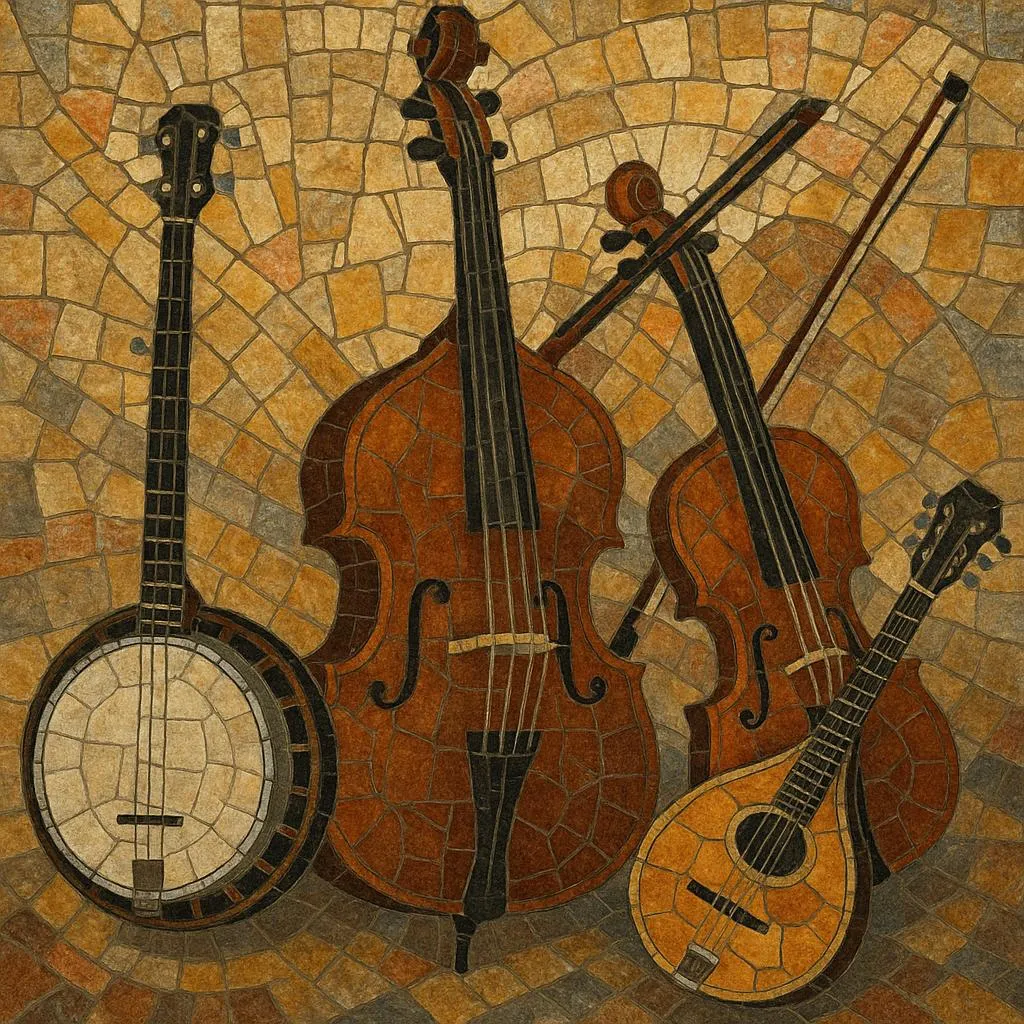
•   Banjo (3‑finger/Scruggs or single‑string/melodic): driving rolls, clear melody statements, and rolling backup. •   Guitar (steel‑string flatpicking): alternating‑bass boom‑chuck rhythm, crosspicking, and scalar/arpeggiated leads. •   Mandolin: backbeat “chop” on 2 and 4, Monroe‑style downstrokes, tremolo for sustain, and octave‑double melody lines. •   Fiddle: AABB fiddle‑tune melodies, shuffle bowing, double‑stops, drones, and harmony lines (twin fiddles for thickness). •   Dobro (resonator): slide‑voice leads and pads, bar slants for chord tones, syncopated rolls. •   Upright bass: 1–5 two‑feel (root–fifth), occasional walking in turnarounds.
Forms, keys, and harmony
•   Common forms: AABB (32 bars), AB, and chorus‑based breakdowns; arrange with kickoff, breaks for each instrument, and a tagged ending. •   Keys: G, A, D, C; frequent capos (guitar to A/D; banjo in open G with spikes); modal flavors (Mixolydian, Dorian). •   Harmony: I–IV–V bedrock; II (A major in G) as a secondary color; quick V turnarounds; use walk‑ups/downs and bass runs.
Rhythm and groove
•   Feel: 2/4 or 4/4 with strong backbeat; tempos from 100–140 BPM (mid) to 160–200+ (breakdowns). •   Ensemble time: keep chop, bass, and guitar aligned; soloist slightly forward in time for drive; avoid rushing tag endings.
Melody and improvisation
•   Start with the tune’s core melody; develop chorus‑by‑chorus variations. •   Vocabulary: pentatonic and major/minor blues notes; arpeggio targeting of chord tones; slides, hammer‑ons, pull‑offs; position shifts for timbre. •   Trade breaks: rotate lead among instruments; add harmony fills (mandolin tremolo, fiddle thirds/sixths) behind other solos.
Arrangement and sound
•   Kickoff: a 1–2 bar pickup that states the groove and key. •   Dynamics: drop to guitar/mandolin/bass for space before a final high‑energy chorus. •   Recording: single‑mic capture for blend and discipline, or spot mics for clarity; keep transients crisp and low end controlled.
Practice tips
•   Metronome with subdivision; isolate tricky A/B parts; increase 5–10 BPM only when clean and relaxed. •   Learn canonical fiddletunes, then write your own AABB melody using the same contour and chord logic.

Top tracks

Locked
Share your favorite track to unlock other users’ top tracks

Upcoming concerts

in this genre
Influenced by

Download our mobile app

Get the Melodigging app and start digging for new genres on the go
© 2026 Melodigging
Melodding was created as a tribute to Every Noise at Once, which inspired us to help curious minds keep digging into music's ever-evolving genres.
Buy me a coffee for Melodigging