Your digging level

For this genre
0/8
🏆
Sign in, then listen to this genre to level up

Description

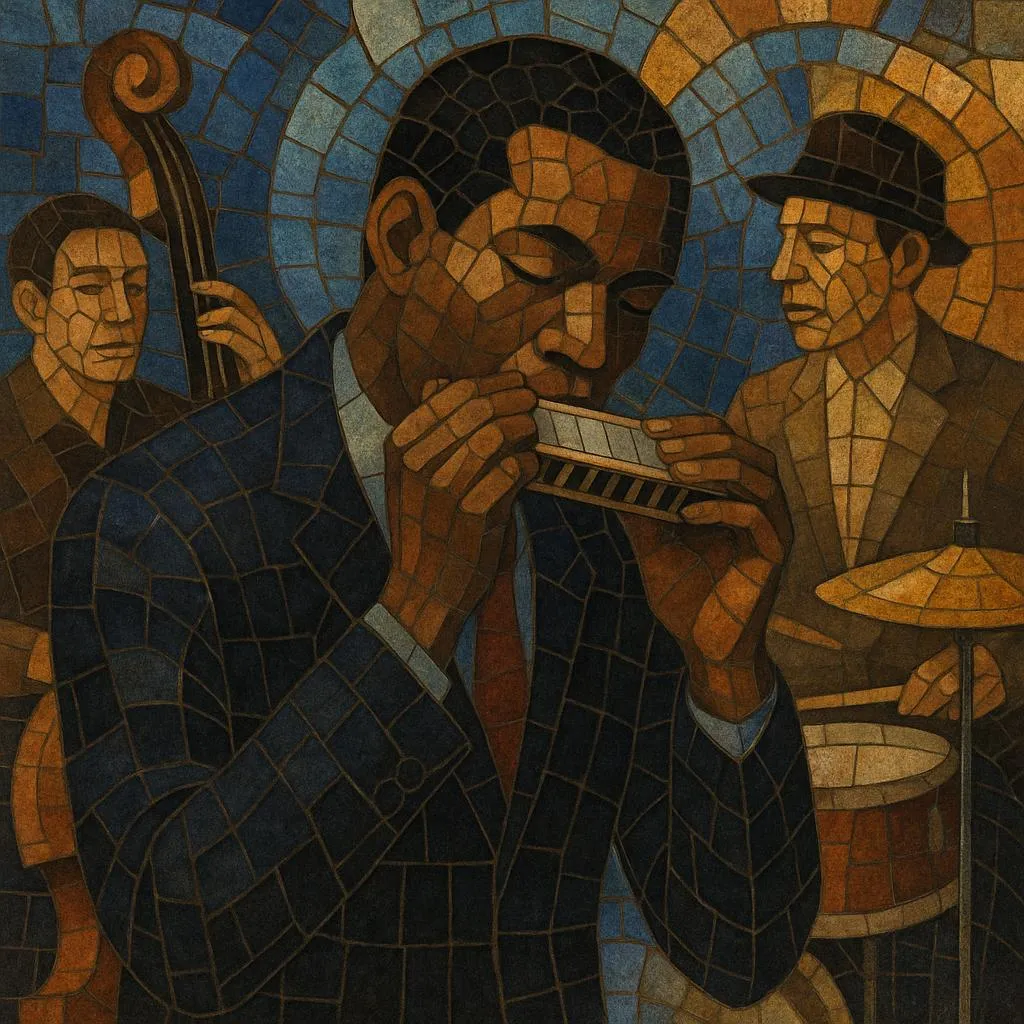
Harmonica jazz is a strand of jazz that features the harmonica (most often the chromatic harmonica) as a lead improvising instrument.

It blends the swing-era and bebop language of jazz—walking bass, drum ride patterns, ii–V–I harmony, and extended chords—with the harmonica’s vocal-like phrasing, bends, and tremolo.

The style is frequently heard in small-group settings (trio/quartet/quintet) where the harmonica takes the role normally occupied by saxophone or trumpet, delivering melodic heads and solo choruses over standard jazz forms such as 12-bar blues, rhythm changes, and 32-bar AABA songs.

Compared with blues harmonica, harmonica jazz typically uses cleaner tone, more chromatic note choice, faster harmonic navigation, and a greater emphasis on bebop articulation and enclosure-based phrasing.


Sources: Spotify, Wikipedia, Discogs, Rate Your Music, MusicBrainz, and other online sources

History

Origins (1930s–1950s)

Although harmonicas were popular in early 20th-century popular music, the chromatic harmonica became especially important for jazz once players began using it to match horn-like chromaticism.

Toots Thielemans and a small circle of innovators demonstrated that the instrument could function as a true jazz frontline voice, improvising fluently through standard harmony and bebop tempos.

Growth and mainstream visibility (1960s–1980s)

Harmonica jazz gained broader recognition through recordings and film/TV sessions where the harmonica’s intimate timbre fit ballads and bossa nova as well as swinging standards.

During this period, the harmonica also appeared in modern jazz contexts and studio jazz orchestras, solidifying the instrument’s reputation as more than a novelty.

Modern era (1990s–present)

Contemporary players expanded the vocabulary into post-bop, European jazz, and crossover contexts while keeping the core practice of jazz standards, advanced harmony, and improvisation.

Technical developments (improved chromatic instruments, better amplification, and refined overblow/valve techniques for some players) helped modern harmonica jazz cover demanding keys and faster harmonic movement more reliably.

How to make a track in this genre

Instrumentation
•   Use chromatic harmonica as the lead voice, functioning like a saxophone/trumpet. •   Typical ensembles: trio (harmonica + piano/guitar + bass + drums) or quartet/quintet with comping harmony. •   Amplification should be clean and dynamic; avoid heavy distortion typical of blues harmonica.
Repertoire and forms
•   Start from jazz standards: 12-bar blues, rhythm changes, and 32-bar AABA or ABAC forms. •   Choose keys comfortable for the harmonica and ensemble, then transpose as needed to suit phrasing and range.
Harmony and harmonic rhythm
•   Write progressions using functional jazz harmony: ii–V–I movement, secondary dominants, tritone substitutions, and turnarounds. •   Use extended chord colors (9ths, 11ths, 13ths) and occasional altered dominants (b9/#9/b5/#5). •   Keep harmonic rhythm flexible: slower changes for lyrical ballads and faster changes for bebop heads.
Melody and improvisation language
•   Compose heads with clear, singable contours that exploit the harmonica’s legato and breath-like phrasing. •   For solos, use bebop vocabulary: enclosure patterns, approach tones, guide-tone lines (3rds/7ths), and arpeggios through changes. •   Mix articulate tongued passages with smooth legato runs; use subtle vibrato and occasional bends for expression without leaving the jazz idiom.
Rhythm and feel
•   Common feels: swing (medium/up), ballad, and bossa/Latin-jazz. •   Drums should emphasize ride-cymbal swing patterns and comping; bass typically walks in swing and plays tumbao patterns in Latin feels.
Arranging tips
•   Give the harmonica space in the midrange by thinning piano voicings (rootless voicings, upper-structure triads) and keeping guitar comping light. •   Use call-and-response between harmonica and rhythm section figures to mimic horn-section phrasing in a small-group setting.
Lyrics
•   Harmonica jazz is primarily instrumental. If vocals are included, treat the harmonica as a second frontline voice that trades phrases or takes obbligato lines.

Top tracks

Locked
Share your favorite track to unlock other users’ top tracks
Influenced by
Has influenced
Challenges
Digger Battle
Let's see who can find the best track in this genre
© 2026 Melodigging
Melodding was created as a tribute to Every Noise at Once, which inspired us to help curious minds keep digging into music's ever-evolving genres.
Buy me a coffee for Melodigging