

Your digging level
Description
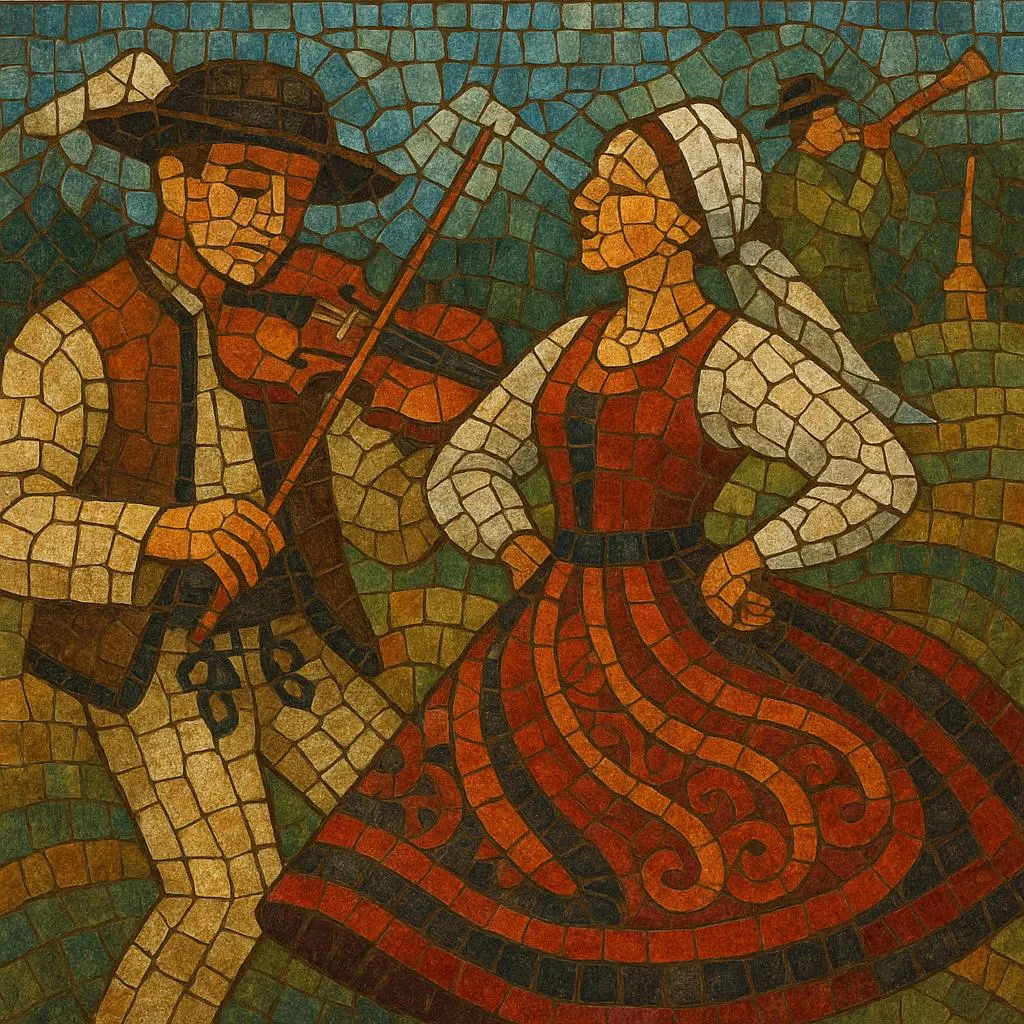
Góralski is the signature couple‑dance music of the Polish Highlanders (Górale) from the Podhale region at the foot of the Tatra Mountains. One man leads a single dance “suite” for his chosen partner: he first intones a short tune (nuta) in a high, tense voice; the string band immediately picks it up and drives a sequence of contrasting sections. The partners dance around one another and touch only at the climactic turning figure (zwyrtanie). The underlying meter is duple (2/4), but the opening can be freer, moving from rubato into a firm pulse.
The band (kapela) centers on a lead fiddle (prym), one or more rhythm/secondary fiddles (sekundy) bowing strong double‑stops and open fifths, and a small three‑string bass (basy); pastoral colors such as Podhale bagpipes (koza), shepherd flutes (fujarka), and the long wooden horn (trombita) are traditional options. The result is a raw, penetrating, highly rhythmic sonority supporting athletic, show‑off male steps and the partner’s fast spins.
Musically, góralski cycles through named tune‑types: a slower, freely intoned ozwodna gives way to faster, accent‑heavy krzesana or tiny‑stepped drobna, among others (zielona, etc.). Melodic language often uses the “Podhalean/Wallachian” modal collection—mixing a raised fourth (Lydian color) and lowered seventh (Mixolydian color)—realized heterophonically as players vary the same tune. The nuta is conceived as a tune‑family realized anew in performance rather than a fixed melody.
History
Góralski crystallized in the Tatra highlands’ Podhale region as a solo‑couple dance suite that showcases a man’s prowess before a community audience. He selects a partner, sings a nuta to cue the band, then leads a chain of figures culminating in the spinning zwyrtanie; between sections he signals changes with steps, shouts, or gestures. This male‑display, couple‑around‑each‑other format is central to Górale social dance and remains a living practice at weddings and village festivities.
A typical suite opens with an ozwodna—often freer or rubato—before locking into 2/4 for quicker krzesana and drobna sections; other named “nuty” circulate locally. The kapela’s prym–sekundy–basy texture bows open fifths and heavy accents, producing a muscular drive for heel‑clicks, stamps, and high jumps. The melodic palette favors the Podhale/Wallachian scale (raised 4th, lowered 7th) and heterophonic variation; the nuta is a tune‑family that performers re‑create each time.
Alongside the fiddle band, pastoral instruments—Podhale bagpipes (koza), shepherd’s flutes, and trombita—reflect medieval Wallachian (Vlach) shepherd migrations across the Carpathians. Historical accounts note the bagpipe–fiddle pairing in older dance practice and detail the regionally distinctive four‑voice Podhale bagpipe.
Podhale repertories were documented by collectors and musicians in the late 19th and early 20th centuries and later analyzed by scholars such as Włodzimierz Kotoński and Timothy J. Cooley. Cooley describes how “muzyka Podhala” was canonized and how concepts like nuta (as an idea, not a fixed melody) frame performance practice.
Highlander dance‑music, including góralski, strongly inspired Karol Szymanowski’s ballet Harnasie (1920s–30s), which stylizes zbójnicki and highland sonorities for the concert stage. In recent decades, family bands and ensembles have kept góralski alive while some—e.g., Trebunie‑Tutki, Zakopower—have fused it with reggae, rock, or pop, broadening its reach while retaining core highland idioms.



