Your digging level
Description
Electroacoustic composition is a branch of art music that uses microphones, tape, analog and digital synthesis, and studio processing to create works in which timbre, texture, space, and transformation are primary musical parameters.
Emerging from the post‑war laboratory and broadcast studio, it brings together recorded real‑world sounds (musique concrète), purely electronic tones (elektronische Musik), and later computer processing. Works may be fixed‑media pieces diffused over multi‑speaker systems, or live‑electronics that transform acoustic sources in real time. Rather than traditional melody and harmony, form is often built from sound objects, spectral evolution, gesture, and spatial motion.
History
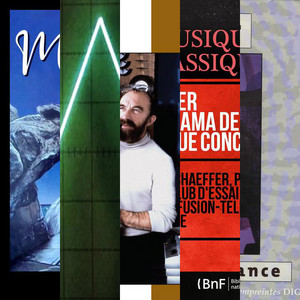
Electroacoustic composition begins in the late 1940s with Pierre Schaeffer’s musique concrète at French radio (RTF/GRM) in Paris, where recorded sounds were edited and transformed on discs and tape. In parallel, the WDR studio in Cologne fostered elektronische Musik (Werner Meyer‑Eppler, Herbert Eimert, Karlheinz Stockhausen), emphasizing electronically generated tones.
These complementary approaches—concrète’s found sound and Cologne’s pure electronics—quickly cross‑pollinated, establishing a studio‑based practice built on recording, transformation, and montage.
Studios and centers proliferated: Groupe de Recherches Musicales (GRM) in Paris, the BBC Radiophonic Workshop in London, and the Columbia‑Princeton Electronic Music Center in New York (Vladimir Ussachevsky, Otto Luening). Composers such as Iannis Xenakis bridged architecture, mathematics, and sound, while Bernard Parmegiani and Luc Ferrari expanded narrative and environmental poetics.
The 1970s saw computer music enter the field: John Chowning’s FM synthesis at CCRMA (Stanford), IRCAM’s research in spectral/FFT analysis‑resynthesis, and the growth of performance‑oriented live electronics. François Bayle’s Acousmonium advanced multi‑speaker “diffusion” as a concert practice.
Affordable samplers, DAWs, and environments like Max/MSP and later SuperCollider democratized electroacoustic techniques. Acousmatic concerts and festivals standardized fixed‑media presentation over arrays of loudspeakers, focusing on spatial projection and sound‑object morphology. Granular and spectral methods became widespread tools for timbral composition.
Today the field spans fixed‑media, mixed works, and live coding; embraces ambisonics, wave field synthesis, and immersive formats; and integrates field recording, machine listening, and audiovisual practice. The aesthetic continues to influence ambient, drone, sound art, experimental club music, and noise, while remaining a core strand of contemporary art music.