Your digging level
Description
Drone rock is a strand of experimental/psychedelic rock that foregrounds sustained tones, repetition, and gradual textural change over traditional song structures.
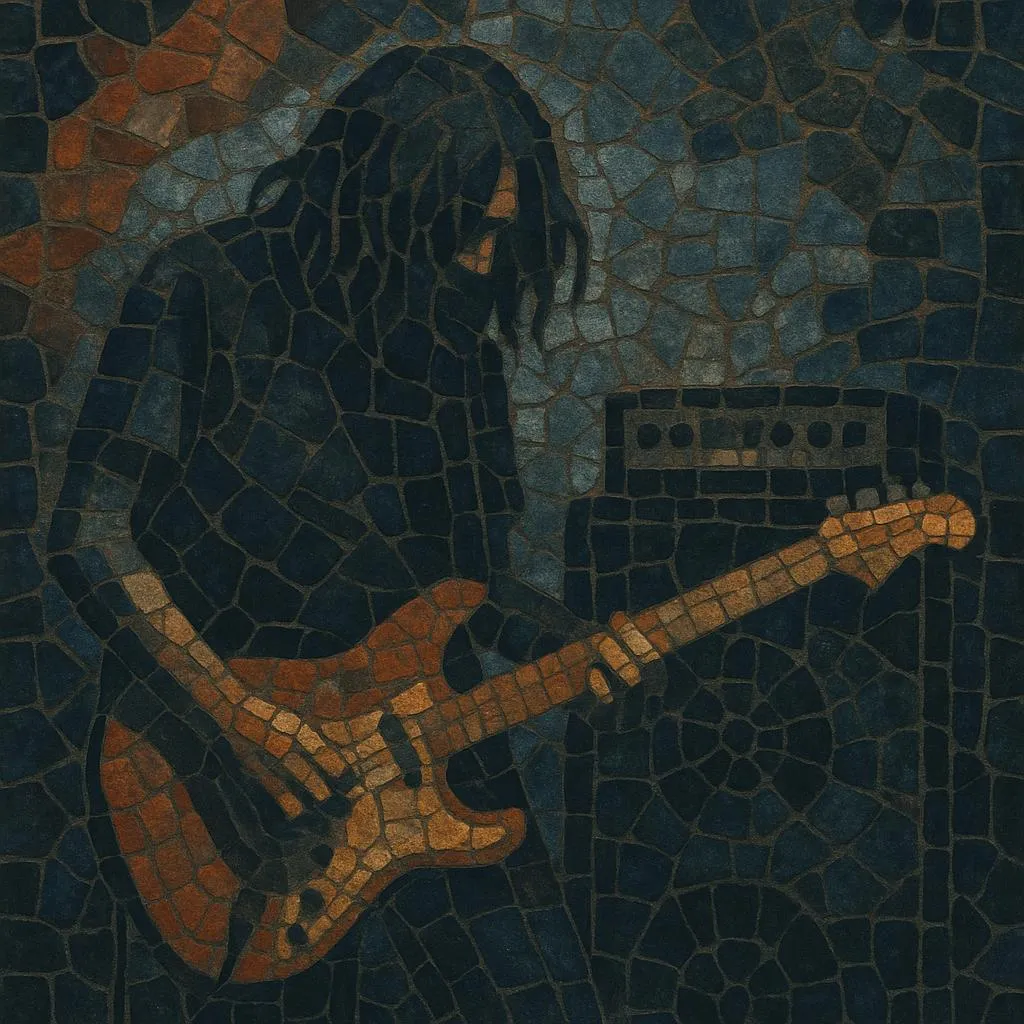
It fuses the amplification and band format of rock with the long-form minimalism of drone and the heady atmospherics of psychedelia and space rock. Guitars (often in open tunings) are layered through distortion, feedback, and effects to create dense harmonic beds, while bass and drums may lock into hypnotic ostinatos or recede to leave a hovering, suspended feel.
Where noise rock confronts and shoegaze blurs, drone rock stretches time: pieces can drift for many minutes, privileging timbre, overtones, and the psychoacoustic shimmer that emerges when sustained tones interact.


History
Drone rock’s conceptual foundations trace to the 1960s minimalist and drone traditions (La Monte Young’s sustained-tone works, the Theatre of Eternal Music), the feedback explorations of The Velvet Underground, and the cosmic sprawl of early German kosmische/krautrock. Psychedelic and space rock introduced long-form repetition and sustained textures, creating a template for later guitar-based drone.
In the 1980s, UK and US underground scenes absorbed minimalism into amplified band contexts. Extended vamps, open tunings, and overdriven harmonics became key, while rehearsal-room experiments with volume, feedback and pedal chains produced a recognizably “droning” guitar language distinct from traditional riff-based rock.
By the 1990s, drone rock cohered as a practice alongside noise rock, shoegaze, post-rock, and space rock revivalism. Independent labels and DIY studios fostered long-form recordings where guitars and organs sustained tones for entire sides, and rhythm sections favored motorik or slow, mantra-like pulses. This period normalized side-long tracks, overtone-rich layering, and live volume-as-timbre.
In the 2000s, drone rock intertwined with drone metal, doomgaze, ambient/drone, and new psychedelia. Artists emphasized texture-first composition, using loopers, e-bows, bowed cymbals, and modular effects to sculpt harmonics. Festivals and reissue culture codified its lineage, while modern practitioners shuttle between rock stages and experimental/ambient contexts, maintaining drone rock’s identity as both a band idiom and a timbral, durational art.
![Musical Drones and Pedal Tones [Theory and Songwriting]](https://i.ytimg.com/vi/5E4Nsa6RL9I/hqdefault.jpg)