Your digging level for this genre

0/8
🏆
Sign in, then listen to this genre to level up

Description

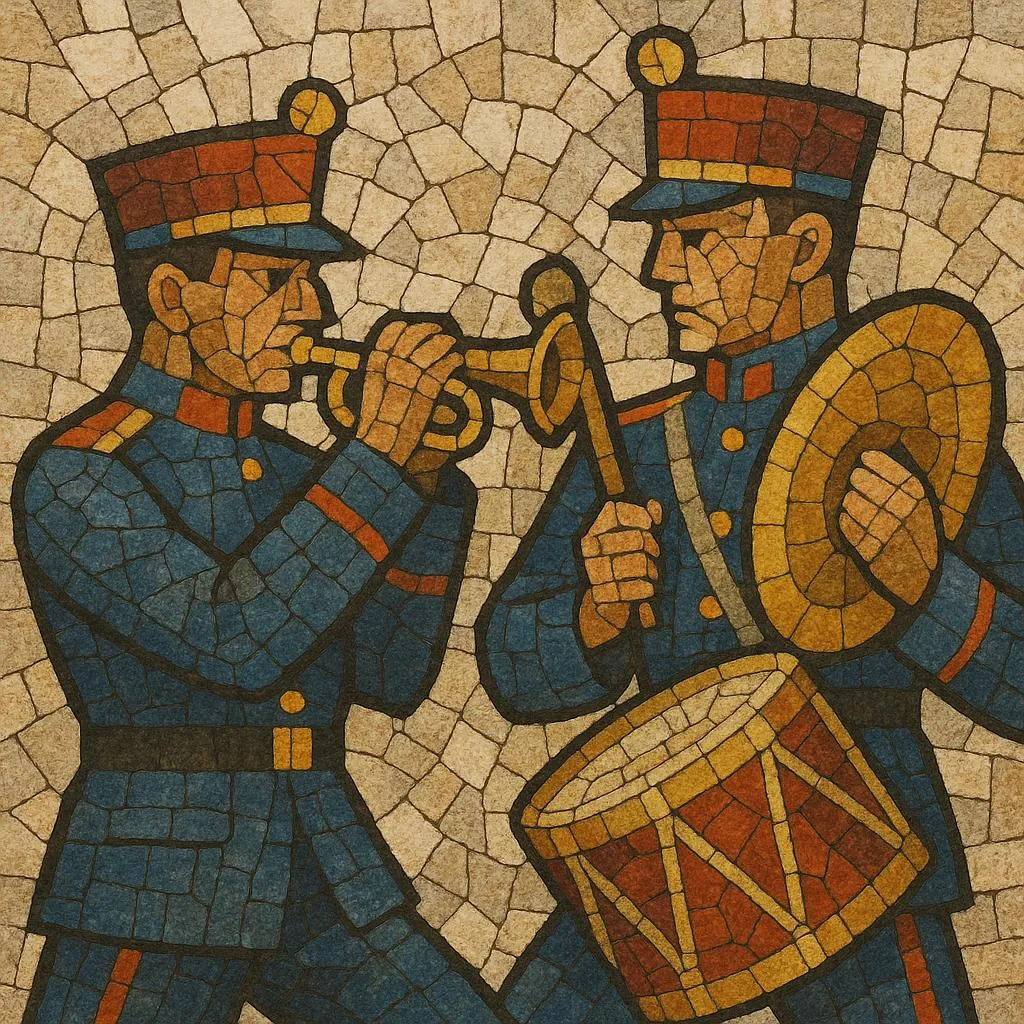
Doble paso is a fast, military-style march from Spain characterized by a "double step" pace and a bright, martial sound.

It is typically written in 2/4 or cut time and performed at an elevated tempo suitable for rapid parade marching, featuring crisp snare patterns, bold brass melodies, and ringing cymbals.

Unlike the dance-oriented pasodoble, doble paso is fundamentally utilitarian and ceremonial—designed to move troops and parade formations—yet it has a distinctive musical profile with fanfare-like themes, clear two-beat accents, and a traditional concert band/brass band instrumentation.

Today it survives in military bands, civic concert bands, and ceremonial occasions, and it also served as a key antecedent to the Spanish pasodoble tradition.

History

Origins (19th century)

Doble paso developed in Spain during the 1800s as a quick-march variant for moving formations at a faster, more practical pace. Its name literally means “double step,” reflecting the quicker cadence compared to ordinary marching tempo. It emerged within military bands, which at the time were expanding their instrumentation and repertoire under the influence of European brass band and concert band practices.

From barracks to parade grounds

As Spanish military music professionalized, doble paso pieces codified common features: duple meter (2/4 or cut time), brisk tempos suitable for parades, and clear, antiphonal brass writing to project outdoors. The style favored snare drum rudiments, bass drum/cymbal punctuation, and melodic material that could cue marching commands and keep large formations in step.

Relation to pasodoble

Historically, the ceremonial and rhythmic vocabulary of the doble paso fed directly into the development of pasodoble, which adapted the quick-march character into a more theatrical, dance- and spectacle-oriented idiom associated with bullrings and popular festivals. In this sense, doble paso functioned as a utilitarian military precursor whose energy and pacing were transformed for public entertainment.

Contemporary use

Today, doble paso remains a staple of Spanish military and civic bands and appears in parades, official ceremonies, and commemorative events. While its core function is still ceremonial, concert bands also program doble paso works for their historical value and their effective, crowd-pleasing drive.

How to make a track in this genre

Meter, tempo, and form
•   Use 2/4 or cut time with a brisk quick-march tempo (roughly 140–160 BPM) to evoke the characteristic “double step.” •   Adopt a march-derived form: short fanfare-like introduction (4–8 bars), first strain (16 bars), second strain (16 bars), a more lyrical trio (often softer dynamics), an optional "dogfight"/break strain with antiphonal brass/percussion interplay, and a final grand strain with countermelodies.
Harmony and melody
•   Keep harmony largely diatonic and functional (I–IV–V with occasional secondary dominants). Clear cadences help cue marching figures. •   Write bold, singable melodies with dotted rhythms, arpeggiated triads, and call-and-response between upper brass/woodwinds and lower brass. •   In the trio, thin textures and smoother legato lines contrast with the crisp outer strains; consider a key change (e.g., to the subdominant) for color.
Orchestration and percussion
•   Core ensemble: piccolos/flutes, clarinets, saxophones (optional), trumpets/cornets, horns, trombones, euphoniums, tubas; percussion: snare, bass drum, crash cymbals (triangle or field drum optional). •   Snare drum drives the pace with rolls, flams, and accented two-beat figures; bass drum and cymbals reinforce downbeats and cadences. •   Balance for outdoor projection: prioritize clear brass articulation and percussion definition.
Articulation and dynamics
•   Favor crisp staccato or marcato in outer strains and more legato phrasing in the trio. •   Use dynamic swells at cadences and tuttis; ensure accents align with the two-beat marching feel.
Practical performance tips
•   Keep phrases square and cadence points predictable to support drill movements. •   Rehearse strict tempo, uniform articulations, and coordinated percussion cues—clarity and consistency are essential for marching utility.

Top tracks

Locked
Share your favorite track to unlock other users’ top tracks
Influenced by
Has influenced
Challenges
Digger Battle
Let's see who can find the best track in this genre
© 2025 Melodigging
Melodding was created as a tribute to Every Noise at Once, which inspired us to help curious minds keep digging into music's ever-evolving genres.
Buy me a coffee for Melodigging