

Your digging level for this genre
Description
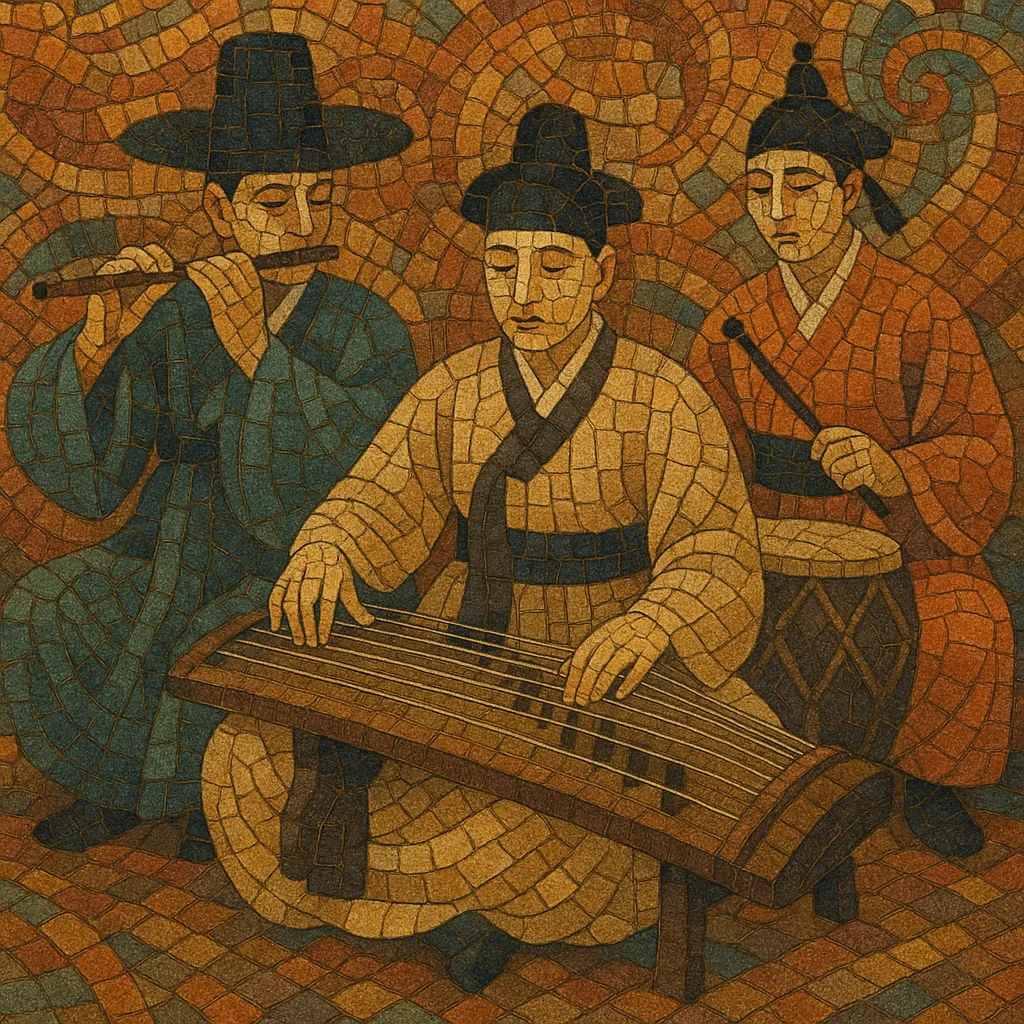
Dang-ak (당악, literally “Tang music”) is a category of Korean court music that originated from musical repertories and instruments imported from Tang- and Song‑dynasty China, then adapted to Korean taste and court protocol.
Performed for banquets and court entertainments (often accompanying refined court dances, jeongjae), Dang‑ak features stately tempos, cyclical rhythms, and elegant, ornamented melodies in pentatonic modes. The ensemble blends Chinese‑derived winds such as the dangpiri (a smaller, mellow piri) and dangjeok (transverse flute) with Korean strings and percussion like gayageum, geomungo, haegeum, ajaeng, janggu, buk, and ceremonial time‑keeping instruments (e.g., bak). Iconic pieces include Nakyangchun (Spring in Luoyang) and Boheoja.
Today, Dang‑ak survives as a living tradition curated by the National Gugak Center and regional court‑music orchestras, and it continues to inform both historically informed performance and modern fusion (changjak/fusion gugak).
History
The roots of Dang‑ak lie in the cosmopolitan musical culture of Tang China. Envoys, monks, scholars, and entertainers moving between the Tang court and the Korean peninsula (especially during late Silla and early Goryeo) transmitted repertories, instruments, tunings, and performance practices. These materials formed the basis of a Chinese‑style court entertainment music that Koreans would later call Dang‑ak (Tang music).
Under the Goryeo dynasty (918–1392), Chinese‑origin repertories became established categories distinct from native Korean court music (Hyang‑ak) and Confucian ritual music (Aak). Goryeo musicians localized the instrumentation and performance practice, creating mixed ensembles that balanced Chinese‑derived winds with Korean strings and percussion. Celebratory banquets at court often featured Dang‑ak and associated court dances (jeongjae).
The early Joseon court undertook systematic codification and notation of court music. Treatises such as the Akhak Gwebeom (1493) documented instruments, tunings, ensemble layout, and repertories, including Dang‑ak. Jeongganbo square notation and court handbooks helped standardize tempo cycles, entry cues, and orchestration. Famous pieces like Nakyangchun and Boheoja were refined for ceremonial and entertainments.
Following the upheavals of the 19th–20th centuries, national institutions restored and stabilized Dang‑ak through archival work and performance practice at the National Gugak Center and regional orchestras. Contemporary presentation often pairs Dang‑ak with court dance and staged ceremonies, while composers draw on its modes and textures to create changjak (new) and fusion gugak works.
How to make a track in this genre
Top albums
![KBS국악관현악단 정악 2 (보허자계통의 음악) [Korean Traditional Music]](https://e.snmc.io/i/300/w/a7f64c75cba00e763f3cd0082e6a3d71/10118831/Various%20Artists%20-%20KBS%EA%B5%AD%EC%95%85%EA%B4%80%ED%98%84%EC%95%85%EB%8B%A8%20%EC%A0%95%EC%95%85%202%20(%EB%B3%B4%ED%97%88%EC%9E%90%EA%B3%84%ED%86%B5%EC%9D%98%20%EC%9D%8C%EC%95%85)%20%5BKorean%20Traditional%20Music%5D%2C%20Cover%20art.webp)
![거문고 보허사 [Geomungo Boheosa]](https://e.snmc.io/i/300/w/9d83654698ae6ed3e753a75b29a2d14f/11489943/%EB%8F%84%EA%B2%BD%ED%83%9C%20%5BDo%20Kyoung-tae%5D%20-%20%EA%B1%B0%EB%AC%B8%EA%B3%A0%20%EB%B3%B4%ED%97%88%EC%82%AC%20%5BGeomungo%20Boheosa%5D%2C%20Cover%20art.webp)
%20%5BKwak%20Tae%20Chun's%20Piri%20Solos%20Vol%20III%20Dangpiri%20(Rakyangchoon_Bonryung_Haeryung_Bohuja)%5D%2C%20Cover%20art.webp)
