Your digging level

For this genre
0/8
🏆
Sign in, then listen to this genre to level up

Description

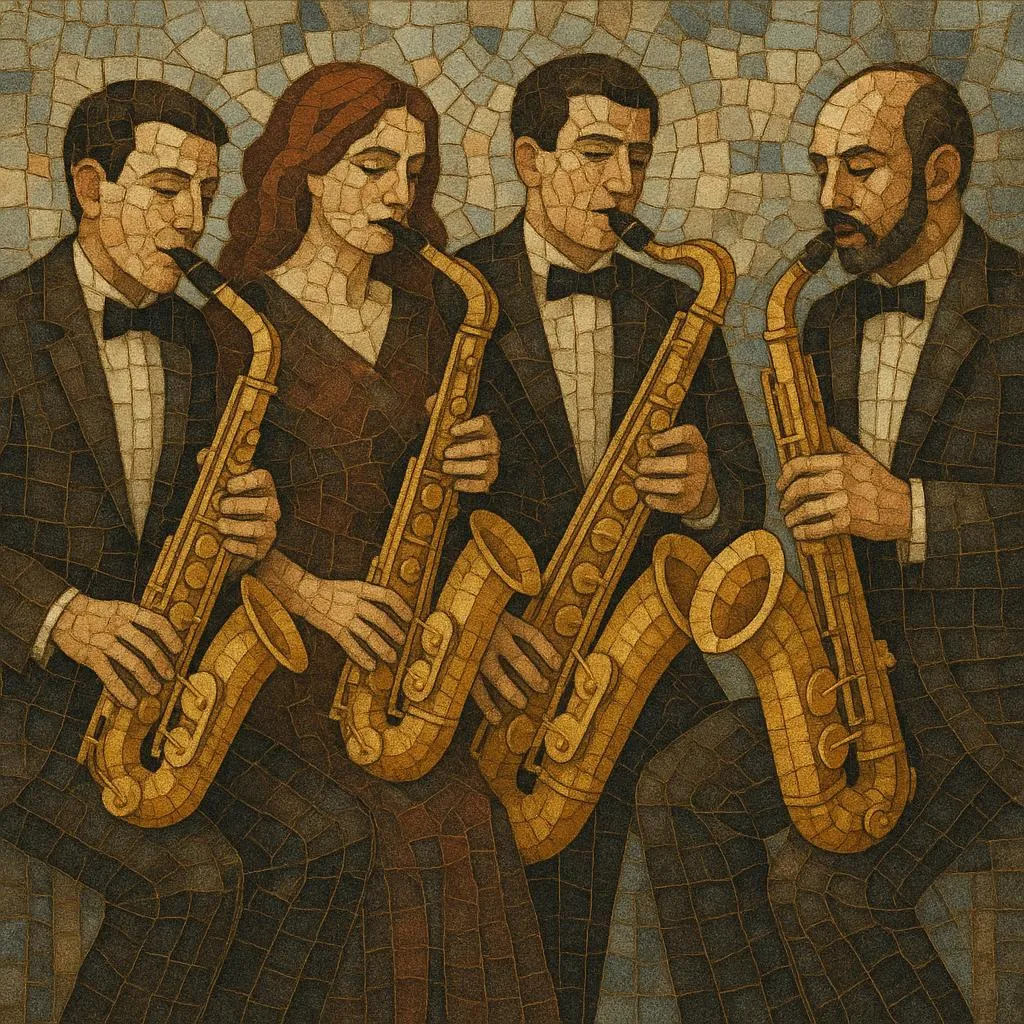
Classical saxophone quartet is the chamber-music tradition for a family of four saxophones—usually soprano, alto, tenor, and baritone (SATB)—performed and composed within the Western classical idiom.

It blends the homogenous timbral color of the saxophone family with the contrapuntal and formal practices of classical chamber music. Typical works explore rich voice-leading, agile articulation, and a wide expressive range—from cantabile lyricism to incisive, motoric writing—supported by modern techniques such as slap-tongue, multiphonics, and altissimo.

Repertoire spans original works from the late‑Romantic period through contemporary music, plus a robust tradition of transcriptions that reimagine Baroque, Classical, and Romantic scores for the uniquely blended sonority of the saxophone quartet.

Sources: Spotify, Wikipedia, Discogs, RYM, MB, user feedback and other online sources

History

Origins (1850s–1900s)
•   The saxophone, patented by Adolphe Sax in 1846, quickly attracted interest from Parisian conservatory circles and military bands. Within a decade, French composer Jean‑Baptiste Singelée wrote what is widely regarded as the first saxophone quartet (1857), establishing the soprano–alto–tenor–baritone constellation and demonstrating the instrument family’s chamber potential. •   Early quartets followed Romantic chamber conventions—clear part-writing, songful melody, and balanced textures—while capitalizing on the saxophone’s homogeneous blend and agile articulation.
Consolidation in France (1920s–1930s)
•   The ensemble matured in interwar Paris, led above all by Marcel Mule, whose quartet (founded 1928) set technical and stylistic standards that shaped pedagogy and repertoire for generations. Composers such as Eugène Bozza, Jean Françaix, and Alexander Glazunov contributed cornerstone works that codified idiomatic quartet writing and broadened expressive vocabulary.
International Expansion and New Virtuosity (1960s–1990s)
•   The Raschèr Saxophone Quartet (founded 1969) catalyzed an international commissioning wave, encouraging composers to treat the saxophone quartet as a modern chamber ensemble with a full virtuoso toolkit. Works by figures such as Iannis Xenakis (e.g., “XAS”), Terry Riley, Philip Glass, William Bolcom, and others advanced rhythmic rigor, extended techniques, and post‑tonal or minimalist languages. •   Parallel to original works, quartets cultivated a culture of artful transcriptions (e.g., Baroque suites, Classical divertimenti, Romantic character pieces), revealing the ensemble’s orchestral coloristic range while remaining faithful to contrapuntal clarity and formal design.
21st Century: Pluralism and Global Reach
•   The repertoire now spans spectral, minimalist, neo‑Romantic, and post‑tonal idioms, often integrating world‑music colors and electronics. Conservatories worldwide train dedicated saxophone quartets, and professional groups tour globally, commissioning cycles, concerti for quartet and orchestra/band, and cross‑disciplinary collaborations. •   Today the classical saxophone quartet stands as both a standard conservatory ensemble and a living laboratory for contemporary chamber music.

How to make a track in this genre

Instrumentation and Register
•   Write for SATB (soprano, alto, tenor, baritone) as four equal voices. Exploit the family’s homogeneous timbre while preserving clear contrapuntal roles. •   Manage register overlap thoughtfully: soprano for brilliance and leading lines; alto as a lyrical and flexible mid‑voice; tenor as a warm inner/upper support; baritone for foundation, pedal points, and agile bass counter‑melodies.
Texture, Counterpoint, and Form
•   Favor transparent textures (two‑part counterpoint, canons, fugato) that showcase blend without masking inner motion. Classical forms (sonata‑allegro, theme and variations, scherzo‑trio, passacaglia) translate well; so do modern sectional or process forms (minimalist phase/ostinato procedures). •   Balance chorale‑style homophony with independent linear writing. Use antiphony and hocketing between pairs (SA vs. TB) to keep long phrases buoyant.
Harmony and Language
•   Tonal/neo‑tonal writing benefits from the quartet’s warm blend; modal or extended tertian harmony (added 2nds/6ths) enriches color without muddying voice‑leading. •   For contemporary idioms, incorporate clusters, planed sonorities, and spectral coloring, but orchestrate registral spacing to avoid midrange congestion (alto/tenor) and to let baritone fundamentals speak.
Rhythm and Articulation
•   The ensemble excels at rhythmic precision. Use mixed meters, off‑beat accents, and ostinati; alternate staccatissimo figures with legato cantabile to exploit articulation contrast. •   Mark articulations meticulously (tongue, slur, accents) and coordinate breaths among parts to maintain line continuity.
Idiomatic Techniques
•   Employ extended techniques tastefully: slap‑tongue for percussive grooves, key‑clicks for subtle color, subtone for hushed lyricism, growl/flutter‑tongue for timbral edge, multiphonics for climactic tension, and altissimo to crown cadences. Indicate fingerings or references when multiphonics are essential. •   Dynamics shape color dramatically—pp blend for chorales; wide crescendi across the choir for orchestral swells.
Notation and Practicalities
•   Transpose parts conventionally (sop/alto in Bb/Eb; tenor in Bb; baritone in Eb) and supply concert scores. Include courtesy accidentals and clear cues where divisi effects or tight entries occur. •   Write breathing/phrase marks and stagger‑breath suggestions; the quartet sustains long textures by sharing respiration.
Programming and Transcription Tips
•   When arranging older repertoire, redistribute inner voices to preserve counterpoint clarity; baritone can double cello/bass lines while tenor/alto articulate inner counter‑subjects. For Baroque dances, keep articulation light and tempi buoyant; for Romantic pieces, prioritize legato and rubato within ensemble tightness.

Top tracks

Locked
Share your favorite track to unlock other users’ top tracks

Upcoming concerts

in this genre
Influenced by
Has influenced

Download our mobile app

Get the Melodigging app and start digging for new genres on the go
© 2026 Melodigging
Melodding was created as a tribute to Every Noise at Once, which inspired us to help curious minds keep digging into music's ever-evolving genres.
Buy me a coffee for Melodigging