Your digging level
Description
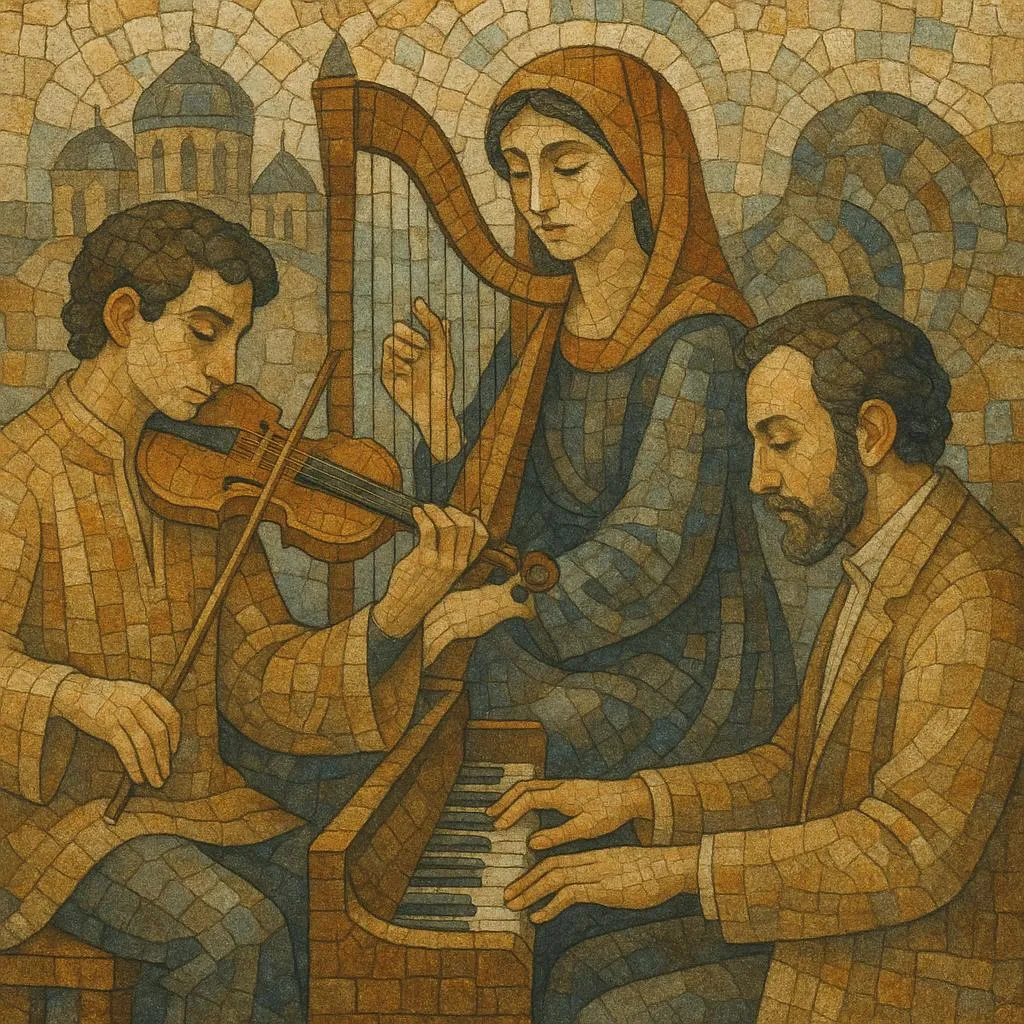
Caucasian classical is a regional umbrella term for Western art-music composition and performance traditions from the Caucasus—especially the South Caucasus (Armenia, Azerbaijan, and Georgia).
It typically uses the instrumentation and large-form thinking of European classical music (symphony, concerto, opera, chamber music), while integrating local musical languages such as modal systems, folk melodic contours, asymmetrical meters, and characteristic ornamentation.
In the 20th century it developed strongly inside the Russian Empire/Soviet conservatory network, producing a recognizable blend of European compositional technique with Caucasian folk and liturgical materials, ranging from late-Romantic nationalism to modernism and post-minimal, spiritual, or austere late-20th-century idioms.
History
Caucasian classical composition emerged as local musicians engaged with European art-music forms through conservatories, opera houses, and church/urban musical life.
A key early pattern was national classicism: composers arranged or reimagined folk and liturgical materials within European harmony, counterpoint, and large-scale forms.
Under Soviet cultural policy, conservatories and state ensembles expanded rapidly, and composers were encouraged to write accessible works while drawing on “national” elements.
This period produced many large-scale symphonic and operatic works that balance folk modality and dance rhythms with late-Romantic orchestration and formal clarity.
From the 1960s onward, several Caucasian composers pursued more modernist languages, including extended harmony, polyrhythm, aleatoric textures, and stark, ritual-like pacing.
The result was a broad aesthetic range—from neo-classical clarity to dense timbral experimentation—often still anchored by recognizable local modal or rhythmic fingerprints.
After the Soviet Union’s dissolution, the scene diversified: composers engaged more freely with Western contemporary techniques, sacred/early-music collaborations, and international commissioning.
Caucasian classical today is best understood as a continuum rather than a single “sound,” unified by geography, shared institutional histories, and a recurring dialogue between Western forms and Caucasian musical identity.
Favor modal pedal points (drones), open fifths, and slowly shifting chord fields.
•When using functional harmony, treat it as an accent color, not the default engine.
•Texture is often central: alternate between
•thick, saturated orchestration (late-Romantic or Soviet symphonic weight), and
•austere, transparent writing (single-line chant, quiet clusters, or spaced intervals).