Your digging level
Description
Cantabrian folk music is the traditional music of Cantabria, a mountainous coastal region in northern Spain. It is shaped by rural life in valleys such as Liébana, Campoo, and the Valles Pasiegos, and by seafaring towns on the Bay of Biscay.
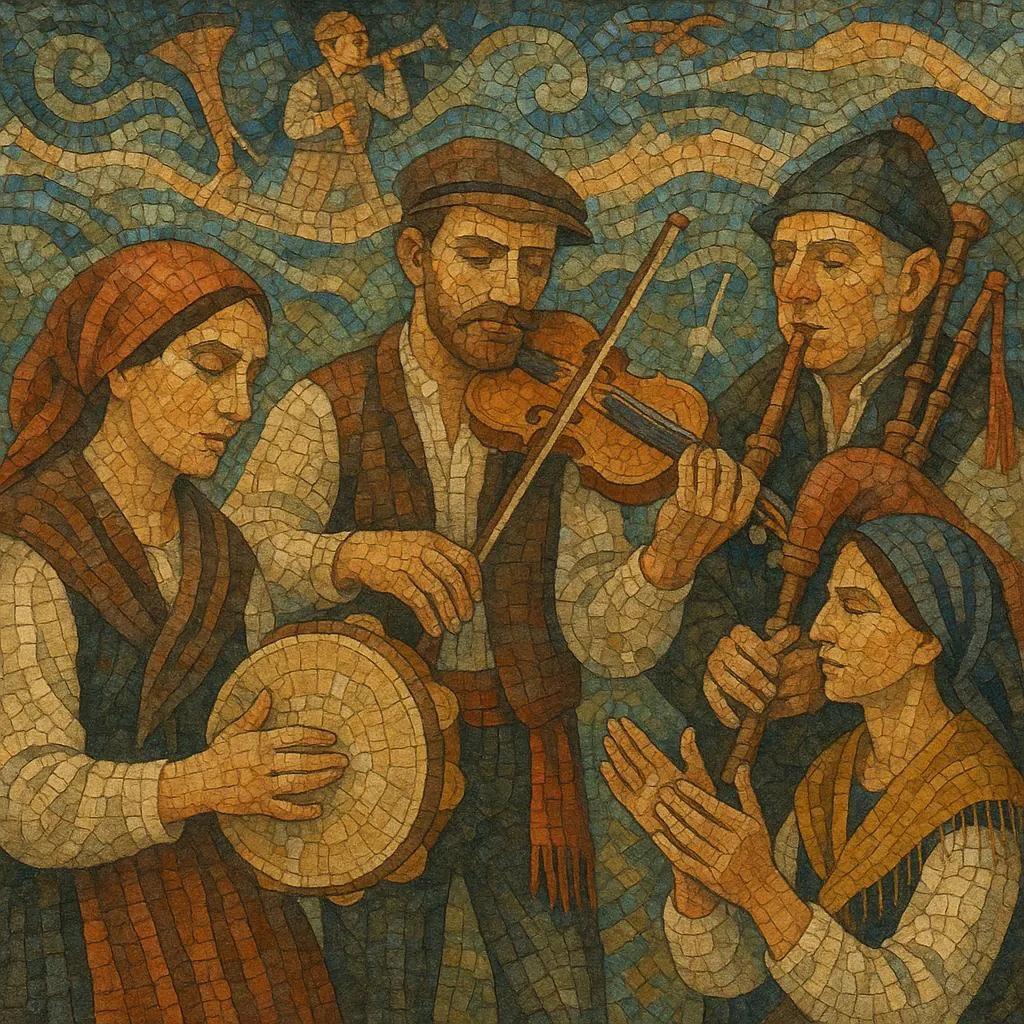
The sound centers on unison and responsorial singing, lively dance rhythms (notably the jota montañesa and the pericote), and a small but distinctive instrumental palette: the rabel (a rustic bowed fiddle), frame drums and tambourines (pandereta/panderu), small flutes and tabor (pito y tambor), handclaps, and, in some areas, accordion and regional bagpipes. Women’s tambourine choirs (pandereteras) and male “ronda” choirs keep the vocal traditions vibrant.
Songs range from festive rounds and processionals to seasonal pieces such as the marzas (sung to welcome March), together with occupational chants, romances (ballads), and devotional pieces. Modal melodies (often Ionian, Mixolydian, and Dorian) and drone-like accompaniments from the rabel are common, giving the repertoire both a rustic brightness and a plaintive edge.
History
Cantabrian folk music took shape over centuries in village, pastoral, and maritime settings. Medieval Iberian ballads (romances) and processional/devotional singing provided a narrative and ceremonial backbone, while local dance forms—especially the jota montañesa (a regional variant of the Spanish jota) and the pericote of Liébana—became social focal points. The rabel, documented in Iberia since the Middle Ages, persisted in Cantabria as a key rustic instrument accompanying solo song and dance.
Seasonal rites such as the marzas (door-to-door singing on the eve of March) and winter masquerades (e.g., the Vijanera of Silió) embedded music in the communal calendar. Male “ronda” choirs and female pandereteras led rounds and processions, blending homophonic chant-like textures with rhythmic percussion. In coastal towns, maritime devotions (e.g., La Folía in San Vicente de la Barquera) linked music to seafaring identity.
Rural depopulation and modernization in the mid‑20th century endangered local practices, but post‑1970s regional cultural movements, folk-dance troupes, and municipal rondas spearheaded a revival. Festivals such as the Día de Cantabria (Cabezón de la Sal) showcased traditional music, while local archives and cultural associations documented repertoires, instruments, and dances.
From the 1990s onward, Cantabrian folk groups blended tradition with broader Celtic and Iberian currents, introducing folk‑rock arrangements and new instrumentation while retaining core elements (rabel, tambourines, dance meters, and strophic coplas). Today, both heritage ensembles and studio artists sustain the style—on stages, in parish fiestas, and in community rituals—ensuring living continuity rather than museum preservation.