Your digging level
Description
Balochi folk music is the traditional music of the Baloch people of the historic region of Balochistan, today spanning southwestern Pakistan, southeastern Iran, and parts of southern Afghanistan. It is a primarily oral tradition that carries epic poetry, heroic ballads, seafaring songs, wedding repertoire, and devotional pieces in the Balochi language.
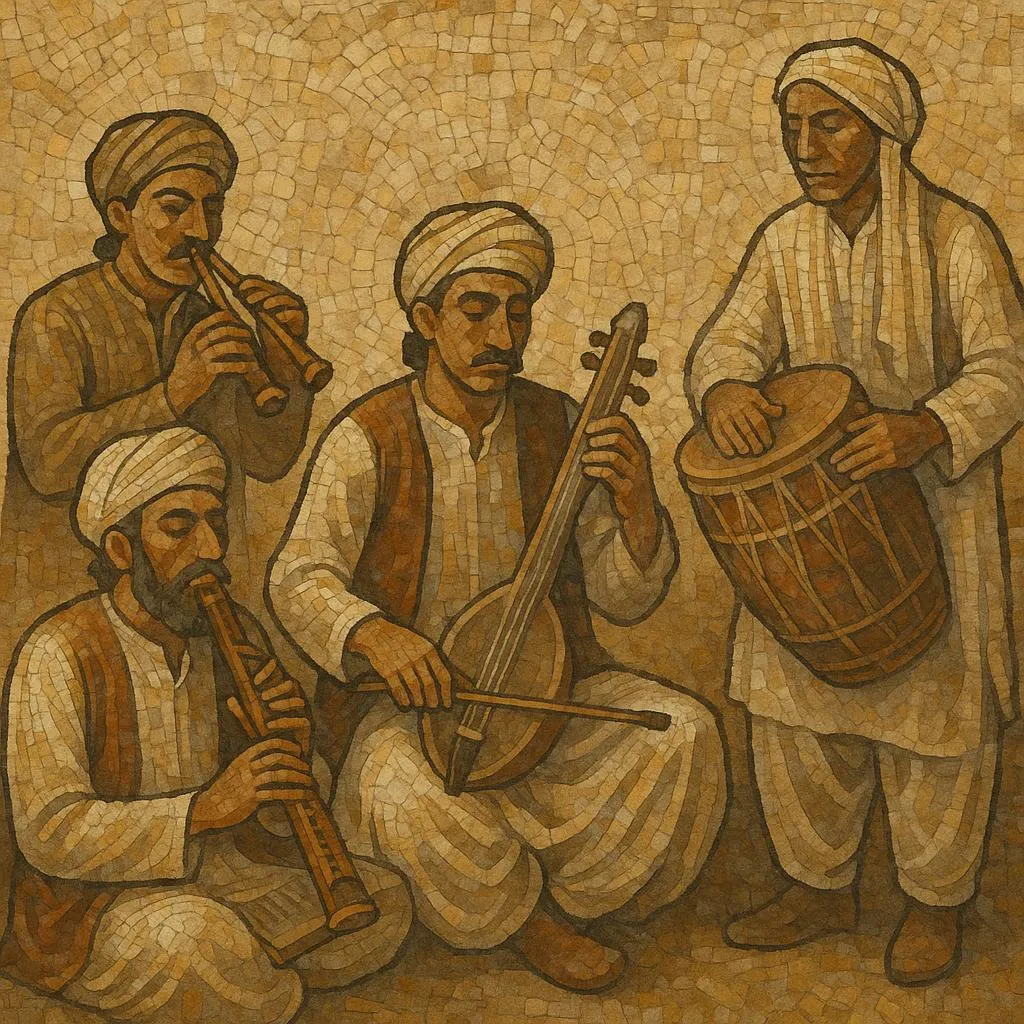
The style is distinguished by its timbres and instruments: the suroz/sorud (a bowed lute related to the sarinda/ghichak family), the damburag (a long‑necked plucked lute), the benju (a keyed zither akin to the bulbul tarang/taishōgoto, widely adopted and localized by Baloch musicians), the doneli/donali (double flute), the sorna/shahnai (double‑reed), and frame or barrel drums such as dhol and dholak. Melodies often draw on modal systems shared with Persian dastgāh and South Asian raga practice, using drones, ornamentation, and microtonal inflections. Rhythms range from stately narrative meters to lively compound and asymmetrical patterns, especially in coastal dance genres.
Distinct sub‑styles include epic narrative singing (dāstān), lyrical love songs (nazenk), clapping dances (do‑chāpi), sword and wedding dances (latti), and the Makran coastal seafaring “levā,” whose 6/8 swing reflects Indian Ocean connections.
History
Balochi folk music descends from a long oral tradition that predates recording history. Poet‑singers (shā’ir) and specialist instrumentalists maintained lineages of epic ballads, praise songs, and ceremonial repertoire that accompanied communal rites, migrations, and pastoral life across Balochistan.
Between the 18th–19th centuries, Baloch musicians consolidated a distinct palette of instruments. The bowed suroz/sorud carried narrative song; the damburag provided drone and rhythmic ostinati; and, by the late 19th to early 20th century, the benju—adapted from the Asian keyed zither—became emblematic in coastal Makran (Gwadar, Pasni) and Karachi’s Baloch communities. Along the Arabian Sea, sailors’ levā songs absorbed and exchanged grooves with Arabian and East African ports, linking Balochi music to wider Indian Ocean circuits.
In the mid‑20th century, migration from Iranian and interior Balochistan to Karachi and Quetta brought master musicians into new media. Radio Pakistan Quetta (from the 1950s) and Karachi studios documented canonical performers such as Faiz Mohammad Baloch, helping to standardize well‑known melodies and performance practices while keeping regional variants alive.
From the 1980s–2000s, diaspora artists (notably in Iran, Pakistan, Scandinavia, and the Gulf) expanded the concert footprint of Balochi folk and introduced the benju and damburag to world‑music stages. The 2010s–2020s saw high‑profile fusions—e.g., Coke Studio Pakistan collaborations that placed Balochi vocals, levā grooves, suroz, and benju against modern arrangements. Viral performances by tradition bearers (such as benju masters on social media) spurred a revivalist interest and instrument making, sustaining transmission to younger musicians.